

Pakistan participates in US-led global drive to secure critical minerals supply chains
US authorities say they mobilize over $30 billion to fund critical minerals projects, attracting private investment

News Desk
The News Desk provides timely and factual coverage of national and international events, with an emphasis on accuracy and clarity.
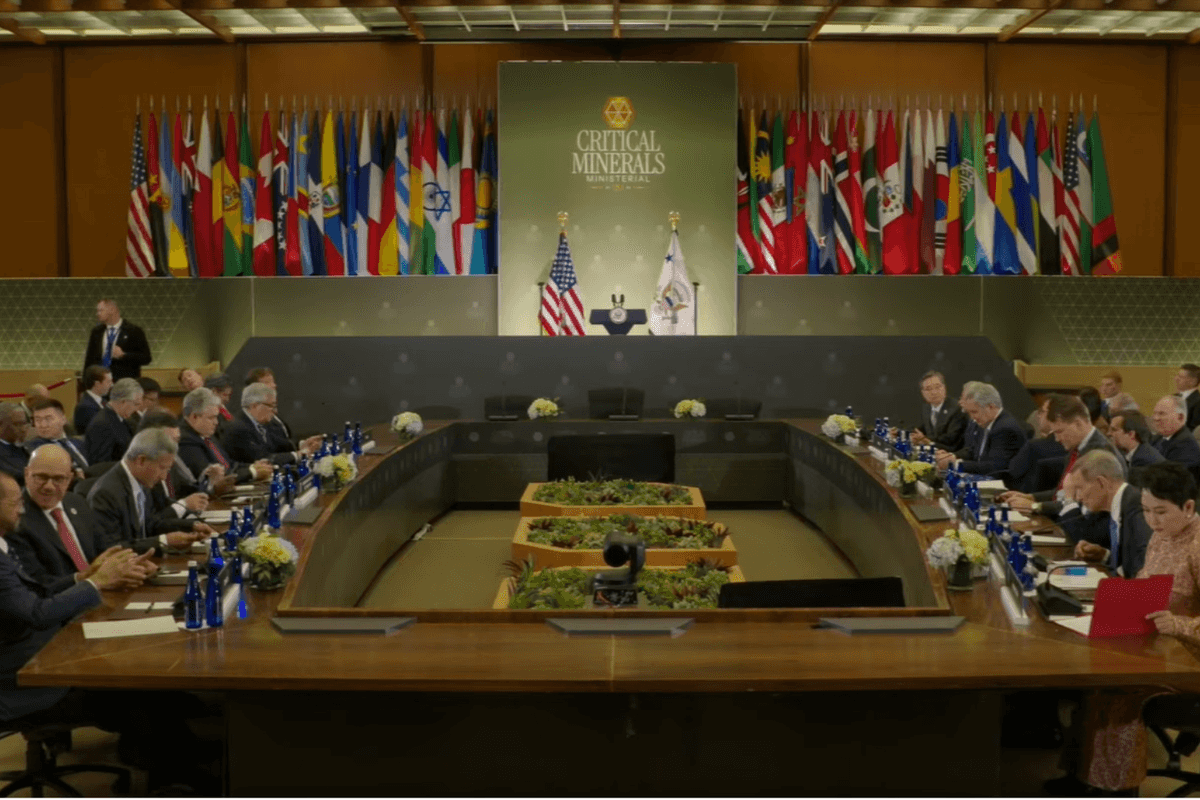
The U.S. and partners vow to strengthen critical mineral supply chains through new sources, logistics and recycling.
US State Department
The United States unveiled a sweeping diplomatic, financial, and industrial initiative on Friday, aimed at reshaping global supply chains for critical minerals and rare earth elements, hosting representatives from 54 countries and the European Commission at the 2026 Critical Minerals Ministerial in Washington.
Secretary of State Marco Rubio, joined by Vice President JD Vance and senior members of the U.S. Cabinet, led the high-level gathering, which brought together 43 foreign and other ministers to address growing vulnerabilities in mineral supply chains essential for advanced technologies, artificial intelligence, clean energy and defense manufacturing.
Delegations included Pakistan, Saudi Arabia, the United Kingdom, Japan, Germany, Canada, Australia, Uzbekistan and dozens of other mineral-producing and consuming nations.
U.S. officials warned that the global market for critical minerals remains highly concentrated, leaving economies exposed to political coercion and supply disruptions.
The United States and its partners pledged to build diversified, resilient, and secure supply chains by developing new sources, improving transport and logistics networks, and expanding processing and recycling capacity.
During the ministerial, the United States signed 11 new bilateral frameworks and memorandums of understanding (MOUs) on critical minerals with countries including Argentina, Ecuador, Guinea, Morocco, Peru, the Philippines, the United Arab Emirates, and Uzbekistan.
Washington has concluded or finalized similar agreements with dozens of countries in recent months, highlighting what officials described as unprecedented U.S. leadership in critical minerals diplomacy.
Secretary Rubio also announced the launch of the Forum on Resource Geostrategic Engagement (FORGE), which will succeed the Minerals Security Partnership and be chaired by South Korea through June. FORGE will coordinate policy and project-level cooperation among partners to strengthen global mineral supply chains.
The United States emphasized close collaboration with the private sector through initiatives such as Pax Silica, which focuses on investments in mining, refining, processing, recycling, and end-use applications.
On the eve of the ministerial, U.S. officials witnessed the signing of an MOU between Glencore and the U.S.-backed Orion Critical Mineral Consortium for potential investments in the Democratic Republic of the Congo, aimed at securing reliable supplies of copper and cobalt.
U.S. authorities said more than $30 billion has been mobilized in financing support for critical minerals projects over the past six months, through loans, equity investments, and letters of interest, generating significantly larger flows of private capital. Major support has come from agencies including the Export-Import Bank of the United States (EXIM), which approved up to $10 billion for Project Vault, a new domestic strategic reserve for critical minerals, and financed projects such as the Reko Diq copper-gold mine in Pakistan.
The Department of Energy, Department of Defense, and U.S. International Development Finance Corporation have also backed large-scale mining, processing, and battery-material projects across the United States and abroad.
U.S. officials said dozens of additional projects are under review and expected to come online in the near future, reinforcing America’s position in the global race for strategic minerals and advanced manufacturing.





Comments
See what people are discussing