

Pakistan rules out talks with militants, accuses Taliban of aiding terrorism
Military spokesperson says opium trade earning up to 250,000 rupees per acre funds terrorist groups across the border
Aamir Abbasi
Editor, Islamabad
Aamir; a journalist with 15 years of experience, working in Newspaper, TV and Digital Media. Worked in Field, covered Big Legal Constitutional and Political Events in Pakistan since 2009 with Pakistan’s Top Media Organizations. Graduate of Quaid I Azam University Islamabad.
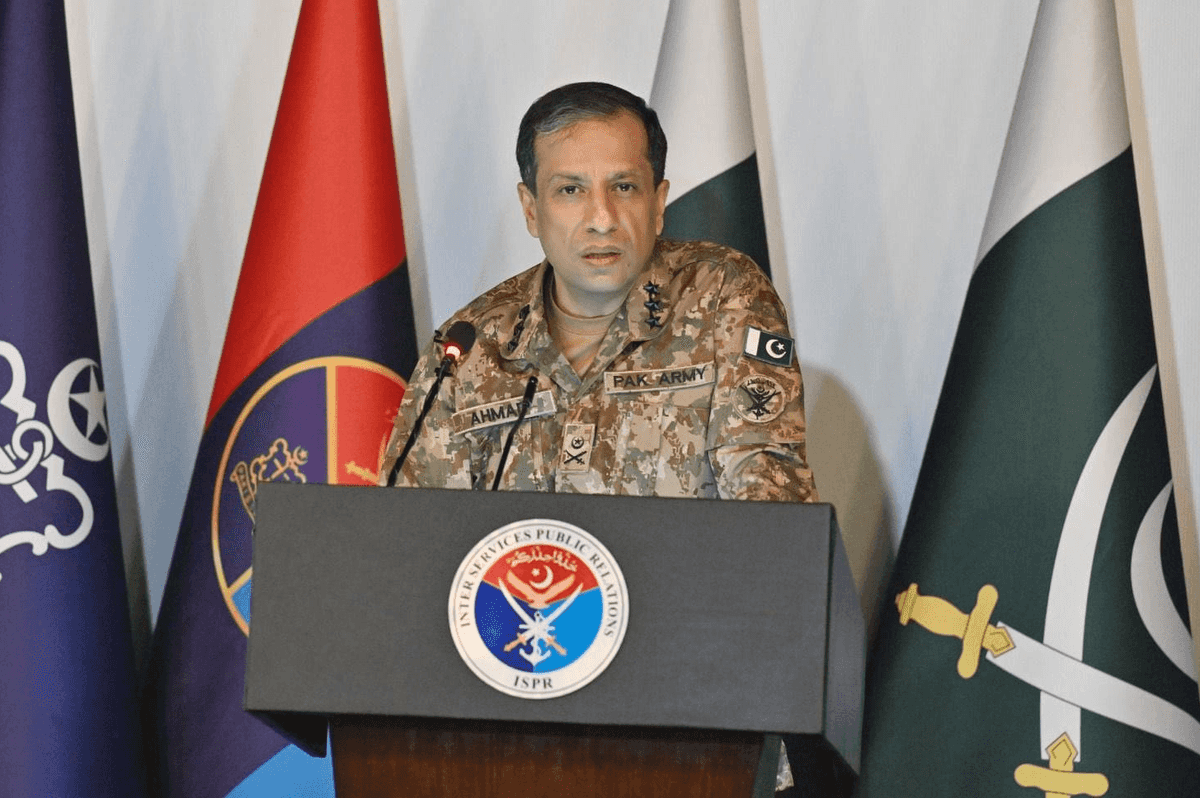
A file photo of Director General Inter-Services Public Relations (ISPR) Lt. Gen. Ahmad Sharif Chaudhry.
Nearly 200 soldiers killed in intelligence-based operations against militant groups
Pakistan denies any formal agreement for US drones flying to Afghanistan
Afghan guards accused of providing cover fire for militants crossing border
Pakistan’s military spokesperson said the country’s security rests firmly with its armed forces but warned that this assurance does not extend to Kabul.
In a briefing to senior journalists, Director General Inter-Services Public Relations (ISPR) Lt. Gen. Ahmad Sharif Chaudhry strongly rejected negotiations with militants, accusing Taliban-linked groups of brutalizing Pakistani security personnel and facilitating terrorist activity.
The military spokesperson said Pakistan has never celebrated the Taliban's return to power and is actively fighting militant groups including the TTP and BLA. "Pakistan's security is guaranteed by the armed forces — that guarantee cannot be handed to Kabul," he said.
Asked about drone strikes, he denied any formal agreement with the United States and said no official complaint about drones has been received from the Taliban. "No American drones fly from Pakistan to Afghanistan," he said, adding that the Information Ministry has repeatedly clarified the matter. "There is no agreement that drones will go from Pakistan to Afghanistan."
The DG ISPR accused the Taliban of facilitating terrorism. He said Pakistani authorities told Taliban representatives in Istanbul that it was their duty to control terrorism and explained how they should do so. He urged that militants who fled to Afghanistan during Pakistan's counterterrorism operations be handed over to face justice under Pakistan's constitution and law.
Drug trade fuels terrorist operations
Lt. Gen. Chaudhry identified the core problem as an alliance among terrorists, criminal elements and the TTP. He said these groups cultivate opium, earning roughly 180,000–250,000 rupees per acre, with warlords cooperating in the enterprise. "The proceeds go to Afghan Taliban, TTP and warlords. Terrorism, hashish and smuggling - these activities are carried out jointly and generate funds," he said.
Regarding the creation of new posts within the military, he said that was a matter for the government, not the army.
Responding to claims about operations in Tirah Valley, the DG ISPR said the army had never claimed an operation there. "If we conduct an operation, we will announce it," he said. He confirmed intelligence-based operations had taken place in which nearly 200 soldiers and officers were killed, and said supply convoys to forward posts are frequently attacked.
Asked about imposing governor's rule, he said that was the responsibility of the federal government. He also said the army acts against those who attack mosques and madrasas.
Border security remains major challenge
Regarding the upcoming conference in Istanbul, Lt. Gen. Chaudhry said Pakistan's position was clear: no terrorism, no external interference and no use of Afghan territory for such activities. He reiterated that a ceasefire agreement had been achieved through Pakistan's own efforts and said some Afghan Taliban leaders had relocated to friendly countries.
"We will not be lectured on morals and we will not beg anyone on bended knee," he declared. "We know how to protect our armed forces and our people."
Asked about possible deployment of troops to Gaza, he said that was a matter for the civilian government.
The DG ISPR also described Pakistan's 2,600-kilometer border with Afghanistan as mountainous and riverine, noting that border posts could not be placed everywhere and were typically 25-40 kilometers apart. He accused Afghan border guards of firing to help militants cross into Pakistan and said Pakistani forces responded to such fire.
The military spokesperson reiterated Pakistan's refusal to negotiate with militants. "The Taliban make footballs out of the heads of our security personnel - how can we negotiate with them?" he said.




Comments
See what people are discussing