

Pakistan sees first impact of Middle East war as fuel prices go up by PKR 55
The new prices will take effect from March 7

Business Desk
The Business Desk tracks economic trends, market movements, and business developments, offering analysis of both local and global financial news.
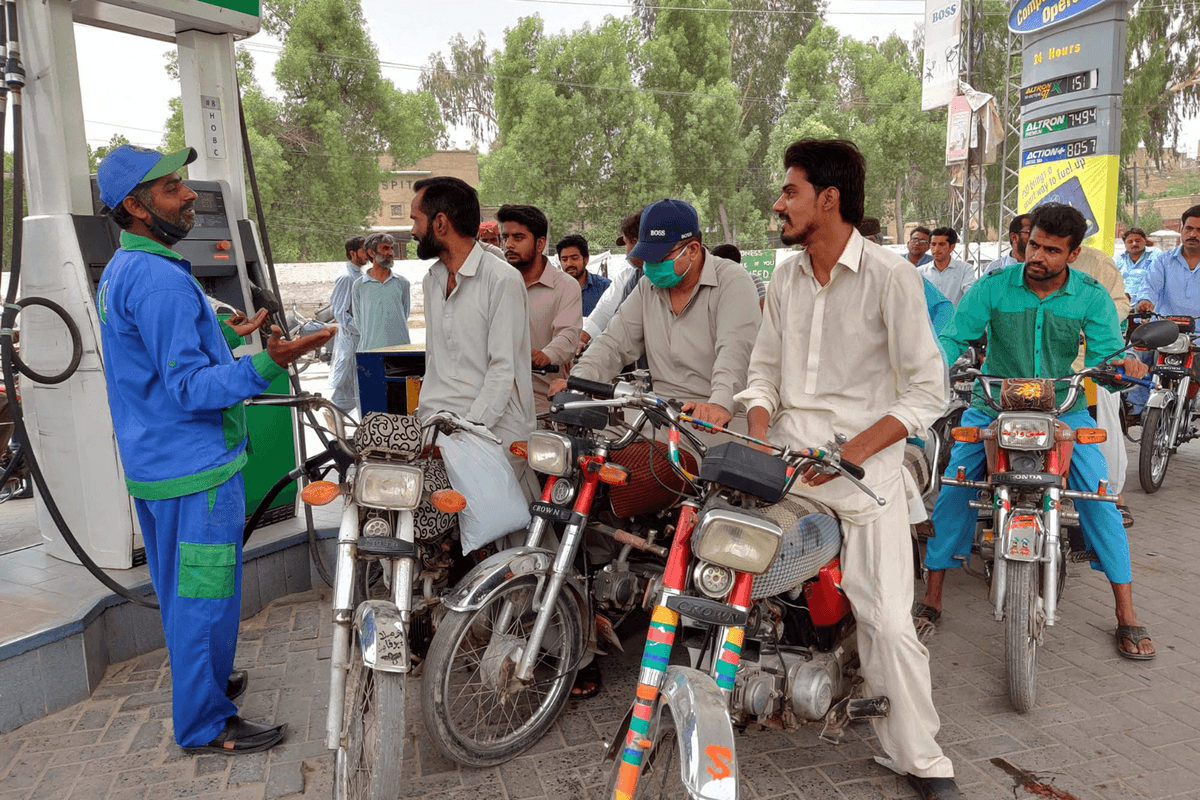
The Pakistan government passed on the impact of rising global oil prices to consumers by increasing petrol and diesel prices by PKR 55 per liter, the highest-ever price hike.
The price of petrol has increased from PKR 266.17 to PKR 321.17. The price of diesel has increased from PKR 280.06 to PKR 335.86 per.
Oil prices have risen sharply in the international market since the U.S. and Israel launched air strikes in Iran on February 28.
On Friday, Brent crude futures were up $5.42, or 6.35%, at $90.83 a barrel by 9:30 PM PST. West Texas Intermediate crude (WTI) was up $7.81, or 9.81%, at $88.96.
The price of Brent crude has surged by 25% in a week. The price jump was so steep that Pakistan had to announce new prices less than a week after rates were revised on February 28. The prices were originally set for two weeks, with the next revision due on March 15.
The new prices, which followed after days of deliberations by officials, were announced by Petroleum Minister Ali Pervaiz Malik during a press conference on Friday.
Deputy Prime Minister and Foreign Minister Ishaq Dar, who also attended the presser, said the revised prices would take effect at midnight.
He noted the ongoing conflict involving Iran, the United States and Israel has expanded and was affecting global markets.
“In this scenario, the prices of petroleum products are soaring,” Dar said, adding that the cost of various products had increased by 50 to 70% internationally.
He noted that in many countries, the surge had automatically translated into higher fuel prices for consumers due to market-linked pricing mechanisms.
However, Dar said the Pakistani government had tried to shield consumers from the full impact of the global spike. According to him, Prime Minister Shehbaz Sharif had been closely monitoring the situation and holding consultations for the past two to three weeks.
Dar said a permanent committee, led by Petroleum Minister Malik and Finance Minister Aurangzeb, regularly reviews developments in the global petroleum market.
“The prime minister has also held meetings and reviewed the global situation,” he added.
Dar further revealed that a special committee, headed by him and comprising Malik and Finance Minister Muhammad Aurangzeb, was later constituted to engage with relevant stakeholders.
“Our objective was to pass the minimum possible impact of the Middle East conflict on petroleum prices to the end consumer,” Dar said.
The government’s final decision on fuel prices, he added, reflects efforts to balance rising international costs with domestic economic stability.





Comments
See what people are discussing