

PM Shehbaz Sharif consults business leaders ahead of budget, reaffirms export-led growth strategy
Business community backs government's economic reforms, tax measures and investment-friendly policies
Haris Zamir
Business Editor
Experience of almost 33 years where started the journey of financial journalism from Business Recorder in 1992. From 2006 onwards attached with Television Media worked at Sun Tv, Dawn Tv, Geo Tv and Dunya Tv. During the period also worked as a stringer for Bloomberg for seven years and Dow Jones for five years. Also wrote articles for several highly acclaimed periodicals like the Newsline, Pakistan Gulf Economist and Money Matters (The News publications)
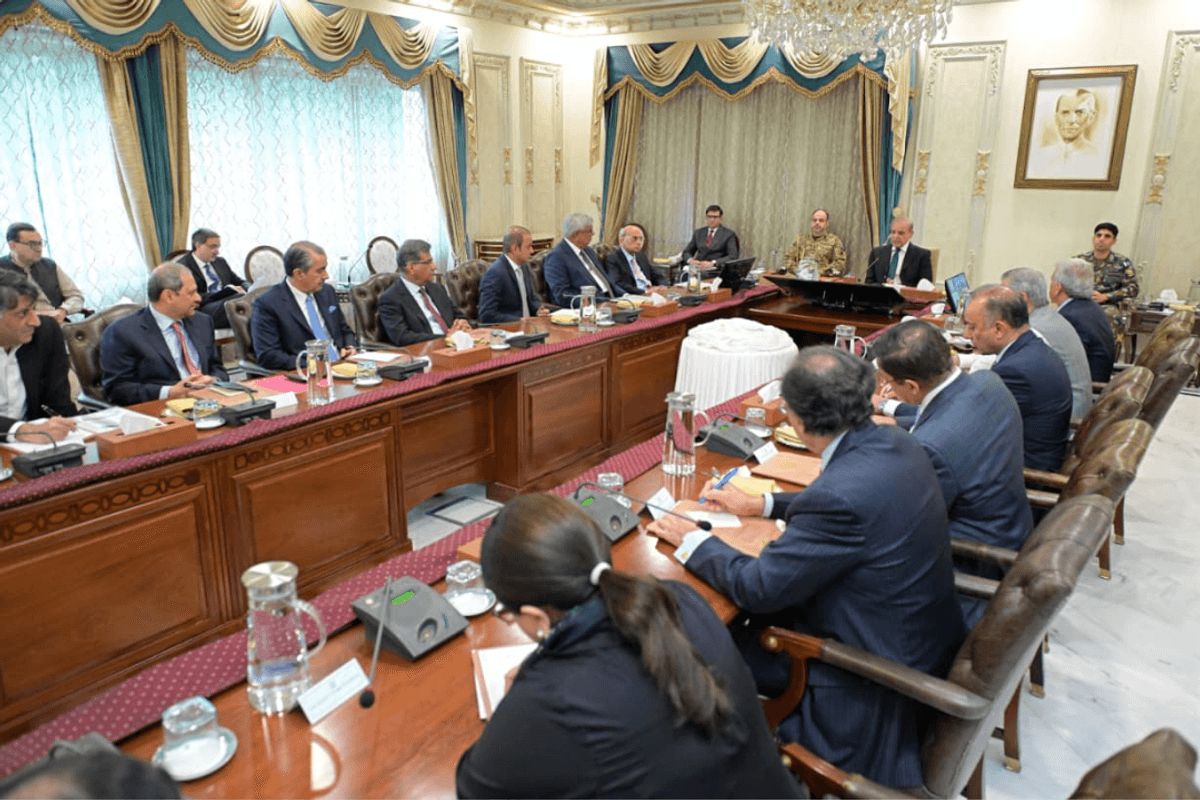
A delegation of leading industrialists and prominent businessmen called on Prime Minister Muhammad Shehbaz Sharif in Islamabad
Government of Pakistan, Facebook
Prime Minister Shehbaz Sharif on Wednesday held a high-level consultation with some of Pakistan’s leading industrialists and business executives as part of the government’s engagement with the private sector ahead of the FY2026-27 federal budget.
The meeting focused on accelerating economic growth, strengthening public-private cooperation and incorporating input from the business community into the upcoming budget.
The delegation included prominent business leaders Mian Muhammad Mansha, Arif Habib, Atif Bajwa, Mohammad Ali Tabba, Mushdaq Zulqarnain, Ziaad Bashir, Zelaf Munir and Amir Ibrahim, among others.
Welcoming the participants, Sharif described Pakistani entrepreneurs as “ambassadors of the country” and praised the business community for supporting the government during challenging economic conditions.
He said a strong partnership between the government and the private sector is essential for sustainable economic growth and emphasized that consultation with businesses remains a key component of economic policymaking.
Sharif reiterated that Pakistan’s economic strategy is centered on export-led growth and highlighted ongoing efforts to bring the informal economy into the tax net. He said the government is preparing measures in the upcoming budget to provide relief to the public while maintaining economic stability.
The prime minister credited business-friendly policies with helping stabilize the economy and restore investor confidence. He added that the government is promoting industries capable of increasing domestic production, boosting exports and generating employment.
Sharif identified industry, agriculture and information technology as key sectors for future economic growth and job creation. He also highlighted technical and vocational training programs aimed at equipping young people with market-relevant skills.
During the meeting, officials briefed participants on a range of economic and infrastructure initiatives. These included reforms to tax tribunals aimed at expediting the resolution of tax disputes, plans to establish special commercial courts and major transport projects designed to improve trade logistics.
Officials said work is continuing on the upgrade of the M-10 Motorway and the Pipri Freight Corridor to improve connectivity between Karachi’s ports and inland markets. The planned M-13 motorway linking Kharian and Rawalpindi is also expected to reduce travel time between Lahore and Islamabad.
The government also highlighted plans to modernize Pakistan Railways through upgrades to the ML-1 and ML-2 railway corridors, improve freight transportation and develop a National AI Transformation Plan to support digital innovation.
Business leaders expressed confidence in the government’s economic management and welcomed reforms aimed at improving the investment climate. They also praised Pakistan’s diplomatic efforts to promote regional peace and stability and commended initiatives to expand digital payments and strengthen the documented economy.
The delegation welcomed tax reforms and measures to improve the ease of doing business. Participants thanked the government for reducing electricity tariffs for industry, eliminating the Export Development Levy and improving the timely payment of tax refunds.
Business representatives also welcomed the government’s decision to consult stakeholders during the budget-making process and presented recommendations aimed at strengthening economic growth, boosting exports and encouraging investment.
The business community reaffirmed its commitment to working closely with the government to support Pakistan’s economic recovery and long-term development objectives.
Several federal ministers, senior government officials, the governor of the State Bank of Pakistan and representatives of key economic institutions also attended the meeting.



Comments
See what people are discussing