

Rubio kicks off Middle East trip as Gulf allies seek answers on Iran deal
Rubio began a three-day Gulf trip in Abu Dhabi to address allies' concerns over the U.S.-Iran deal, including a $300 billion fund

News Desk
The News Desk provides timely and factual coverage of national and international events, with an emphasis on accuracy and clarity.
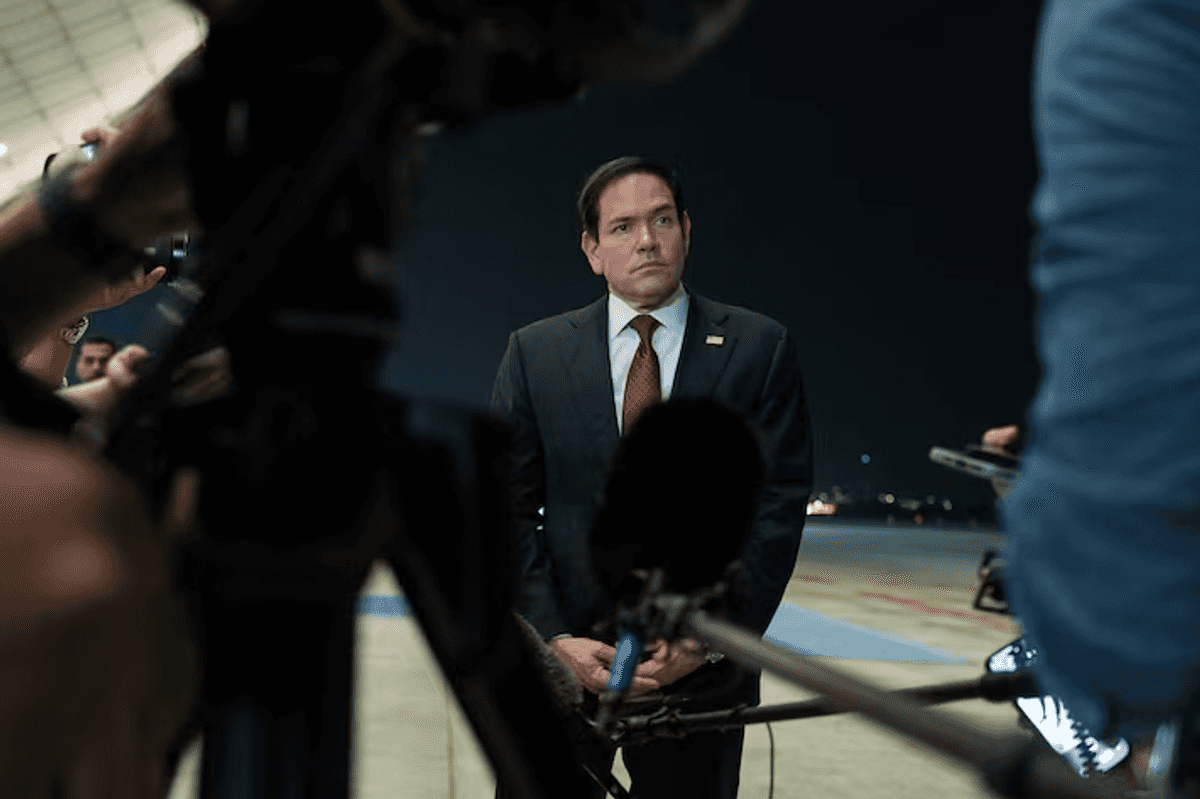
U.S. Secretary of State Marco Rubio speaks to the media upon his arrival at Al Bateen Executive Airport to discuss the interim deal between the U.S. and Iran with Arab Gulf allies, in Abu Dhabi, United Arab Emirates, June 23, 2026.
Reuters
U.S. Secretary of State Marco Rubio began a Middle East tour in earnest on Wednesday, arriving in Abu Dhabi late Tuesday for a three-day Gulf trip.
He is seeking to reassure allies who view concessions in President Donald Trump's Iran deal, including a proposed $300 billion fund, as too generous to a regional foe, Reuters reported.
What is the US-Iran deal that Gulf states are worried about?
The deal, reached last week, ended the four-month-old U.S.-Israeli war with Iran. It includes a proposed $300 billion reconstruction fund for Iran but does not address Tehran's ballistic missile capacity, a key concern for Gulf states that were struck by Iranian missiles and drones during the conflict.
This marks Rubio's first high-level diplomatic mission tied to the agreement. Asked on arrival whether he planned to address allies' unease with the accord, Rubio told reporters that the topic would come up in discussions. He added that talks would also cover issues not addressed in the memorandum of understanding.
Why has Rubio been absent from recent Iran talks?
Rubio has been largely absent from Iran-related discussions in recent weeks. Vice President JD Vance instead led a round of talks with Iranian counterparts over the weekend in Switzerland.
Rubio's remarks during this regional tour will be closely watched. Many will look to see how a man once known as a hawkish critic of Iran frames a deal that several congressional Republicans argue amounts to capitulation.
Rubio and Vance, both former U.S. senators, are widely viewed within Republican Party circles as potential 2028 contenders. Party insiders and early polling often frame the race as a two-way contest between them.
Why is Rubio's Gulf trip considered delicate?
Rubio's mission carries political risk on two fronts. He must defend a preliminary accord that Trump firmly supports, while also addressing the concerns of Gulf counterparts who remain more cautious about the deal's terms.
Gulf leaders pushed for peace throughout the four-month conflict, but many were surprised and disappointed by the final terms. Their central concern is that Iran could use the $300 billion reconstruction fund to rebuild its military rather than its economy.
How has the Iran war affected Gulf states like the UAE and Kuwait?
Among the countries on Rubio's itinerary are the United Arab Emirates and Kuwait. Both nations host strategic U.S. military bases and were hit by Iranian missiles during the war, resulting in civilian deaths.
The UAE faces particularly severe economic strain. Thousands of expatriates central to its non-oil economy fled during the conflict, raising questions about the long-term viability of a global financial hub located so close to a country that came under attack.
Tehran has pointed out that Gulf states made logistical accommodations for Washington's war effort, including hosting U.S. military bases central to the conflict.
Has Iran continued targeting Gulf countries since the war?
Last week, Reuters reported that Iran set up secretive new cells in Iraq to carry out attacks on Gulf countries, including Kuwait and the UAE.
According to Reuters, those cells carried out at least seven drone attacks on sites in Kuwait, the UAE and Saudi Arabia over a roughly one-month period in April and May.


Comments
See what people are discussing