

Sindh government faces Rs26 billion damages claim over Karachi BRT contract
Dispute Board ruled Sindh's termination of the Karachi BRT Red Line contractor unlawful, deepening delays on the $600 million project

Akhtiar Khokhar
Special Correspondent
Akhtiar Khokhar is a one of the karachi-based senior journalists. He has been doing investigative reporting for Pakistan's mainstream print and electronic media for the past 33 years, especially highlighting corruption and bad governance in government institutions and development projects.
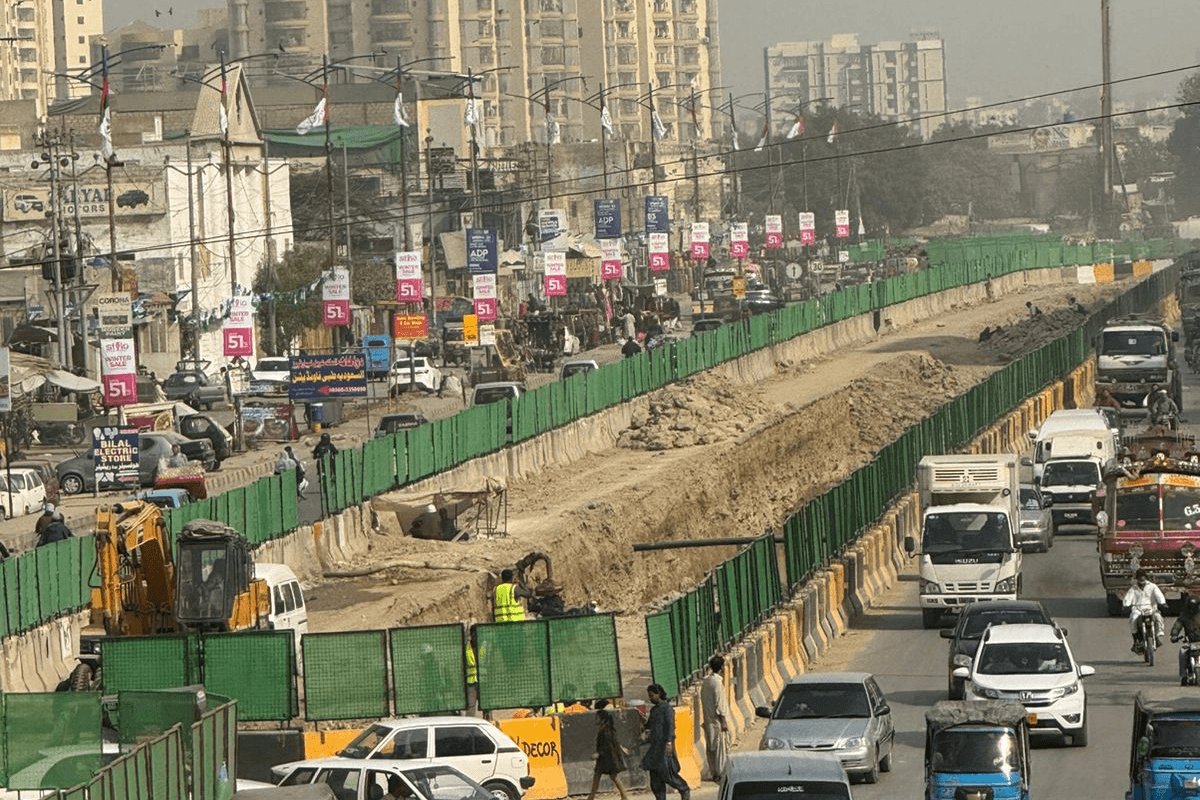
An under-construction section of Karachi's BRT Red Line project.
Courtesy: ZKB website
Sindh's government is facing a Rs26 billion ($92 million) damages claim from the contractor of Karachi's delayed Bus Rapid Transit (BRT) Red Line project, after an independent Dispute Board ruled that the termination of the contract was unlawful and in breach of contractual obligations.
The claim was filed by the joint venture between China Railway CR3 and AMC Associates against TransKarachi and the Government of Sindh, according to Ameen Jan, owner of AMC Associates. It follows a July 28 ruling by a three-member Dispute Board that declared the government's termination notices against the contractor unlawful, invalid and without legal effect.
Jan told Nukta that Rs18 billion of the claim relates to the alleged unlawful termination of the contract before its scheduled completion, while the remaining Rs8 billion covers compensation for what the contractor alleges were various breaches of the contract before the termination.
He said the contractor was prepared to negotiate a settlement with the Sindh government based on the Dispute Board's ruling. If no agreement could be reached, the contractor would pursue the matter through international arbitration, he said.
The latest development adds another layer of uncertainty to the ADB-funded $600 million project, which has already faced prolonged delays and disruption along one of Karachi's main transport corridors.
Why did the Dispute Board rule the termination unlawful?
The Dispute Board found that TransKarachi had issued the termination notices "in undue haste" without adequately considering the complexity of the project. It declared notices dated April 21 and May 6, 2026, unlawful, invalid and of no legal effect.
The three-member board was constituted under the project's FIDIC contract, in line with an earlier Sindh High Court order that referred the legality of the termination to the board.
A Dispute Board is an independent body established under FIDIC, the International Federation of Consulting Engineers, contracts to help resolve disputes between employers and contractors during construction projects. Under the contractual framework governing the Red Line project, its decisions are binding on the parties unless challenged through the agreed dispute-resolution process.
The board's ruling does not automatically carry the force of a court judgment, however, and either party can challenge the decision under the procedures set out in the contract.
Why did Sindh terminate the BRT contract?
The Sindh government terminated the Lot-2 contract in April and May, citing slow progress, poor-quality work, unsatisfactory performance and alleged violations of health, safety and environmental standards. Authorities also sealed the contractor's site offices at the time.
The Lot-2 contract was awarded on Jan. 4, 2022, to the joint venture of China Railway CR3 and AMC Associates.
The 23-km Red Line is being built along University Road, linking Malir Halt with Numaish Chowrangi. The project is divided into two packages: Lot-1 covers the 10-km stretch from Malir Halt to Mosamiyat, while Lot-2 covers the remaining 13 km from Mosamiyat to Numaish Chowrangi.
What did the Sindh High Court say?
After the termination, the contractor challenged the decision in the Sindh High Court. On May 7, the court expressed concern over prolonged delays in the reconstruction of University Road and directed the Sindh government to restore the road within two months on an emergency basis.
The court, however, referred the legality of the contract termination to the Dispute Board, identifying it as the appropriate forum to determine the contractual dispute.
Separately, the Sindh government awarded an emergency contract to the Frontier Works Organization in April to restore University Road within three months. That deadline has since passed, while the road remains incomplete and work on the Lot-2 section remains suspended.
What did the Dispute Board find about project management?
Beyond the termination itself, the board's ruling pointed to broader problems in the management and execution of the project.
It found that construction had begun before the design was finalised and that the design continued to change during execution. Although the project envisaged 16 BRT stations, the contractor had initially been provided with the design for only one station, according to the ruling.
The board also criticised project management for failing to hold the engineering consultant accountable for repeated design revisions. It found that the contractor was not provided with an obstruction-free site and that payments for completed work were withheld or significantly delayed, factors it said contributed to persistent delays.
The ruling further raised concerns about the experience and institutional capacity of the employer's project management team, citing weak coordination and delays in decision-making among engineers and consultants.
What happens next?
The Dispute Board decision was reached by a majority of two members, while the third member issued a dissenting opinion.
Under the FIDIC contract, either party can issue a Notice of Dissatisfaction within 28 days under Clause 20.4. If the dispute remains unresolved, it can proceed to arbitration.
That leaves the Sindh government with the option of accepting the ruling and negotiating with the contractor or challenging it through the contractual dispute-resolution process.
For the contractor, the Rs26 billion claim adds a significant financial dimension to the dispute. For the government, the ruling and the compensation claim could complicate efforts to replace the contractor and restart work on the stalled Lot-2 section.
The dispute also leaves open a broader question for Karachi: when, and under what arrangement, construction will resume on a project intended to provide a major public transport link through one of the city's busiest corridors.





Comments
See what people are discussing