

Pakistan stocks drop amid budget uncertainty, global market pressures
Technology, cement sectors lead losses as investors await FY26 tax policies

Business Desk
The Business Desk tracks economic trends, market movements, and business developments, offering analysis of both local and global financial news.
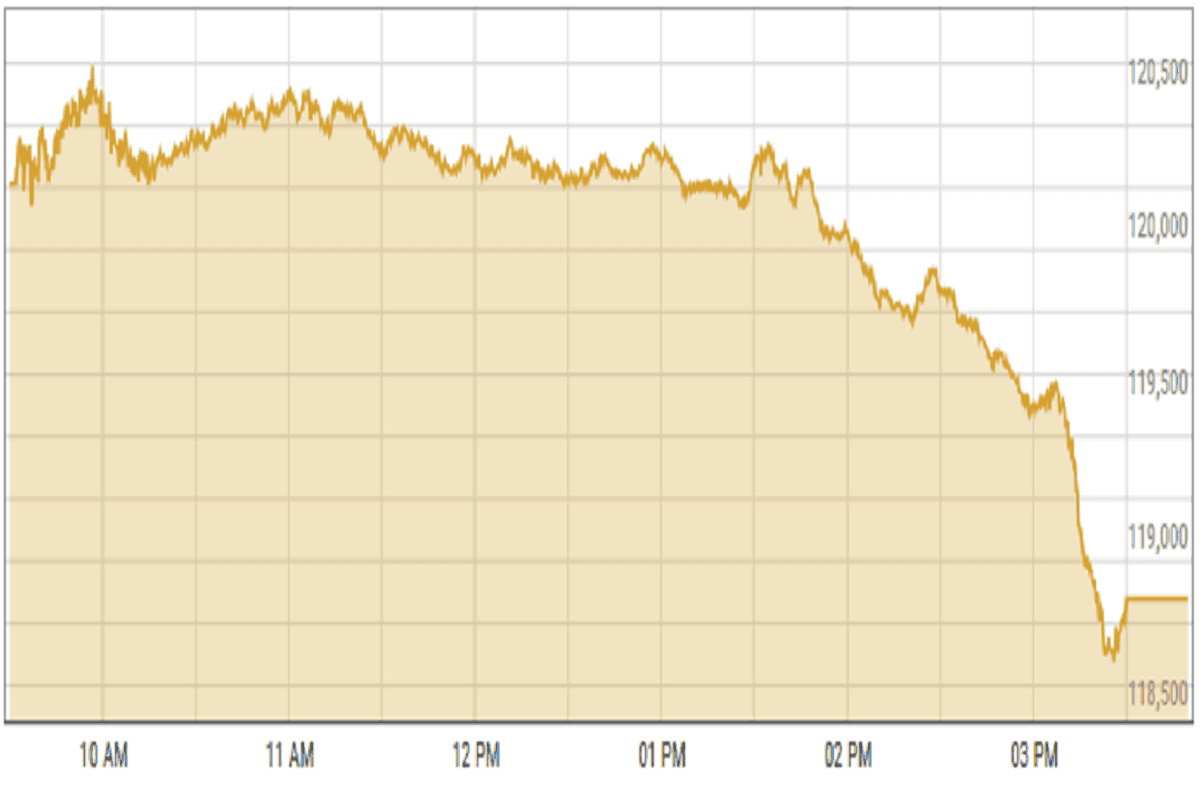
KSE-100 index shed 0.68%
PSX
Pakistan’s benchmark stock index closed lower Wednesday as investors remained cautious ahead of the fiscal year 2026 budget, with key sectors dragging the market down, analysts said.
The KSE-100 index fell sharply near the session’s end, with technology, cement and oil and gas exploration companies among the worst performers, collectively losing 521 points.
"Volatility persisted, while lackluster volumes reflected a cautious tone as investors adopted a wait-and-see approach ahead of the FY26 budget," said an analyst at Ismail Iqbal Securities.
Trading remained turbulent, with the index swinging in a wide range amid global market pressures.
"Local equities faced selling pressure due to uncertainty around the upcoming budget and the government’s proposed 2–3% hike in the tax rate on passive income," an analyst at Topline Securities noted.
Ahsan Mehanti of Arif Habib Corp said stocks closed under pressure at the Pakistan Stock Exchange (PSX) as pre-budget jitters weighed on sentiment.
"Reports of higher taxes on banking and savings schemes income, along with increased petroleum levies in the Federal Budget FY26, hurt market confidence," Mehanti said.
KSE-100 index shed 0.68% or 813.29 points to close at 118,877.81 points.
Currency
US dollar eased against PKR in the inter-bank market. Pakistani currency gained 5 paisas to close at 281.97. In the open market USD was trading at PKR 284.15.
Indian Stocks
India's stock market closed slightly lower on Monday, mainly because IT and metal stocks fell. Investors were worried about global trade issues, even though India's economy showed stronger-than-expected growth.
On Friday, U.S. President Donald Trump said he might double tariffs on imported steel and aluminium to 50% starting June 4, increasing concerns about global trade.
As a result, metal and IT companies lost 0.7% and were the worst-performing sectors.
The growing trade tensions could slow down the U.S. economy, reduce tech spending, and delay expected interest rate cuts by the Federal Reserve due to fears of inflation caused by tariffs.
BSE-100 index gained 0.02% or 6.31 points to close at 25,946.55 points.
DFM General Index gained 0.08% or 4.21 points to close at 5,484.72 points.
Crude Oil
Oil prices went up more than 3% on Monday because OPEC+ decided to increase production in July, just like in May and June.
Over the weekend, OPEC and its partners agreed to add 411,000 more barrels of oil per day starting in July. The ongoing conflict between Russia and Ukraine also pushed prices higher.
Brent crude prices increased by 3.71% to $65.11 per barrel.
Gold Prices
Gold prices went up on Monday as traders made new investments. Investors moved their money to safer options like gold because of rising global tensions and worries about trade conflicts.
When there is uncertainty in world affairs, people often take their money out of risky investments, such as stocks, and put it into secure assets like gold and government bonds.
International gold prices increased 1.85% to close at $ 3,350.52 per ounce. In the local market, gold prices remained flat at PKR 5,900 to 353,100 per tola.





Comments
See what people are discussing