

Trump considers military action to seize Iran’s uranium
Kamran Khan says Trump’s threats could trigger global economic shock

News Desk
The News Desk provides timely and factual coverage of national and international events, with an emphasis on accuracy and clarity.
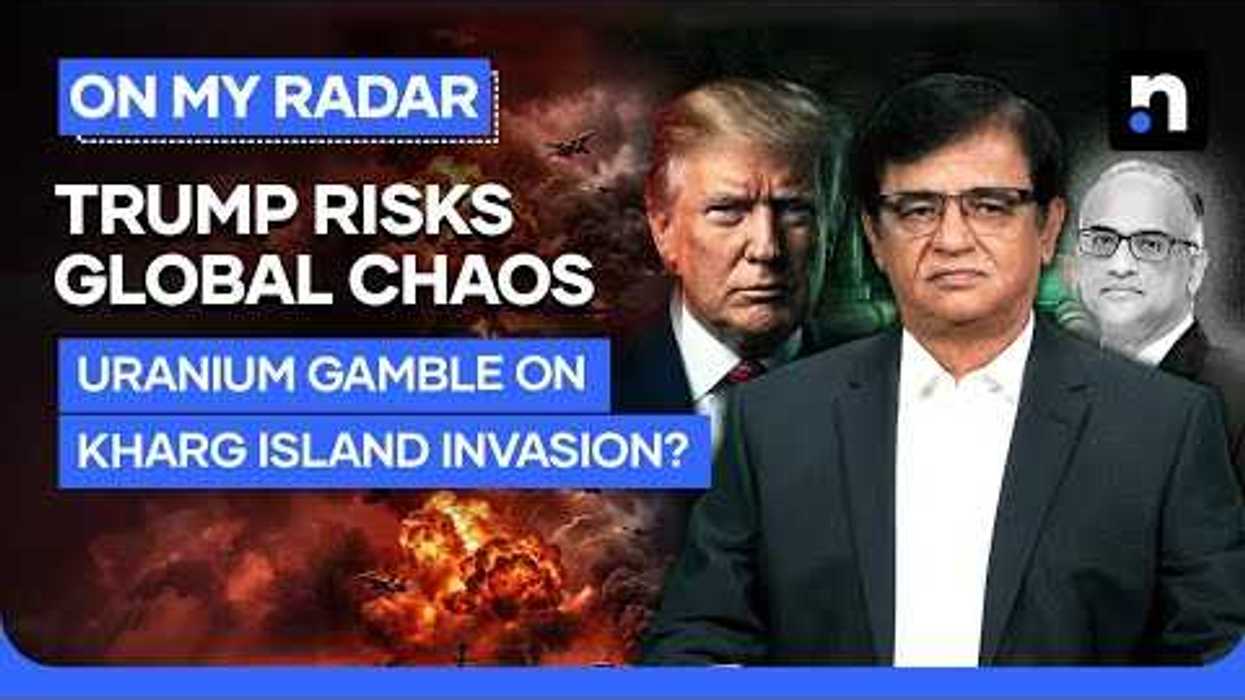
Kamran Khan says President Trump is increasingly desperate over Iran, driven by the military and diplomatic resistance Tehran continues to mount.
On his show “On My Radar,” Khan said Iran’s forces and civilians have effectively countered U.S. and Israeli military strength, leaving Trump “obsessed with a last-ditch gamble.”
According to Khan, Trump may consider a nuclear-related operation if conventional military or diplomatic avenues fail, warning such a move could cause “irreversible damage” to the global economy.
The Wall Street Journal reports Trump is exploring a military plan to seize roughly 1,000 pounds of enriched uranium in Iran. U.S. officials told the paper no final decision has been made, citing significant risk to American troops. Khan noted that Trump is pressing advisors to pressure Iran into surrendering the uranium, and the president has publicly demanded compliance, warning Tehran its existence could be at stake otherwise.
Financial Times reported an extraordinary U.S. military buildup in the region. Approximately 3,500 troops have arrived, with another 2,200 Marines en route. The Pentagon has ordered the deployment of 10,000 soldiers trained for territory seizure and occupation. The U.S. already maintains about 50,000 personnel in the Middle East, stationed across Qatar, the UAE, Saudi Arabia, Kuwait, Iraq, Jordan, and Bahrain.
Naval power is concentrated near Iran, with USS Abraham Lincoln in the Arabian Gulf and USS Gerald R. Ford in the Red Sea. Additional carrier deployment is under consideration. Some 100–150 advanced aircraft, including F-22s, F-35s, F-15Es, AWACS, and refueling tankers, are active in the region, Khan said, marking the largest U.S. aerial presence since the Iraq War. About 2,500 Marines and amphibious assault ships, including USS Tripoli, are near the Strait of Hormuz.
Khan warned, however, that locating Iran’s uranium remains uncertain. Before any conflict, Tehran reportedly held roughly 440 kilograms of 60% enriched, weapons-grade uranium, primarily in hardened underground facilities near Isfahan. International Atomic Energy Agency inspections are restricted by conflict, complicating verification.
Highly enriched uranium is stored in specialized cylinders requiring expert handling. Khan cited historical precedent: U.S. operations in Kazakhstan (1994) and Georgia (1998) successfully removed such material, but he noted the current environment is far more complex and dangerous.
Trump’s threats extend beyond nuclear sites. Khan reported the president has targeted Iran’s power grid, oil infrastructure, and desalination plants, and expressed a desire to control Iranian oil, likening his plans to past U.S. actions in Venezuela. Iran has retaliated, warning it could target energy and water infrastructure in Gulf states, potentially sparking a wider regional conflict.
Khan highlighted Kharg Island, Iran’s largest oil export terminal, as a strategic concern. Disruption there or in the Strait of Hormuz could shake global oil markets. The bigger question, he said, is whether the U.S. can locate and secure the uranium. If hidden or distributed, military success is uncertain, timelines are unpredictable, and the risk to negotiations and civilian infrastructure could be severe.
Khan concluded that the uranium “gamble” lies at the heart of Trump’s current strategy, balancing potential nuclear control against a dangerously uncertain military and economic outcome.



Comments
See what people are discussing