

UAE affirms stability, high readiness after Iranian missile attacks
Ministers say essential services remain uninterrupted, strategic reserves can cover up to six months, and security forces are on maximum alert

Dubai Desk
The Dubai Desk reports on major developments across the UAE, covering news, culture, business, and social trends shaping the region.
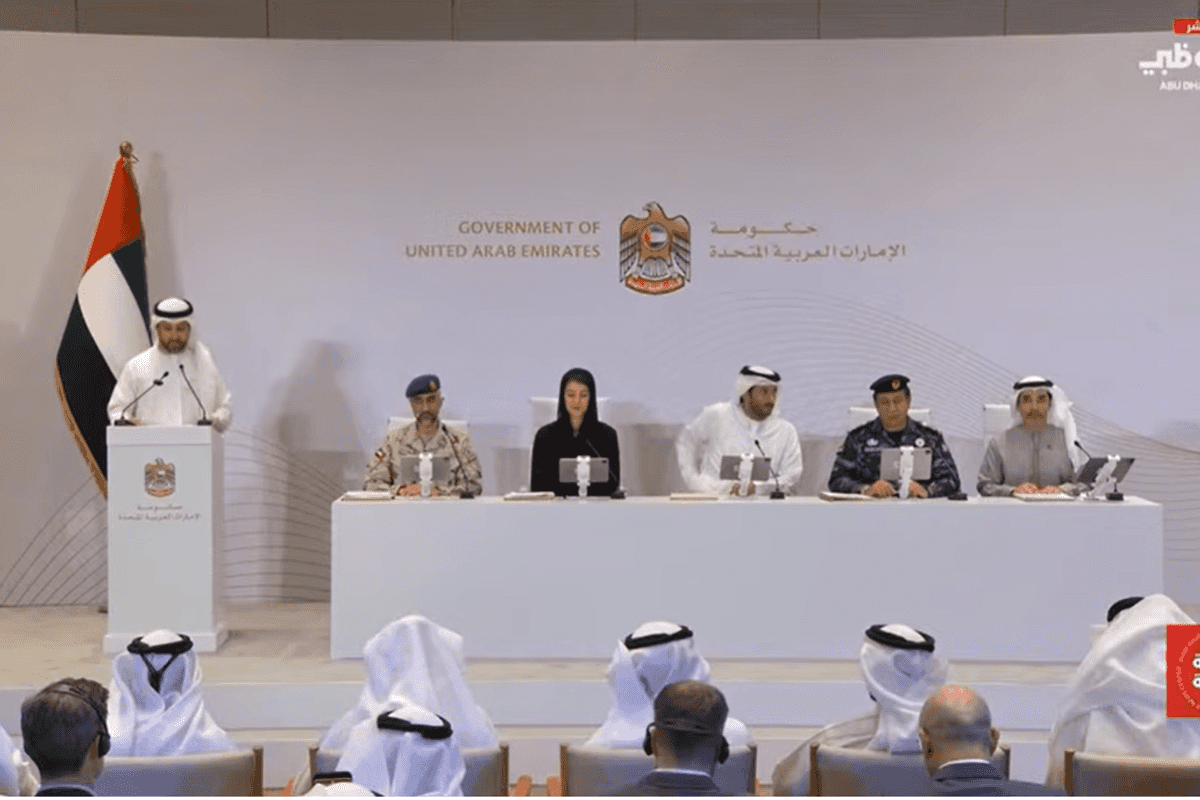
UAE Government officials brief the media on the fourth day of Iranian missile and drone attacks carried out in the aftermath of U.S.-Israeli attacks on Iran.
Courtesy: Screengrab/Abu Dhabi TV
Senior UAE officials on Tuesday briefed the media on the impact of Iranian missile and drone attacks on the country following US-Israeli strikes on Iran, with ministers across portfolios detailing security, economic and diplomatic measures.
Authorities stressed that the situation remains stable and that the country is operating at the highest levels of preparedness.
'UAE reserves right to take necessary defence measures'
The UAE maintains strategic reserves of air defence systems capable of countering aerial threats over an extended period, Abdul Naser Al Hummaidi, spokesperson for the UAE Ministry of Defence, said during the media briefing.
He added that the UAE will not tolerate any violation of its sovereignty or threats to its territory and reserves the right to take all necessary defence measures. “Our defence systems operate around the clock to detect and respond to potential threats,” Al Hummaidi said.
The UAE also has sufficient ammunition and domestically produced weaponry designed to counter all types of aerial threats and safeguard the nation’s airspace.
Since the Iranian attacks began on Saturday, UAE defence forces have intercepted 186 ballistic missiles, 812 drones, and eight cruise missiles. Al Hummaidi confirmed that all reported injuries were caused by debris from intercepted missiles.
Economy, aviation and supply chains
Minister of Economy and Tourism Abdulla bin Touq Al Marri said the UAE has “sufficient strategic reserves of basic goods to cover needs for between four and six months,” adding that the country can “quickly find alternative markets and respond to various crises.”
He said the government is focusing on “the potential impacts of the ongoing regional crisis on its economy, tourism, aviation, and business environment, while assessing the national economy’s ability to manage the situation effectively.”
“We affirm that the UAE economy has proven its resilience in absorbing pressures resulting from international and regional crises, maintaining high levels of stability and efficiency,” Al Marri said.
“One of the key reasons for this resilience is the clear red lines set by the leadership regarding national security,” he added, noting that the UAE has built “a strong and sustainable legislative framework built on flexibility, proactiveness, and openness to the world,” strengthened global partnerships and developed “one of the most competitive business environments worldwide.”
He also confirmed that “precautionary measures” have been implemented to ensure economic stability.
Between March 1, 2026 and now, approximately 17,980 passengers have been transported on limited operational flights to facilitate the return of affected citizens and residents. More than 80 additional flights are scheduled, with capacity exceeding 27,000 passengers.
Regional escalation and diplomatic position
Minister of State for International Cooperation Reem Al Hashimy said the conflict had disregarded the UAE’s repeated position that it “won’t allow its lands as a use of conflict.”
“A conflict that ignored the UAE position, and how much it reiterated times and times again that it won’t allow its lands as a use of conflict,” she said.
She added that “the problem isn’t just the nuclear program but is the comprehensive missile program that is a danger to region as well,” highlighting broader regional security concerns.
Officials reiterated that the UAE remains fully prepared to safeguard its territory, residents and economic interests while continuing to call for stability amid the ongoing escalation.
Security and emergency response
The Minister of Interior Sheikh Saif bin Zayed Al Nahyan affirmed that “the security situation across the country remains stable, with preparedness levels at their highest in line with precise professional standards and a clear institutional framework.”
He said the ministry had reinforced field capacity with “over 3,200 specialized vehicles, more than 4,100 traffic and security patrols, and armed rapid-response units" deployed proactively to ensure swift intervention.
The ministry was operating “within a comprehensive proactive security system, in coordination with more than 25 national entities,” based on continuously updated national plans and scenario analysis.
Urging public cooperation, the minister called on residents to “obtain information only from official sources,” “fully comply with safety instructions and procedures,” and “continue daily life as normally as possible.”
During the briefing, the Ministry of Defence released images of missiles to provide “official insight into the recent aerial threats and the country’s defensive operations,” underscoring preparedness.
Amid ongoing Iranian attacks in the region, parents and teachers across the UAE are carefully monitoring developments and evaluating classroom safety, awaiting guidance on when students can return.
Speaking at a UAE Government media briefing, Dr. Saif Al Dhaheri, spokesperson for the National Emergency Crisis and Disaster Management Authority (NCEMA), said a decision on whether students will resume in-person classes or continue with remote learning is expected within the next 24 hours.
The NECMA confirmed that “daily life in the UAE continues as normal,” with essential services — including energy, water, telecommunications, transport, healthcare and goods supply — operating “efficiently and without disruption.” It added that business continuity plans have been activated “as a precaution to ensure full sector readiness.”


Comments
See what people are discussing