


News Desk
The News Desk provides timely and factual coverage of national and international events, with an emphasis on accuracy and clarity.
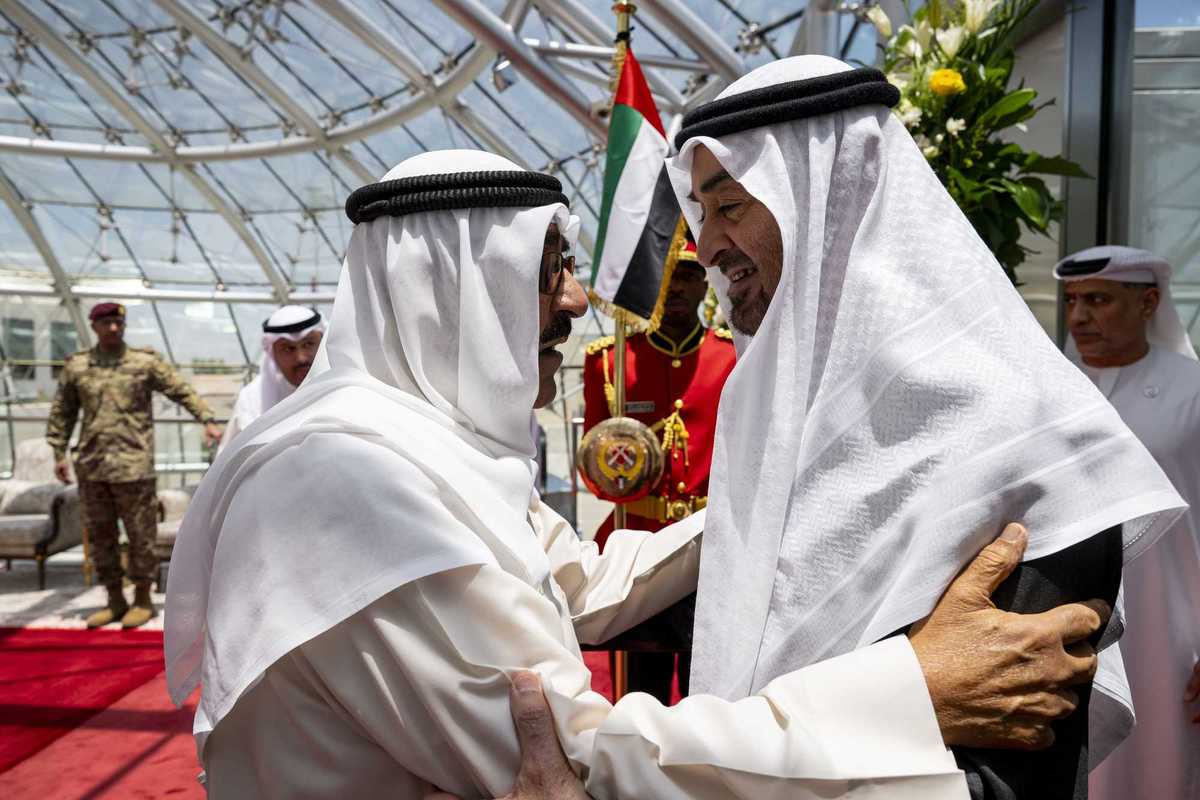
Picture Courtesy: WAM
UAE President Sheikh Mohamed bin Zayed Al Nahyan arrived in Kuwait on Thursday to execute an urgent fraternal visit, WAM reported.
Why did the UAE President initiate an urgent visit to Kuwait?
According to Khaleej Times, the UAE President's visit to Kuwait aims to solidify Gulf diplomatic cooperation and ensure mutual security defenses against expanding regional threats. The urgent bilateral assembly provides critical coordination after direct military exchanges between United States forces and Iran disrupted local stability.
The Emir of Kuwait, Sheikh Mishal Al-Ahmad Al-Jaber Al-Sabah, formally received the United Arab Emirates' head of state at the Amiri Airport.
Crown Prince Sheikh Sabah Al-Khaled Al-Hamad Al-Sabah and Prime Minister Sheikh Ahmad Abdullah Al-Ahmad Al-Sabah also joined the airport welcoming delegation.
The specialized diplomatic meeting takes place during an incredibly volatile week marked by escalating cross-border military strikes across the Gulf.
Who accompanied the UAE President on his fraternal visit to Kuwait?
A senior ministerial delegation accompanied the head of state to participate in the high-level defense and economic bilateral discussions.
The official traveling party includes Vice President and Deputy Prime Minister Sheikh Mansour bin Zayed Al Nahyan to oversee corporate cooperation. Interior Minister Lieutenant General Sheikh Saif bin Zayed Al Nahyan also joined the assembly to align homeland security protocols between the states.
The brief fraternal gathering underscores a critical need for shared intelligence frameworks among the primary Gulf Cooperation Council leadership teams.
Local administrations are aggressively coordinating with security counterparts to guarantee the absolute safety of vital energy export infrastructure. Both nations intend to maintain highly flexible diplomatic channels as the broader geographic territory prepares for potential future military hostilities.
Missiles intercepted by Kuwait
Kuwaiti armed forces successfully intercepted and neutralized three ballistic missiles, one cruise missile, and 10 hostile drones inside national airspace, WAM reported.
Ministry of Defense spokesperson Colonel Saud Al-Atwan confirmed that the multi-layered air defense systems performed effectively to mitigate the complex airborne threat. Although military units neutralized the incoming projectiles, falling shrapnel debris caused minor material damage and left one civilian resident injured.
Iran's Revolutionary Guards confirmed they intentionally targeted various American military infrastructure facilities situated across the strategic Gulf trade zone.
The coordinated missile strikes directly targeted Camp Arifjan and the Ali Al Salem air base in Kuwait, alongside maritime assets in Bahrain. Iranian state media reported that the sudden kamikaze drone operations were executed in response to previous American airstrikes launched earlier Thursday morning.
The violent military flare-up forced authorities in Qatar to issue emergency civilian alerts warning local residents of highly elevated threat levels. Qatari diplomats have previously mediated communication channels between Washington and Tehran to maintain regional balance and prevent uncontrolled combat escalations. The rapid deterioration of the active ceasefire has pressured neighboring oil-producing states to reinforce their collective tactical containment parameters.




Comments
See what people are discussing