


News Desk
The News Desk provides timely and factual coverage of national and international events, with an emphasis on accuracy and clarity.

Gargash called for a firm, collective response from Gulf states, arguing that no single country should bear the burden of Iranian aggression alone.
Reuters/File
UAE presidential advisor Anwar Gargash on Wednesday called for a unified Gulf response after renewed attacks on Kuwait and Bahrain attributed to Iran.
A drone strike hit a passenger terminal at Kuwait International Airport, injuring several people and briefly suspending air traffic. The incidents came amid escalating exchanges between Iranian and US forces in the Gulf.
What did Gargash say about the attacks on Kuwait and Bahrain?
Gargash called for a firm, collective response from Gulf states, arguing that no single country should bear the burden of Iranian aggression alone. Posting on X, he said the security, interests and destiny of GCC states are shared. He added that the latest attacks do not target one country but the entire Gulf.
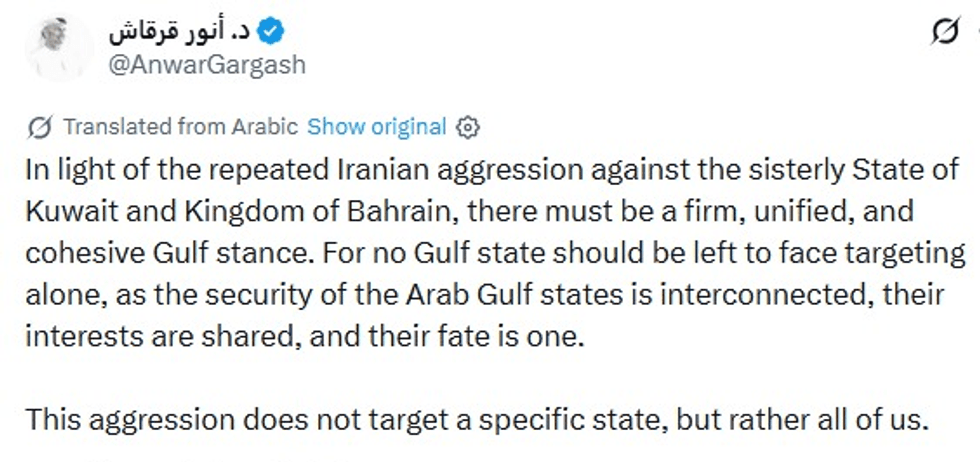
"In light of Iran's repeated aggression against the brotherly states of Kuwait and Bahrain, a firm, unified and cohesive Gulf stance is imperative," Gargash wrote. "No Gulf state should be left to face these attacks alone, because the security of the GCC states is interconnected, their interests are shared, and their destiny is one and the same." He urged stronger coordination among Gulf states in response to what he described as aggression targeting the region collectively.
What happened at Kuwait International Airport?
A drone strike hit a passenger terminal at Kuwait International Airport on Wednesday, causing significant material damage and injuring several people. Kuwaiti authorities attributed the attack to Iran. Kuwait's defense ministry spokesman, Brigadier General Saud Abdulaziz Al-Atwan, described it as "criminal Iranian aggression."
Air traffic was temporarily suspended following the strike. The airport attack marked one of the most serious tests yet of a fragile ceasefire that took effect on April 8. The ceasefire has largely held despite intermittent strikes following more than a month of conflict triggered by US and Israeli attacks on Iran.
How did Iran respond to the escalation?
The Islamic Revolutionary Guard Corps accused US forces of provoking the latest escalation by targeting a communications tower on Iran's Qeshm Island, which it said prompted a response.
Tehran has consistently accused Kuwait and other Gulf states of enabling US military operations from their territory. Those countries have denied the charge.
Bahrain also reported overnight drone activity, further heightening regional tensions and prompting renewed diplomatic concern across the Gulf. Kuwait, a close US ally, has faced repeated Iranian-linked attacks in the aftermath of the wider conflict, including the killing of Iran's supreme leader in late February. The latest strikes have intensified calls from Gulf capitals for a coordinated regional position.


Comments
See what people are discussing