

US-Iran strikes escalate despite Islamabad peace framework
Kamran Khan says renewed attacks deepen uncertainty as Pakistan urges both sides to honor the Islamabad MoU

News Desk
The News Desk provides timely and factual coverage of national and international events, with an emphasis on accuracy and clarity.
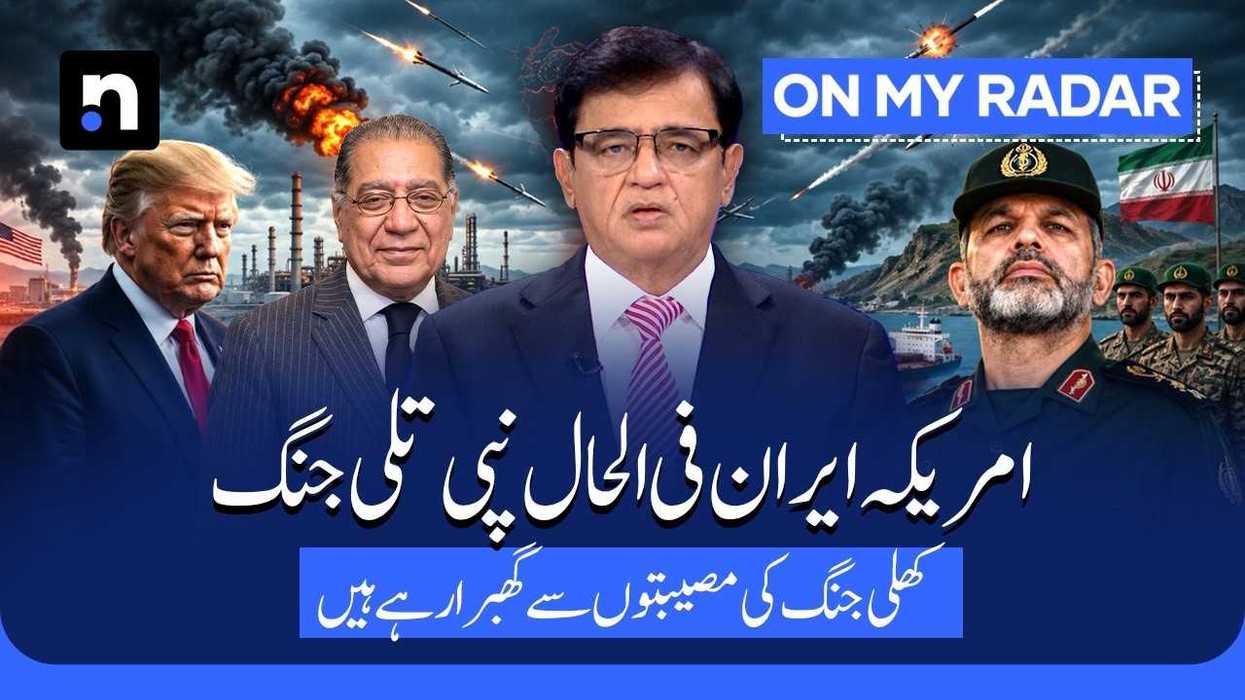
Hopes for peace between the United States and Iran appeared to fade further as both sides exchanged fresh military strikes, despite an interim understanding reached under the Islamabad Memorandum of Understanding (MoU), according to the latest episode of Kamran Khan's On My Radar.
Pakistan has urged both countries to honor the Islamabad MoU and avoid further confrontation, even as military exchanges intensified. Neither Washington nor Tehran has formally announced the end of the interim agreement.
The renewed uncertainty follows comments by U.S. President Donald Trump, who said a day earlier that he believed the MoU with Iran was effectively over, while adding that negotiations could still continue.
The United States carried out a second consecutive day of airstrikes on Iran, described in the program as the largest attacks since the Islamabad MoU. U.S. Central Command (CENTCOM) said the operation targeted 90 Iranian military sites, including locations in Bandar Abbas, Chabahar, Bushehr and other coastal provinces.
Trump said, "We Hit Iran 20 Times Harder."
Iran said U.S. missiles landed near the Bushehr nuclear power plant and that a bridge on the China-Iran railway corridor was also damaged. Iranian state media reported that eight members of the country's air force and navy were killed, while international media reported 14 civilian deaths.
Hours after the U.S. strikes, Iran's Islamic Revolutionary Guard Corps said it launched missile and drone attacks on U.S. military bases and strategic facilities in Bahrain, Kuwait and Qatar. Tehran warned that additional U.S. bases across the region could be targeted if the attacks continued.
Jordan's military also said it intercepted eight Iranian missiles that entered its airspace.
The program said the latest escalation centers on differing interpretations of the fifth clause of the Islamabad MoU, which calls for ensuring the safe passage of commercial shipping through the Strait of Hormuz.
According to the program, Tehran argues that only Iran has the authority to manage security arrangements in the strategic waterway. Iranian Parliament Speaker Mohammad Bagher Ghalibaf said Hormuz would remain open only under "Iranian arrangements," not under U.S. pressure.
The Trump administration, however, maintains that the agreement guarantees unrestricted passage for all commercial vessels through the Strait of Hormuz. Washington accuses Iran of attempting to assert control over one of the world's most important maritime trade routes, a move it says threatens global commerce and economic stability.




Comments
See what people are discussing