

Vast oil wealth, limited production: Venezuela’s energy paradox
Despite holding 17% of global reserves, output rivals that of small U.S. states

Business Desk
The Business Desk tracks economic trends, market movements, and business developments, offering analysis of both local and global financial news.
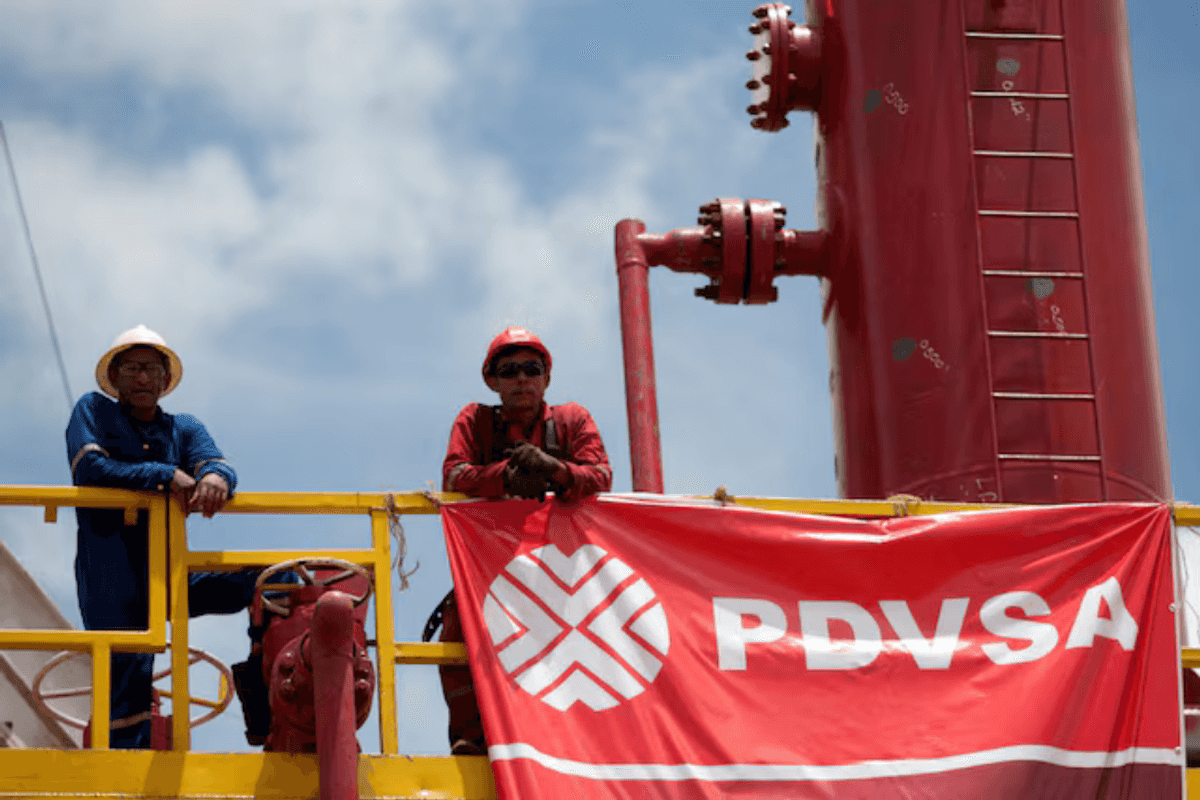
Workers stand in front of a drilling rig at an oil well operated by Venezuela's state oil company PDVSA
Reuters
Venezuela sits on the world’s largest estimated oil reserves, yet its crude production remains a shadow of what it once was. Decades of mismanagement, underinvestment and international sanctions have left the South American nation unable to fully tap its resource base, according to official data and foreign energy analysts.
World’s biggest reserves, shrinking production
Venezuela holds about 303 billion barrels of proven oil reserves, roughly 17% of the global total, making it the largest reserve holder worldwide, according to the London-based Energy Institute. That puts it ahead of Saudi Arabia, which has an estimated 267.2 billion barrels, followed by Iran and Canada. Together, the top four countries control more than half of the world’s proven reserves, which total around 1.73 trillion barrels globally.
By comparison, the United States holds about 55 billion barrels, ranking ninth. Venezuela’s reserves are therefore more than five times larger than those of the U.S.
Despite this, Venezuela’s oil output has collapsed. The country produced as much as 3.5 million barrels per day (bpd) in the 1970s — more than 7% of global supply at the time. Production fell below 2 million bpd in the 2010s and averaged around 1.1 million bpd last year, or roughly 1% of global output, similar to production levels in the US state of North Dakota, according to industry estimates cited by Reuters.
Heavy oil, high costs
Most of Venezuela’s oil lies in the Orinoco Belt, a vast region covering about 55,000 square kilometers in eastern and central Venezuela. The reserves are dominated by extra-heavy crude, which is dense, viscous and costly to extract.
The U.S. Energy Information Administration has said production in the Orinoco requires advanced techniques such as steam injection and blending with lighter crudes to make the oil marketable. Because of its density and high sulfur content, extra-heavy crude typically sells at a discount to lighter, sweeter grades on global markets.
PDVSA and sanctions
Oil production is dominated by state-owned PDVSA (Petroleos de Venezuela S.A.), which controls most Orinoco operations.
Analysts say ageing infrastructure, lack of investment, skilled labour losses and US-led sanctions have severely constrained output.
Venezuela nationalized its oil industry in the 1970s and later required PDVSA to hold majority stakes in all projects. Major international oil companies such as Exxon Mobil and ConocoPhillips exited in the 2000s after assets were expropriated.
PDVSA later formed joint ventures with firms including Chevron, ENI, Total, China National Petroleum Corporation and Rosneft, but production gains were limited.
Cheap fuel at home
Despite its production struggles, Venezuela has some of the cheapest gasoline prices in the world due to heavy government subsidies. As of September, 95-octane gasoline sold for about $0.04 per liter, compared with a global average of roughly $1.29 per liter, according to official pricing data cited by Reuters.
Beyond oil: mining ambitions
Facing declining oil revenues, President Nicolás Maduro announced a five-year mining plan in 2019 to boost production of minerals such as gold, coal and iron ore. However, industry experts say the government has often blurred the distinction between resources and reserves, making it difficult to assess how much can be economically extracted.
A 2018 government “minerals catalogue” estimated coal reserves of about 3 billion metric tons and nickel reserves of roughly 408,000 metric tons, while listing gold and iron ore mainly as resources rather than proven reserves. A 2021 map published by the government showed the presence of minerals including copper, coltan, uranium and zinc, but did not provide volumes.
The U.S. Geological Survey estimated in 2019 that Venezuela produced just 100,000 metric tons of coal from reserves of 731 million metric tons. Much of the country’s mineral output has fallen sharply over the past decade alongside oil production.
Could politics change the outlook?
Some analysts say a political shift could eventually revive Venezuela’s oil sector, though recovery would take years.
“If developments ultimately lead to a genuine regime change, this could even result in more oil on the market over time,” said Arne Lohmann Rasmussen of Global Risk Management, adding that production would not rebound quickly.
Saul Kavonic of MST Marquee said exports could rise if sanctions are lifted and foreign investment returns, but warned the process would be gradual. Others are more cautious.
“History shows that forced regime change rarely stabilizes oil supply quickly, with Libya and Iraq offering clear and sobering precedents,” said Jorge León, head of geopolitical analysis at Rystad Energy.
U.S. President Donald Trump said in a recent interview with Fox News that the United States would be “very strongly involved” in Venezuela’s oil sector, comments that briefly drew market attention.
For now, analysts say Venezuela’s vast reserves remain largely untapped — an illustration of how geology alone does not guarantee energy wealth without investment, stability and technical capacity.




Comments
See what people are discussing