

A year after the Pakistan-India war, the battle over truth still rages
Media coverage of the 2025 conflict exposed how digital-era misinformation can inflame war

Imran Kazmi
Senior Producer/Acting News Editor
Imran Kazmi is a seasoned digital journalist with nearly 15 years of experience in the media industry, including senior editorial roles at Pakistan’s leading news organisations.
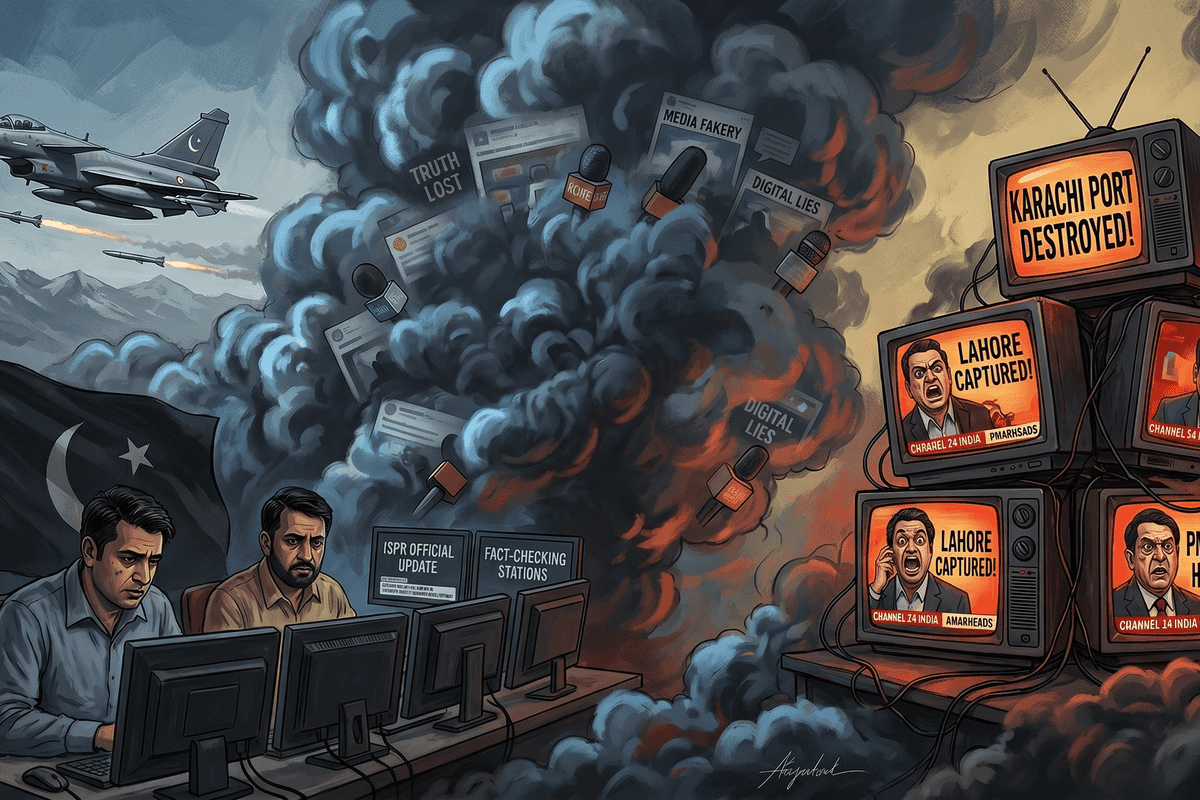
A war of narratives fought on television screens, social media feeds and digital platforms consumed by millions across the region.
AI-generated image
As India and Pakistan moved to the brink of full-scale war in May 2025, fighter jets roared across contested skies, missiles struck military installations and nuclear fears spread far beyond South Asia. But alongside the military confrontation, another battle unfolded in real time – a war of narratives fought on television screens, social media feeds and digital platforms consumed by millions across the region.
One year later, the conflict is remembered not only for its military escalation but also for the flood of misinformation, fabricated battlefield claims and hyper-nationalistic media coverage that accompanied it. For many observers around the world, the episode marked a defining collapse in the credibility of sections of the Indian media, particularly television channels accused of airing sensational and unverifiable reports detached from realities on the ground.
“As they say, truth is the first casualty of war,” said Owais Tohid, a senior Pakistani journalist and foreign affairs analyst. “With its role in the Pakistan-India conflict, the Indian media’s credibility has likely been lost forever in the fog.”
The military crisis began on April 22, 2025, when gunmen killed 26 civilians, mostly Hindu tourists, near Pahalgam in Indian-administered Kashmir. India blamed Pakistan-linked groups for the attack and responded by suspending the Indus Waters Treaty, downgrading diplomatic ties and expelling Pakistani diplomats.
Pakistan retaliated swiftly, suspending visas for Indian nationals, closing its airspace to Indian aircraft, halting trade and threatening to suspend the Simla Agreement. Cross-border shelling intensified along the Line of Control as diplomatic tensions spiraled into military confrontation.
Over the following days, fears of war deepened across the region. India ordered large-scale civil defense drills while Pakistan warned against unilateral military action. Tensions escalated further after India released water from the Uri Dam without prior notice, triggering flooding concerns downstream in Pakistan.
Global powers, including the United States, China, Russia and Iran, urged restraint as the nuclear-armed rivals edged closer to open conflict.
In the early hours of May 7, India launched “Operation Sindoor,” targeting what it described as militant infrastructure in Pakistan and Pakistan-administered Kashmir, including sites in Muridke, Bahawalpur and Muzaffarabad. The strikes triggered the largest aerial confrontation between the two countries in decades, involving more than 100 fighter aircraft.
Pakistan said it shot down several Indian jets, including advanced French jets Rafale, using Chinese-made J-10C fighters armed with PL-15 missiles. India later carried out additional strikes targeting Pakistani military infrastructure.
The conflict intensified again during the night of May 9-10, when Pakistan launched “Operation Bunyan-um-Marsoos” – or Iron Wall – in retaliation for Indian attacks on Pakistani air bases. Pakistan claimed to have struck multiple Indian military sites, including missile facilities and airfields, while reports of drone activity near Delhi and Gujarat raised fears of wider escalation.
Speculation about a possible nuclear confrontation spread rapidly after reports emerged suggesting Pakistan had convened its National Command Authority, though officials later denied the claim.
As governments exchanged accusations and military statements, media organizations on both sides raced to dominate the information space. But according to Pakistani editors and analysts, the contrast in coverage became increasingly stark.
Naveed Hussain, editor of The Express Tribune, said the conflict exposed the growing dangers posed by misinformation in the digital age, where speed increasingly overrides verification.
“Since the advent of digital media, the biggest challenge we face is that of misinformation, disinformation, and fake news,” Hussain told Nukta. “This is a huge challenge in the era of digital journalism: how to tackle and verify information, especially at a time when there is a ‘mad rush’ to break a story.”
Hussain said similar patterns had emerged during the Russia-Ukraine war and during anti-immigrant unrest in Britain, where viral misinformation spread rapidly online before facts could be verified.
“In a traditional newsroom or traditional media, there are various checks,” he said. “There is a reporter, then the news goes to the Bureau Chief, then to the sub-editor, then to the shift-in-charge, then the news editor, the editor, and finally the publisher; it is an entire system of checks.”
Digital platforms, however, often bypass those editorial safeguards.
“In a digital newsroom, these checks might not be as effective because there is a mad rush to break the story, much like on TV,” Hussain said.
According to Hussain, Pakistani media organizations largely relied on statements and briefings issued by the military’s media wing, the Inter-Services Public Relations, or ISPR, during the conflict.
“Obviously, in a war situation, you cannot send your assets – your reporters – into conflict zones to verify things and provide information; you rely on officially provided information,” he said.
Hussain argued that while Pakistani coverage remained nationalistic, it generally avoided speculative reporting and sensationalism.
“If a comparison is made between Indian and Pakistani media, in my opinion, the role of Pakistani media was more responsible in the sense that no hypothetical scenarios or concocted stories were run,” he said.
He pointed specifically to Indian television coverage that aired dramatic claims that Karachi port had been destroyed, Lahore was under attack, Prime Minister Shehbaz Sharif had fled the country and Army Chief Gen. Asim Munir had been arrested.
“They were doing all sorts of wishful reporting,” Hussain said.
Tohid was even more critical of Indian television networks, accusing them of transforming war coverage into theatrical propaganda.
“The Indian mainstream media presented a fiction – sponsored by the Modi-led BJP regime – as reality during the war against Pakistan,” he said.
“TV anchors became cheerleaders of war, presenting manufactured drama. They aired siren-filled shows, doctored videos, and jingoistic language – including false claims of capturing Lahore and destroying Karachi port – while ignoring that this was a war between two nuclear-armed states.”
“As the world watched Indian jet fighters including Rafale being downed by Pakistan, the Indian media projected the military’s false and absurd claims of capturing Pakistani cities,” Tohid said. “Every claim backfired.”
“Pakistani mainstream media was nationalistic but not irresponsible,” he added. “Indian media, however, literally turned into gutter journalism and became a laughingstock around the world.”
The war ultimately ended on May 10 after intense diplomatic intervention by Washington. U.S. President Donald Trump publicly announced that both countries had agreed to a ceasefire through military hotlines. Though sporadic violations followed, the truce largely held.
In the aftermath, Pakistan celebrated what it described as a strategic victory. Army Chief Gen. Asim Munir was later promoted to field marshal, and Pakistan nominated Trump for the Nobel Peace Prize for helping broker the ceasefire.
Yet despite the cessation of hostilities, the information war has left enduring scars.
Hussain said the deeper challenge now facing journalism is restoring credibility in an era where social media dominates public discourse but verification struggles to keep pace.
“There is no doubt that digital media, and social media in particular, has become the biggest source of information for people,” he said. “However, the issue of credibility still exists.”
He pointed to surveys showing audiences increasingly consume news online before turning to established media organizations to confirm whether the information is accurate.
“There is a major credibility issue in digital journalism, and fake news, misinformation, and disinformation are major challenges,” Hussain said.
He argued that governments, journalists and media organizations must collectively develop regulations aimed at combating false information without suppressing dissent or restricting press freedom.
“The intention and sincerity matter,” he said. “Are you bringing regulations to counter and stop fake news, or are you bringing them to suppress dissent?”
One year after South Asia’s most dangerous military confrontation in decades, the question remains unresolved. The ceasefire may have silenced the guns, but the battle over truth continues – more fragmented, more instantaneous and potentially more dangerous than ever before.



Comments
See what people are discussing