

Aaqib Javed explains Pakistan’s sweeping Test overhaul
Seven players were recalled from England following Pakistan’s heavy defeat at Lord’s, in a sweeping overhaul that also saw head coach Sarfaraz Ahmed and bowling coach Umar Gul removed.

Sports Desk
The Sports Desk is the editorial team responsible for covering the latest news, updates, and analysis from the world of sports. Our team of experienced writers and journalists bring you in-depth coverage of local and international sports events, player profiles, and expert opinions.
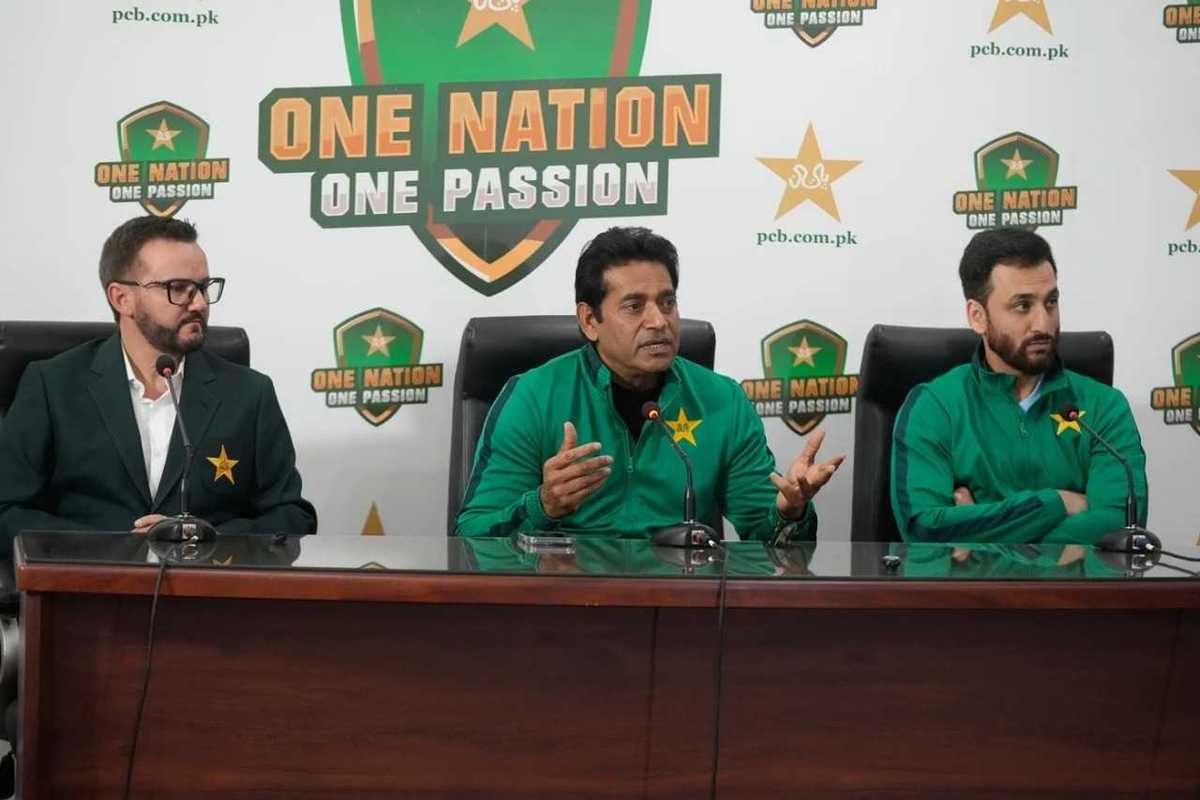
Mike Hesson, Aaqib Javed and Salman Ali Agha during a press conference in Lahore.
PCB
Pakistan’s Test cricket crisis has taken another dramatic turn, with PCB director of high-performance Aaqib Javed launching a scathing attack on opening batter Imam-ul-Haq over his failure to bat in either innings of the Lord’s Test.
Imam was ruled out of batting after suffering a low-grade calf tear, but Aaqib questioned whether the injury should have prevented him from taking the field at all. He also confirmed that the batter will face an inquiry over the incident.
The criticism comes days after Imam was among seven players recalled from England following Pakistan’s heavy defeat at Lord’s, in a sweeping overhaul that also saw head coach Sarfaraz Ahmed and bowling coach Umar Gul removed.
Why has Aaqib Javed criticised Imam-ul-Haq?
Speaking to Geo News, Aaqib said he was “deeply disappointed” by Imam’s decision not to bat in either innings, despite the nature of his injury.
Aaqib argued that players in the past had attempted to play through injuries and suggested that Imam should at least have tried to bat.
He stopped short of accusing Imam of faking the injury, but questioned whether a muscle tear could genuinely prevent a batter from contributing in both innings.
“The Imam injury is a big question mark, and a deep disappointment,” Aaqib said.
He added that Imam would have to face an inquiry and insisted that the PCB would “take action” over the matter.
What happened to Imam at Lord’s?
Minutes before the start of the second day, the PCB announced that Imam had suffered a tear in his left calf.
His participation in the remainder of the Test was made subject to medical advice, and he subsequently did not bat in either innings.
However, Imam returned to the field to warm up with the rest of the Pakistan team on the fourth morning.
That appearance immediately raised eyebrows, particularly because he had not been involved in batting during the match.
Former England bowler Stuart Broad criticised the episode while on broadcast, describing the warm-up as “all for show”. Former Australia opener David Warner also questioned the situation in a social media post.
Imam was eventually one of seven players sent home following Pakistan’s defeat.
Why did the PCB recall seven players?
Aaqib said the decision was not simply about individual performances but about sending a message to the players and changing the direction of a Test side that, in his view, had failed to compete.
Pakistan lost the first two Tests of the series, leaving them 2-0 down with one match remaining.
According to Aaqib, the team management had failed to make changes he believed could have improved the balance of the side.
He pointed to the availability of pace all-rounder Aamer Jamal, wicketkeeper-batter Ghazi Ghori and fast bowler Ubaid Shah as examples.
Aaqib particularly wanted Ubaid included because of his pace, arguing that a bowler capable of operating close to 140kph could have changed the composition of Pakistan’s attack.
He also questioned the decision to play Mohammad Rizwan as wicketkeeper instead of Ghori and acknowledged that Salman Ali Agha had been out of form.
Did Aaqib blame Pakistan’s team management?
Aaqib placed responsibility on the captain, head coach and management for failing to make what he considered the correct match-to-match decisions.
He argued that selectors could choose the travelling squad, but once a tour began, the team management was responsible for selecting the best combination for each match.
Aaqib said the original squad had been selected because the players were considered good enough, but their performances and Pakistan’s lack of competitiveness forced the PCB to intervene.
He claimed messages had been conveyed to the management about playing a more effective combination, but the necessary changes were not made.
For Aaqib, that failure ultimately meant someone had to act.
Why has the overhaul created wider controversy?
The changes have come amid growing frustration over Pakistan’s Test performances and the instability surrounding the national team.
Seven players were recalled, while Sarfaraz and Umar Gul were removed from their coaching positions.
The developments also followed Misbah-ul-Haq’s resignation from the selection panel.
Aaqib himself has been a central figure in Pakistan cricket for around two years and has worked through several coaching changes, including the departures of Jason Gillespie and Gary Kirsten.
He also briefly took on coaching responsibilities himself and was involved in the decision to appoint Sarfaraz only months before the former captain was removed.
That has naturally raised questions about accountability within the PCB.
Is Aaqib Javed also under pressure?
Despite the upheaval around him, Aaqib made it clear that he does not intend to follow Misbah out of the PCB.
Instead, he sought to distinguish between the selection of the original squad and the decisions made once the team arrived in England.
His argument is that the players were selected on the basis of their previous performances, while the responsibility for the poor combinations used during the Tests rested with the captain and management.
That stance places significant responsibility on the leadership group while allowing Aaqib to defend his own role in the selection process.
Can Mike Hesson turn things around?
Pakistan have now turned to Mike Hesson to lead the Test side into the final match of the series.
Hesson, who already serves as Pakistan’s white-ball coach, will take charge of the Test team alongside captain Babar Azam.
Aaqib backed Hesson and promised that the PCB would provide him with full support.
However, he admitted that expecting an immediate turnaround would be unrealistic.
He said it would be difficult for Pakistan to produce a result in a single Test after losing the first two matches so convincingly.
Instead, the immediate objective appears to be demonstrating that Pakistan still have enough talent to compete at this level.
Can Pakistan salvage anything from the England tour?
The third Test begins at Edgbaston on September 9, with Pakistan already trailing 2-0.
The wholesale changes may therefore be less about securing a series victory and more about beginning another rebuild.
For Aaqib, the message is clear: players must raise their standards on major tours, management must make stronger tactical decisions and Pakistan must show greater competitiveness.
But the controversy surrounding Imam, the removal of seven players and the departure of two coaches means Pakistan will arrive at Edgbaston under even greater scrutiny.
What began as a disappointing Test series has now become a major examination of Pakistan cricket’s leadership, selection process and player accountability.



Comments
See what people are discussing