

Escalating Iran conflict sends shockwaves across region and global markets
Kamran Khan says that despite mounting casualties and sustained military pressure, Iran appears neither subdued nor exhausted

News Desk
The News Desk provides timely and factual coverage of national and international events, with an emphasis on accuracy and clarity.
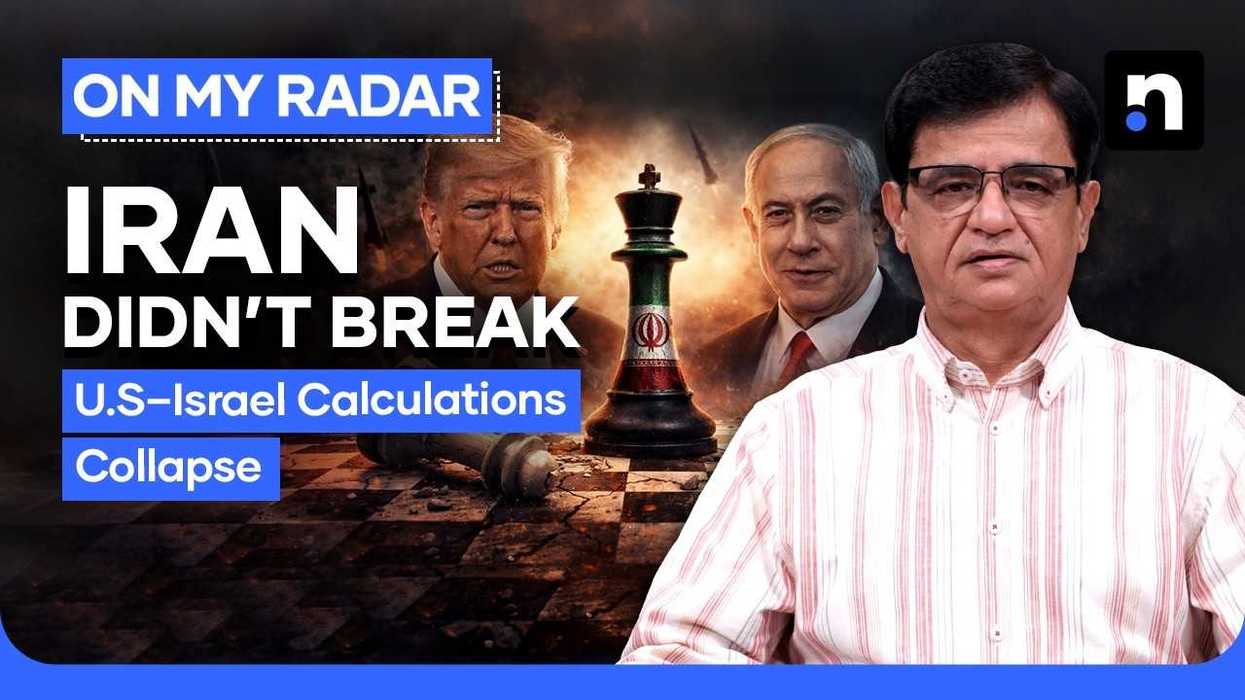
Ninety million Iranians, alongside their embattled government, are projecting defiance amid an intensifying conflict with the United States and Israel, in what supporters describe as a display of national unity that has surprised observers worldwide and unsettled Western capitals.
In the latest episode of On My Radar, Kamran Khan said that despite mounting casualties and sustained military pressure, Iran appears neither subdued nor exhausted. Referring to the martyrdom of Supreme Leader Ayatollah Ali Khamenei and the funeral prayers held collectively for 168 children and civilians, he said that the massive public turnout in Minab signaled resilience rather than retreat. He also recalled that on the first day of the conflict, Israeli bombardment of a girls’ school in northern Iran reportedly killed dozens of students, setting a grim tone for the escalation.
As the war enters its fourth day, the battlefield dynamics appear more complex than initial expectations of a swift outcome. Analysts note that resistance on the ground and the widening geographic scope of hostilities are challenging early assumptions. Iran is reportedly targeting U.S. military assets and allied installations across the Middle East, while simultaneously leveraging its strategic position along vital global energy routes.
Security concerns have also deepened following reports of an Iranian drone strike targeting the U.S. Embassy in Riyadh. Although no casualties were reported, Washington has advised American citizens to leave several countries in the region, including Bahrain, Kuwait, Egypt, Oman, Qatar, Saudi Arabia, the UAE, Yemen, Jordan, Israel, and Lebanon. The U.S. Embassy in Kuwait has suspended operations, and reports indicate limited consular assistance in certain locations as security risks escalate. Meanwhile, missile and drone activity targeting U.S. bases in Kuwait, Dubai, and Bahrain has further heightened tensions.
Beyond the military dimension, the economic consequences are rapidly unfolding. Energy infrastructure and maritime trade routes have effectively become new fronts in the conflict. Disruptions to oil and gas facilities, including Saudi Aramco installations and a Qatari LNG facility reportedly struck by missiles, have rattled global markets. Compounding the strain is instability in the Strait of Hormuz, a chokepoint critical to global energy supply chains.
Oil prices have responded sharply, with Brent crude climbing to $81 per barrel, while gas prices are expected to rise further as shipping costs surge. Industry reports indicate that daily charter rates for LNG tankers in the Atlantic region have tripled to around $200,000, reflecting mounting logistical risks.
Global equity markets have reacted with sustained volatility. Exchanges across the United States, Europe, Asia, and the Middle East remain under pressure. After suffering one of its steepest declines in history, the Pakistan Stock Exchange is showing tentative signs of stabilization. Market analysts increasingly describe the crisis not as a short-lived flare-up but as a potential “chokepoint conflict” — one capable of disrupting global energy flows and drawing in major powers such as China and Russia should their strategic interests be threatened.
Diplomatic anxieties are also intensifying. In an interview with CNN, President Donald Trump acknowledged that Iranian strikes on Bahrain, Jordan, Kuwait, Qatar, and the UAE came as a significant surprise, despite Tehran’s prior warnings that countries hosting U.S. bases could face retaliation. China has since issued a firm statement cautioning that prolonged disruptions to oil and gas supplies could prompt direct intervention. Reports suggest that Qatar and the UAE are engaging diplomatic channels in an effort to de-escalate tensions.
The conflict has also prompted deeper introspection within Gulf states hosting U.S. military bases. Policymakers are increasingly debating whether such installations serve as protective shields or potential liabilities. The immediate pressure felt across the Gulf has sparked renewed discussion about reassessing long-term national security strategies.
Looking ahead, key uncertainties persist. If the objective is to constrain Iran’s nuclear program, verification mechanisms in an active war environment remain unclear. At the same time, prolonged disruption in the Strait of Hormuz could drive sustained increases in energy and shipping costs, fueling a new wave of global inflation.
Perhaps most notably, early assumptions that sustained military pressure would trigger internal collapse in Iran have not materialized. Instead, wartime nationalism appears to have reinforced internal cohesion. The broader question now centers on how long global financial systems and regional economies can withstand prolonged instability extending beyond the battlefield into energy, logistics, and capital flows.
As the conflict unfolds, endurance may prove decisive. Whether Iran exhausts its military capabilities first or Western resolve weakens under mounting economic and strategic strain remains uncertain. Equally critical is the capacity of Gulf economies — from Qatar to Saudi Arabia — to absorb extended disruption. With shipping lanes constrained and supply chains under stress, the prospect of oil approaching $100 per barrel and sharply higher LNG prices is no longer implausible. Economists warn that Europe, in particular, could face severe economic headwinds if the crisis persists.
The coming months will determine whether this confrontation remains regionally contained or evolves into a broader geopolitical and economic rupture with global consequences.


Comments
See what people are discussing