

Gulf stock markets plunge as geopolitical tensions simmer
Kuwait authorities halt trading until further notice after missile strikes

Business Desk
The Business Desk tracks economic trends, market movements, and business developments, offering analysis of both local and global financial news.
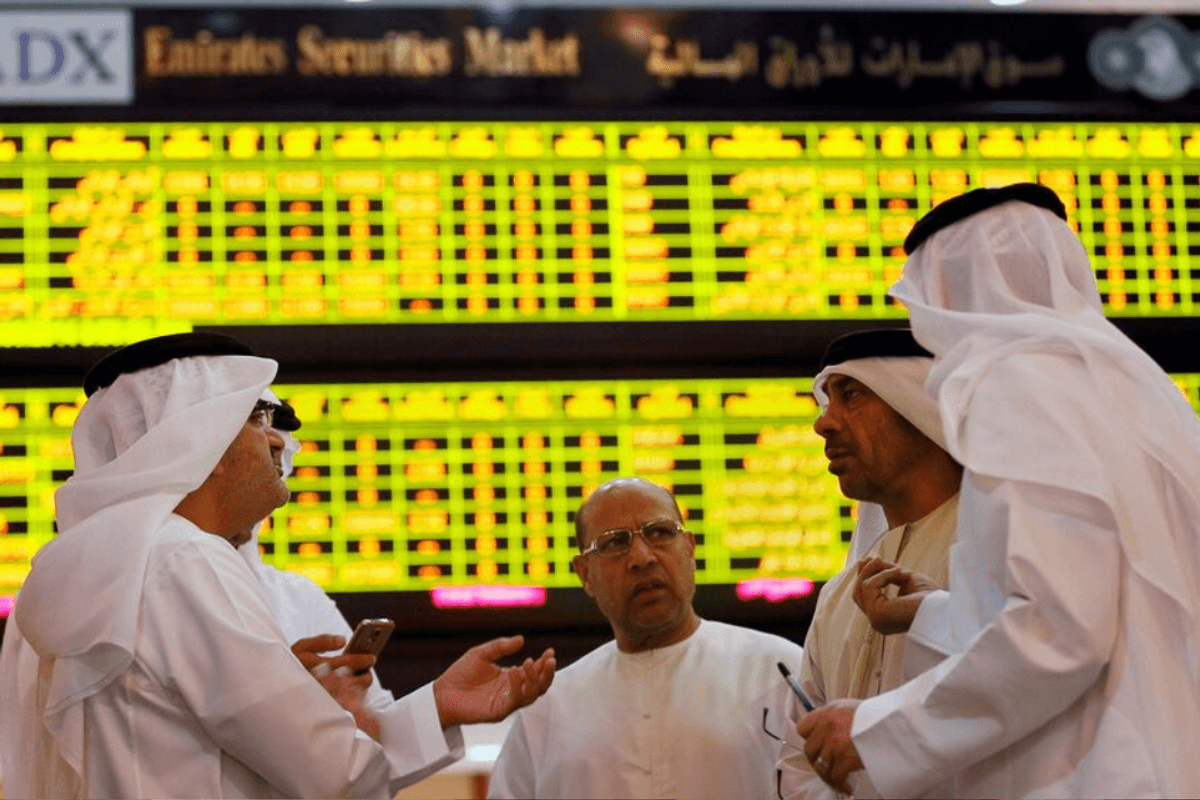
Investors speak in front of a screen displaying stock information at the Abu Dhabi Securities Exchange.
Reuters
Stock markets across the Gulf fell sharply on Sunday as escalating military conflict between the United States and Iran sent shockwaves through regional financial markets, prompting Kuwait to suspend trading and investors to shift toward defensive assets.
Saudi Arabia’s benchmark Tadawul All Share Index dropped 2.67% in early trading, marking its steepest decline since April and wiping out gains for the year. The selloff was led by shares of Elm Co., Flynas, Shaker Group and Tourism Enterprise Co.
The losses were partially offset by gains in Saudi Aramco, which rose about 3.4% as investors anticipated higher crude prices when global markets open in Asia. The oil giant accounts for roughly 16% of the exchange’s weighting. Other gainers included Al Rajhi Takaful, Lazurde, Amak and Herfy Foods.
Elsewhere in the region, Egypt’s main index fell 2.5%, extending losses since mid-February — when prospects of war intensified — to more than 8%. The Egyptian pound weakened to around 48.8 per dollar on Sunday, its lowest level since mid-2025, according to market data.
Omani and Bahraini equities also retreated.
In Kuwait, authorities halted trading as missile and drone attacks struck the country Saturday, damaging property. Boursa Kuwait announced the suspension of trading effective Sunday “until further notice,” citing exceptional circumstances and a decision by the Capital Markets Authority’s board of commissioners.
Kuwait was among the Gulf states targeted after Iran launched retaliatory strikes following joint U.S.-Israeli military action against the Islamic Republic. Israel’s market was closed on Sunday as it recently shifted to a Monday-to-Friday trading week. Qatar’s stock exchange was shut for a holiday, while markets in the United Arab Emirates are scheduled to open on Monday.
Analysts said Gulf markets are likely to remain volatile but avoid steep declines.
“Equity markets in the UAE and across the Gulf are likely to react to recent developments with a high degree of caution, potentially registering limited declines in the initial sessions, which would not exceed 1% to 1.5%,” said Rania Gule, senior market analyst for MENA at xs.com.
Investors are expected to gravitate toward defensive stocks with stable dividend yields until geopolitical tensions ease.
Egypt has been particularly vulnerable to regional turmoil. Since the start of the Israel-Hamas war in Gaza in late 2023, revenue from the Suez Canal — a major source of foreign currency — has been pressured by shipping disruptions. Additional strain came after Israel halted natural gas supplies to Egypt following the latest escalation.
Cairo, which previously received about 1 billion cubic feet of gas per day from Israel, is now seeking additional liquefied natural gas cargoes ahead of peak summer demand, according to reports.
The market turmoil underscores the broader economic risks facing Middle Eastern economies as the conflict threatens energy flows, trade routes and investor confidence across the region.





Comments
See what people are discussing