

Hamas announces dissolution of Gaza governing body to clear path for civilian rule
Hamas announced the dissolution of Gaza governing body on Monday, clearing the way for a technocratic committee to implement a civilian transition

News Desk
The News Desk provides timely and factual coverage of national and international events, with an emphasis on accuracy and clarity.
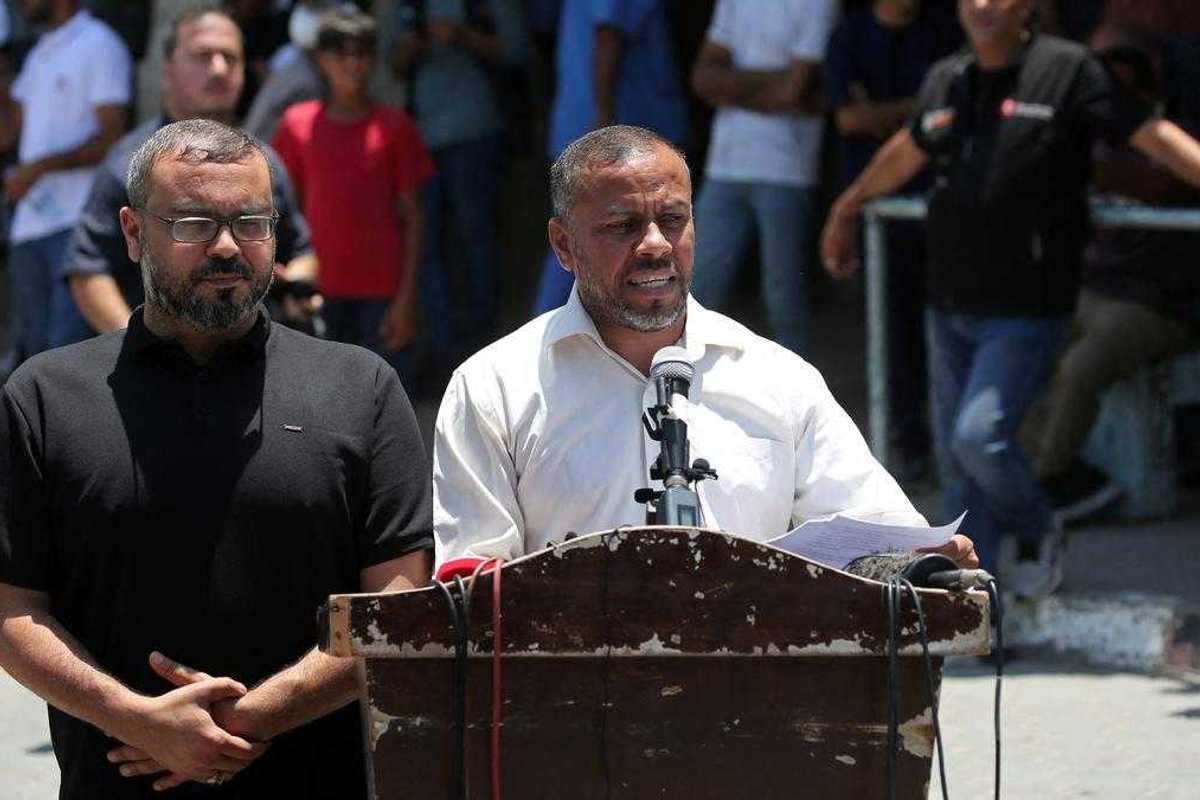
Ismail al-Thawabta, head of Hamas' government media office, addresses a press conference at the Al-Aqsa Hospital in Deir al-Balah, central Gaza Strip on July 6, 2026.
AFP
Hamas announced the official dissolution of the Gaza governing body in Gaza City on Monday to clear the way for a new technocratic civilian administration.
The unprecedented political decision effectively ends nearly two decades of exclusive administrative rule over the war-devastated coastal territory.
Why did Hamas agree to the dissolution of Gaza governing body?
The group dissolved its executive emergency committee to remove political pretexts for the ongoing military occupation and facilitate a civilian administrative transition. This shift allows a neutral, externally brokered technocratic council to assume daily municipal governance and manage humanitarian relief across the territory.
The head of the government's emergency committee, Mohammed al-Farra, officially submitted his resignation to senior leadership earlier on Monday afternoon. Government media office chief Ismail al-Thawabta confirmed that this resignation effectively dissolves the active committee, facilitating an immediate administrative handover. The new governing structure will transfer all domestic municipal responsibilities to the National Committee for the Administration of Gaza.
Hamas fighters originally seized exclusive executive control of the coastal strip from the rival Palestinian movement Fatah during a brief civil conflict in 2007.
That historic shift occurred shortly after the Islamist movement won the national legislative elections during the previous calendar year. Since a regional ceasefire took effect last October, the group has repeatedly expressed a willingness to step away from daily municipal governance.
The Board of Peace created the incoming administrative committee under a regional framework brokered by US President Donald Trump.
Spokesman Hazem Qassem stated that the organization intends to hand over all public duties swiftly to ensure the success of the new council. Group officials already informed other prominent Palestinian factions about the political transition during a recent high-level diplomatic meeting held in Cairo.
Who will take over governance in the Gaza Strip?
Palestinian technocrat Ali Shaath will head the National Committee for the Administration of Gaza to oversee all upcoming civilian reconstruction efforts.
The newly formed administrative council has remained based outside the territory for several months due to persistent Israeli objections regarding its entry. Regional faction leaders formally welcomed the transition, describing the dissolution as a serious step toward enabling effective independent governance.
Hamas negotiators have simultaneously participated in multiple rounds of Cairo talks with international mediators to resolve disputes over the ceasefire framework.
The initial phase of the agreement successfully achieved the release of the last remaining Israeli hostages in exchange for detained Palestinians. However, transitioning to the second phase of the peace roadmap has remained stalled for months due to deep security disagreements.
The stalled second phase requires the verified disarmament of the militant group alongside a gradual withdrawal of foreign military forces from Gaza. Instead of withdrawing, Israeli military forces have expanded their physical presence in the territory to occupy nearly 70 percent of the land. Consequently, the militant group demands the complete establishment of a recognized Palestinian administration before considering changes to its weapons arsenal.
What are the main obstacles to a permanent ceasefire?
The thorny question of post-war territorial governance remains one of the primary sticking points preventing a permanent end to the regional conflict.
The Israeli government firmly rejects any political framework that allows the Islamist group to return to formal administrative power in the region. Furthermore, Prime Minister Benjamin Netanyahu categorically rejects a direct governance takeover by the Ramallah-based Palestinian Authority at this specific stage.





Comments
See what people are discussing