

How weaker forces are challenging military superpowers
Kamran Khan examines how Iran and Yemen's Houthis are inflicting economic costs on stronger adversaries

News Desk
The News Desk provides timely and factual coverage of national and international events, with an emphasis on accuracy and clarity.
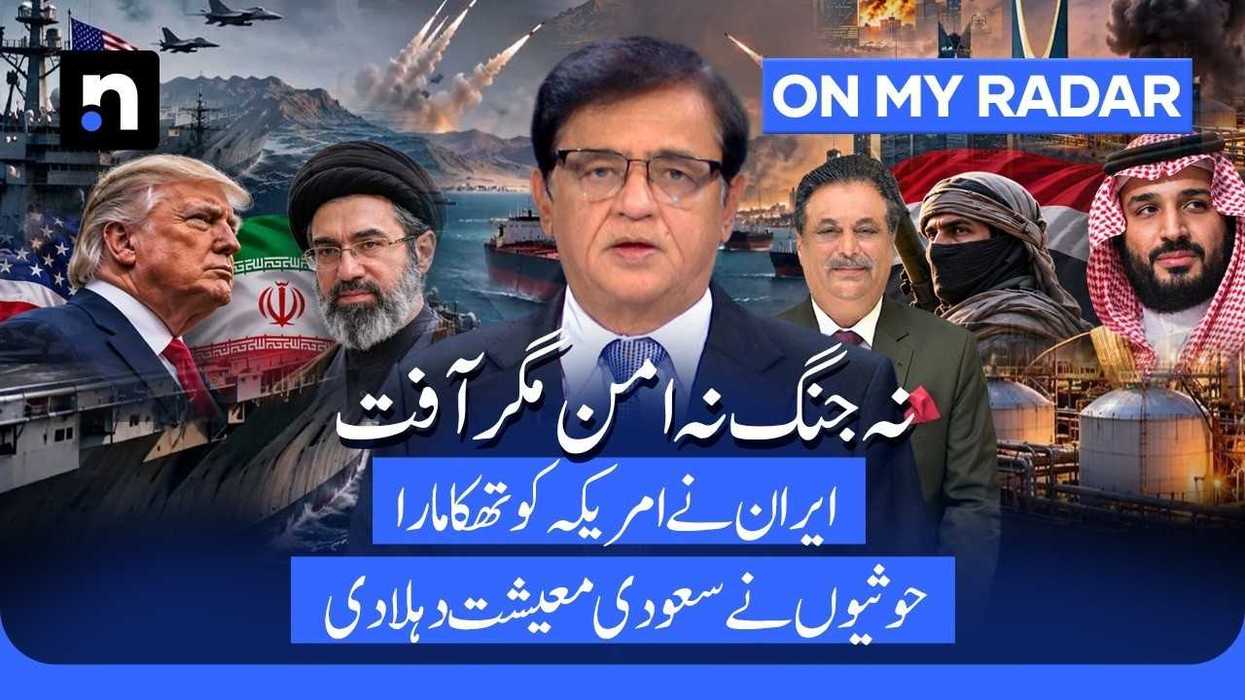
The United States and Saudi Arabia have failed to secure decisive victories against opponents with far fewer military resources, exposing how drones, missiles and unconventional warfare are changing the nature of modern conflicts and allowing weaker forces to threaten major economies.
In the latest episode of his show "On My Radar," Kamran Khan examined how Iran has resisted months of US military pressure and how Yemen's Houthi rebels have continued targeting Saudi Arabia despite its advanced military capabilities. He said the emerging pattern was also visible in Russia's prolonged war against Ukraine, where Moscow has failed to eliminate Ukrainian resistance despite its military superiority.
The result is a growing number of conflicts in which neither side achieves a decisive victory nor establishes lasting peace. Instead, economies suffer, investments are disrupted and civilians pay the price.
Iran resists US pressure
US President Donald Trump has used extensive military force against Iran, including attacks on military installations and its nuclear program, alongside a naval blockade of Iranian ports. However, nine months into the conflict, Tehran has not agreed to a comprehensive deal on Washington's terms.
On Nov. 12, Trump announced that he was withdrawing Vice President JD Vance from negotiations with Iran, saying the United States did not currently need an agreement. But the situation appeared to shift again on Nov. 24, when Trump spoke about the possibility of a deal while also suggesting that other countries could join the US blockade in the Strait of Hormuz.
Britain and Spain quickly rejected the possibility of joining such an operation.
Khan said Washington was using continued pressure around the Strait of Hormuz to put pressure on its allies and global trade rather than relying solely on conventional military operations to defeat Iran.
The economic consequences of the conflict have been severe for ordinary Iranians. War, international sanctions and the naval blockade have intensified inflation, currency pressures, energy shortages, business disruptions and employment problems.
Despite possessing some of the world's largest oil and gas reserves, Iran has struggled to fully benefit from its natural resources because of the conflict and economic restrictions.
Iranian leaders, meanwhile, continue to make freedom of navigation through the Strait of Hormuz, an end to the blockade and sanctions relief key conditions for any agreement.
Houthis put Saudi Arabia's economy under pressure
A similar challenge is unfolding in the Arabian Peninsula, where Yemen's Houthi rebels have continued attacking Saudi targets despite the kingdom's superior air force and defense systems.
Khan highlighted the Nov. 24 attack on Riyadh's King Abdullah Financial District, which he described as more than a military incident. The attack struck at Saudi Arabia's ambitions to establish itself as a global financial and investment center.
The Houthis targeted the district for the second time in less than a week. An attack on the 80-story Public Investment Fund tower injured 11 people. The building houses Saudi Arabia's sovereign wealth fund, which manages assets worth trillions of dollars.
The district had also suffered damage to a Saudi Aramco building in an attack on Nov. 8. Separately, four drones attempted to strike Ras Tanura, one of Saudi Arabia's most important oil export and refining centers, on Nov. 24.
Saudi Arabia's international aviation sector has also faced disruption. An Oct. 10 attack on Riyadh's King Khalid International Airport killed 13 people and injured more than 300, with further attacks reported afterward.
Reuters reported on Oct. 26 that nearly 86% of scheduled flights at Riyadh airport were canceled between Oct. 8 and 25. The cancellation rate was about 42% in Dammam and 47% in Abha.
Several international airlines suspended flights to Riyadh, while US-based Delta Air Lines postponed its Atlanta-Riyadh service until March 2027.
The disruption has also affected Saudi Arabia's efforts to attract international investment and tourism. The kingdom postponed its flagship Future Investment Initiative conference, widely known as "Davos in the Desert," until 2027.
A major European Union-Gulf summit was also postponed, while international sporting and entertainment events, including a Saudi international golf tournament, a global cycling championship and a FIFA event, were canceled or delayed.
Riyadh Fashion Week was postponed, the Soundstorm music festival was canceled and the Six Kings Slam tennis event was pushed back to December.
Khan said the impact extended well beyond sports and entertainment, affecting hotels, airlines, restaurants, tourism, international business meetings and opportunities for foreign investment.
A changing model of modern warfare
Khan drew parallels between the conflicts involving the United States and Iran, Saudi Arabia and the Houthis, and Russia and Ukraine.
Russia has considerably greater military resources than Ukraine but has been unable to end Ukrainian resistance after years of fighting. Similarly, the United States has failed to force Iran to accept all its demands, while Saudi Arabia has been unable to eliminate the Houthis' capacity to launch attacks.
One major factor behind this shift is modern military technology. Relatively inexpensive drones, missiles and unconventional warfare tactics have enabled smaller forces to threaten countries with far greater military and financial resources.
The ability to strike critical economic infrastructure has changed the calculation of victory, Khan argued. Destroying an opponent's military capabilities is no longer the only measure of success. Disrupting its economy, investment climate and commercial activity has become an increasingly important objective.
The emerging lesson is that military superiority does not necessarily translate into political victory, particularly when weaker opponents can impose substantial economic costs over an extended period.



Comments
See what people are discussing