

Investors optimistic of PSX rally after Feb sees worst decline since COVID-19
Insight Securities says historically, February has been the weakest month for the market; however course correction follows in subsequent months

Haris Zamir
Business Editor
Experience of almost 33 years where started the journey of financial journalism from Business Recorder in 1992. From 2006 onwards attached with Television Media worked at Sun Tv, Dawn Tv, Geo Tv and Dunya Tv. During the period also worked as a stringer for Bloomberg for seven years and Dow Jones for five years. Also wrote articles for several highly acclaimed periodicals like the Newsline, Pakistan Gulf Economist and Money Matters (The News publications)
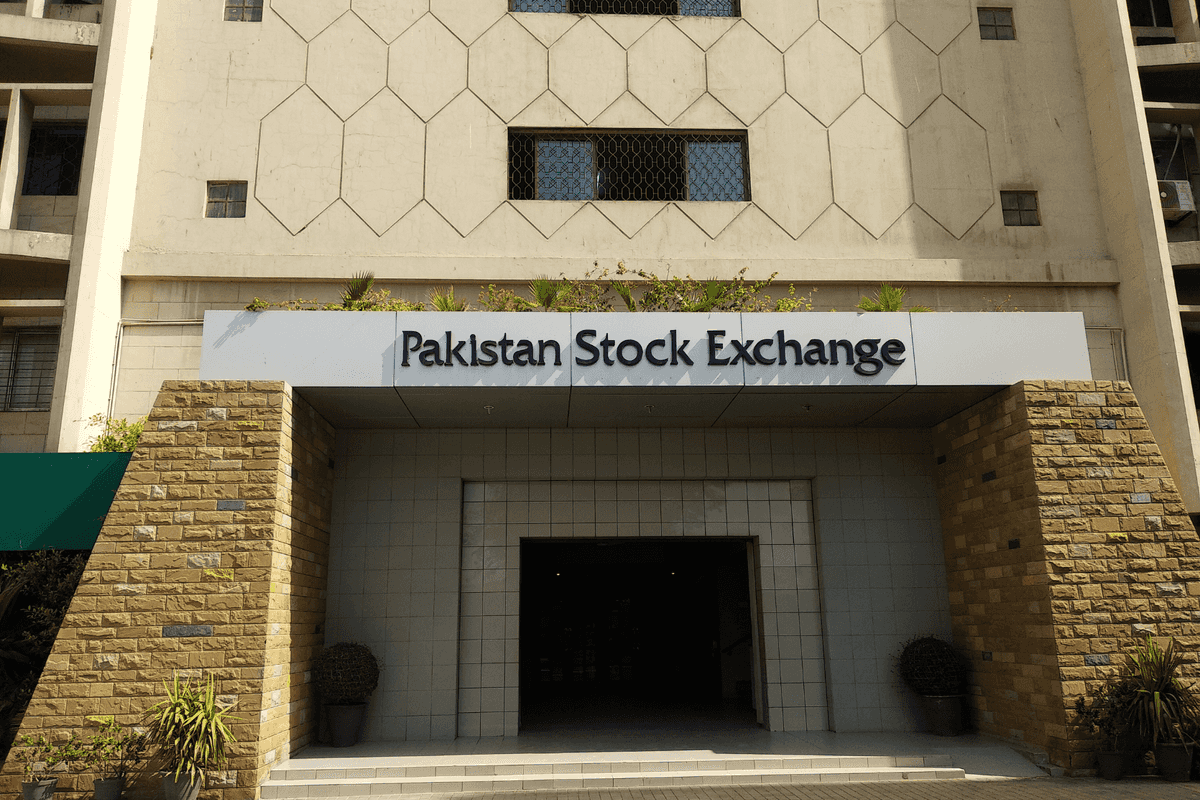
Investors in the Pakistan Stock Exchange (PSX) are optimistic that momentum will return to the market, which fell 8.7% in February – the sharpest decline since the COVID-19 pandemic.
“As uncertainty gradually subsides, we believe the KSE-100 index is likely to regain momentum in the coming weeks,” brokerage house Insight Securities said in a note to clients.
The uncertainties he was referring to included escalating security concerns, geopolitical tensions, and domestic political noise, which triggered broad-based profit-taking in February.
The benchmark KSE-100 Index fell 16,112 points during the month to close at 168,062, marking an 8.7% month-on-month decline. Last time the market was in such a freefall was in March 2020, it plunged 26% after the onset of the COVID-19 pandemic.
Analysts said the sell-off was fueled by rising security concerns in Balochistan, fears of a potential U.S.–Iran conflict, foreign selling pressure, weaker-than-expected corporate earnings and uncertainty surrounding the Reko Diq mining project.
The downturn came as the market was trading at all-time highs, prompting investors to lock in gains.
“February has historically been the weakest month for the KSE-100, and the recent correction aligns with that seasonal pattern,” Insight Securities said in its note to clients.
“Given the relatively stable macroeconomic backdrop and attractive valuations in select blue chips, we view the recent decline as profit-taking rather than a structural shift in fundamentals.”
Historical data from 2010 to 2026 show the index delivered negative returns in 10 out of 17 Februarys. August ranks as the second-weakest month, with nine negative returns in 16 instances.
Still, Insight Securities said, forward returns have typically been constructive: since 2010, the KSE-100 has gained an average 4.6% over the subsequent three months and 6.9% over six months following February.
There have been notable exceptions. In 2011, 2018, 2019 and 2022, six-month forward returns after February remained negative, coinciding with periods of heightened macroeconomic stress. In fiscal years 2018, 2019 and 2022, Pakistan’s combined twin deficits — fiscal and current account gaps — stood at 11.1%, 12.0% and 12.5% of GDP, respectively, well above the 16-year average of about 8%.
In contrast, analysts say the current outlook appears more stable.
“The external account remains manageable, supported by resilient remittance inflows, while fiscal discipline under the IMF program is expected to continue,” Arif Habib Limited said in its monthly review. The firm estimates the combined twin deficit for fiscal year 2026 at roughly 5.2% of GDP.
Macroeconomic indicators offered mixed signals. Consumer price inflation rose 5.8% year-on-year in January, slightly up from 5.6% in December. Pakistan recorded a current account surplus of $121 million in January, reversing deficits of $393 million a year earlier and $265 million in December. For the first seven months of fiscal 2026, however, the country posted a cumulative current account deficit of $1.07 billion, compared with a surplus of $564 million in the same period last year.
Workers’ remittances rose 15% year-on-year to $3.5 billion in January, though they declined 4% from December. Cumulatively, remittances increased 11% year-on-year to $23.2 billion in the first seven months of the fiscal year.
Market activity also slowed down sharply. Average daily traded volume fell 29% to 770 million shares in February, while average traded value dropped 37% to $141 million.
Moody’s revised Pakistan’s banking sector outlook to “stable” from “positive,” citing gradual improvement in macroeconomic indicators and the operating environment. Meanwhile, the National Clearing Company of Pakistan Ltd., in collaboration with the Central Depository Company, Pakistan Stock Exchange and the Securities and Exchange Commission of Pakistan, transitioned the capital market settlement cycle from T+2 to T+1 on Feb. 9.
A report by Arif Habib Ltd. said the sectors that contributed negatively to the index in February were banks (-4,146 points), E&P (-3,011 points), technology (-1,078 points) and oil and gas marketing companies (-923 points).
Scrip-wise negative contributors during the month were UBL (-1,400 points), PPL (-1,329 points), FFC (-1,041 points), LUCK (-893 points), and OGDC (-885 points).
Scrip-wise positive contributors were ENGROH (309 points), THALL (71 points), HMB (59 points), POL (57 points) and KEL (52 points).
Foreign buying was observed in the Asia-Pacific region in February, led by Taiwan (USD 10,267 million), followed by India (USD 2,702 million) and Thailand (USD 1,581 million).
On the domestic stock exchange, foreign selling activity of USD 279 million was reported in February. The outflows were predominantly in cement (-USD 228.7 million), technology (-USD 13.5 million) & E&Ps (-USD 8.5 million).




Comments
See what people are discussing