

Iran's Revolutionary Guards seize wartime power as Mojtaba Khamenei's role narrows: report
IRGC has filled the power vacuum left by Ali Khamenei's death, with his son Mojtaba largely endorsing decisions rather than directing them

News Desk
The News Desk provides timely and factual coverage of national and international events, with an emphasis on accuracy and clarity.
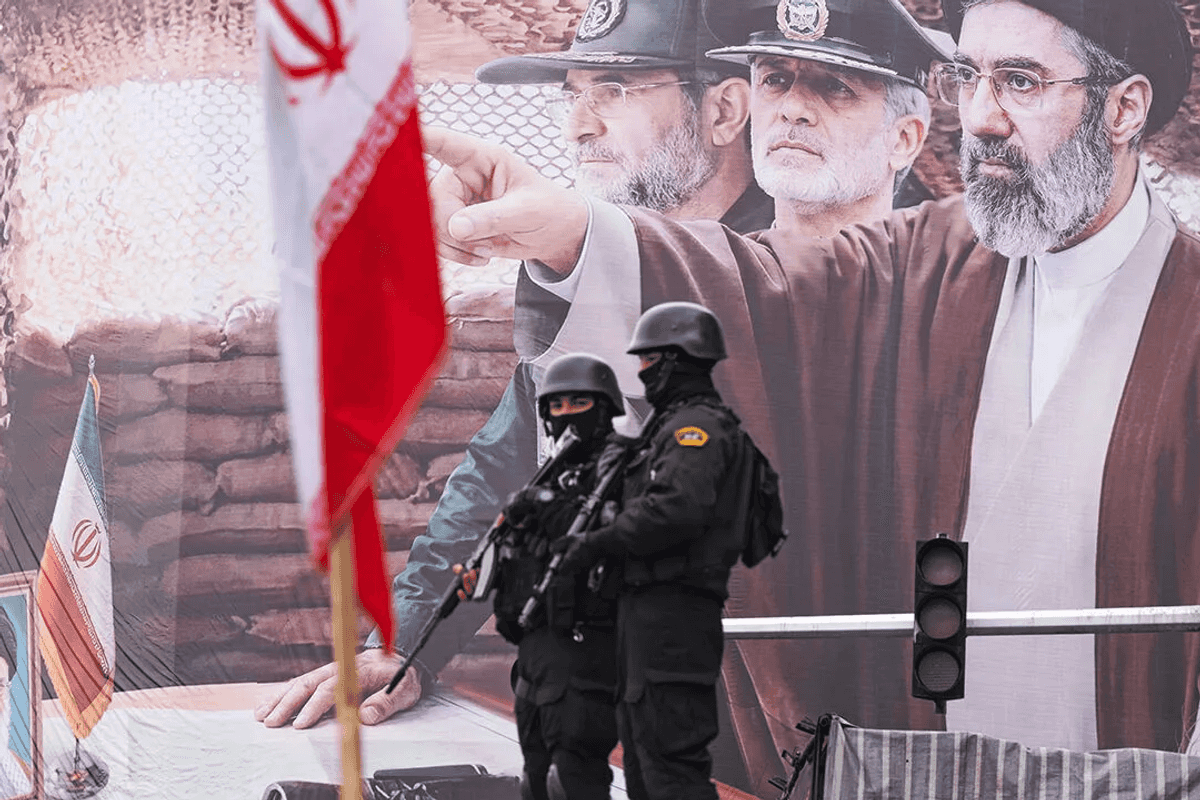
Mojtaba Khamenei communicates indirectly through IRGC intermediaries due to security constraints, according to people close to his circle.
AFP/File
Two months into the war with the U.S. and Israel, real authority inside Iran has shifted away from the supreme leader's office and toward the Islamic Revolutionary Guard Corps, according to Iranian officials and people familiar with internal deliberations, Reuters reported.
The killing of Ali Khamenei on the first day of the war and the elevation of his injured son Mojtaba have left a vacuum that the IRGC has moved to fill. The shift may be hardening Tehran's stance as it weighs renewed talks with Washington.
Who holds power in Iran now that Ali Khamenei is dead?
The IRGC, together with the Supreme National Security Council, now dominates both battlefield strategy and key political decisions. Mojtaba Khamenei holds the formal position of supreme leader but sources say his role has shifted toward endorsing decisions already shaped by military commanders.
He has not appeared publicly since being severely injured in the initial strikes that also killed his father and relatives.
How has the IRGC consolidated control during the Iran war?
Since the Islamic Republic's founding, ultimate authority rested with a supreme leader whose word settled disputes across state institutions. That structure has fractured under wartime conditions, with power concentrating in a narrower inner circle anchored in the Supreme National Security Council, the supreme leader's office and the IRGC.
Mojtaba Khamenei communicates indirectly through IRGC intermediaries due to security constraints, according to people close to his circle.
A senior Pakistani official involved in mediation efforts between Iran and the United States described a fragmented and slow-moving decision-making process in Tehran. Responses to diplomatic initiatives can take days due to the absence of a clear central command structure.
On the security side, IRGC commander Ahmad Vahidi has emerged as a central figure in wartime coordination, including during the period when a ceasefire was announced.
Iran's diplomatic channel has been led publicly by Foreign Minister Abbas Araqchi, alongside parliamentary speaker Mohammad Baqer Qalibaf, a former IRGC commander who has become a key link between Iran's political and security establishment. Iranian officials have previously denied divisions over negotiations with the United States. Iran's foreign ministry did not immediately respond to a request for comment.
How does the IRGC power shift affect Iran's nuclear talks with the US?
Analysts say the main obstacle to progress in talks is not internal rivalry but a widening gap between Washington's demands and what Iran's military establishment will accept. Iran submitted a proposal envisioning phased negotiations in which nuclear discussions would be postponed until after the war, with maritime disputes in the Gulf addressed first.
The United States rejected that sequencing, insisting the nuclear issue must be tackled immediately.
Former U.S. diplomat and Iran analyst Alan Eyre said neither side appears ready to compromise, with each believing time is working in its favor.
Iran is relying on its leverage over the Strait of Hormuz, while Washington is applying economic pressure and military containment. Former U.S. negotiator Aaron David Miller said Iran's system has effectively transitioned from clerical primacy to security dominance.
What does the IRGC's rise mean for Iran's political future?
Analysts describe the IRGC as increasingly dominant in both foreign and domestic policy, driven by a revolutionary ideology that prioritizes regime survival, deterrence abroad and strict internal control.
Hardline figures, including former nuclear negotiator Saeed Jalili, have become more vocal during the war but lack the institutional leverage to shape outcomes. Sources say Mojtaba's elevation itself reflects IRGC backing after pragmatist factions were sidelined.
Middle East Institute fellow Alex Vatanka said decision-making has consolidated around collective security institutions rather than a single leader. Iranian analyst Arash Azizi said key agreements would still pass through Mojtaba but not override the National Security Council or IRGC command structure.
Despite nearly nine weeks of sustained conflict and external pressure, analysts say Iran has shown no signs of systemic fracture or political collapse, with a strategic consensus emerging to avoid full escalation, maintain leverage over Hormuz, and emerge from the conflict in a stronger position.


Comments
See what people are discussing