

Iran says US cannot portray itself as victim while waging war
Iran accuses US of aggression at the UN, demanding an end to the war and the naval blockade while warning of an immediate response to any new attack

News Desk
The News Desk provides timely and factual coverage of national and international events, with an emphasis on accuracy and clarity.
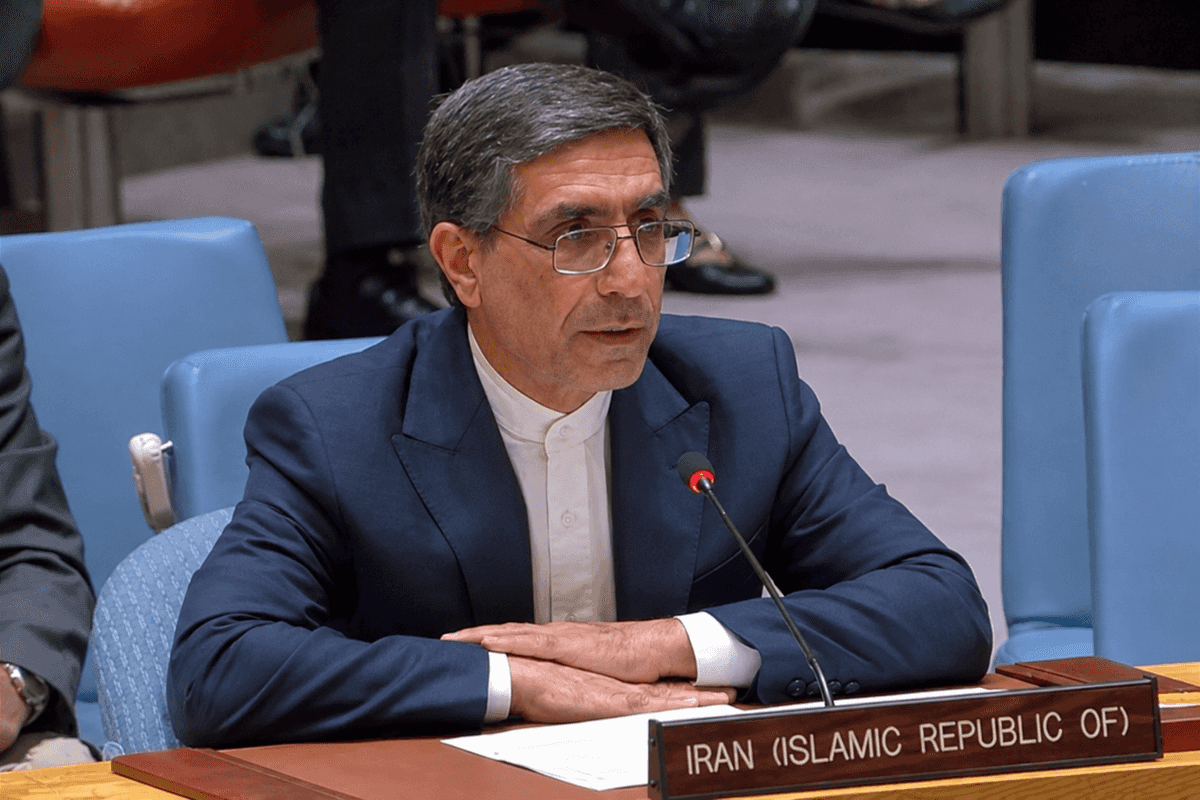
File photo of Iran’s UN ambassador Gholamhossein Darzi.
WANA News Agency
Iran’s UN ambassador Gholamhossein Darzi accused the United States of aggression at a Security Council meeting on Friday, demanding Washington end its military campaign and lift its naval blockade. He said tensions around the Strait of Hormuz cannot ease while those measures continue, Press TV reported.
Why does Iran accuse the US of aggression?
Darzi said the current crisis traces back to US and Israeli attacks on Iran on June 13, 2025, and February 28, 2026, which he called unprovoked. He argued the United States is the aggressor rather than the victim, and condemned the killing of Supreme Leader Ayatollah Seyyed Ali Khamenei, senior officials and nuclear scientists.
Darzi said the US-Israeli bombing campaigns had killed more than 5,000 people, including 254 children and 251 women. He cited a Tomahawk missile strike on a school in Minab that, by his account, killed 168 children. He also pointed to an attack on a stadium in Lamerd that claimed at least 21 civilian lives.
He criticised US Secretary of War Pete Hegseth over his reported declaration of “no quarter, no mercy”, arguing it violated international humanitarian law. Darzi also condemned US President Donald Trump’s threats to destroy Iranian civilian infrastructure, including bridges and power plants.
What conditions did Iran set for easing Hormuz tensions?
Darzi said insecurity in the Strait of Hormuz is a consequence of US military actions, its naval blockade and other measures against Iran. He argued Washington cannot target Iranian territory and civilian infrastructure while expecting maritime traffic through the waterway to return to normal.
Iran has remained open to negotiations and engaged in good faith over the past two years, he said, but Washington repeatedly chose military action over dialogue. Any settlement would require the United States to end its operations unconditionally, give guarantees against further attacks, respect Iran’s sovereignty and lift the naval blockade and other unilateral measures.
He also warned that any renewed US-Israeli military campaign would prompt an immediate response from Iran. Tehran, he said, would target the source of any aggression.
What did Iran say about Resolution 2817 and Gulf states?
Darzi rejected UN Security Council Resolution 2817 (2026), describing it as politically motivated. He accused the Council of undermining Iran’s right to self-defense under Article 51 of the UN Charter.
He also criticized Bahrain and other members of the Gulf Cooperation Council (GCC), alleging that some regional states had facilitated US and Israeli military operations by allowing the use of their territory, airspace and military bases. He said those countries should be held internationally responsible and compensate Iran for material and moral damages.



Comments
See what people are discussing