

Karachi’s unfinished megaprojects become symbol of decades of delays and rising costs
Kamran Khan says stalled infrastructure schemes have left Pakistan’s largest city struggling

News Desk
The News Desk provides timely and factual coverage of national and international events, with an emphasis on accuracy and clarity.
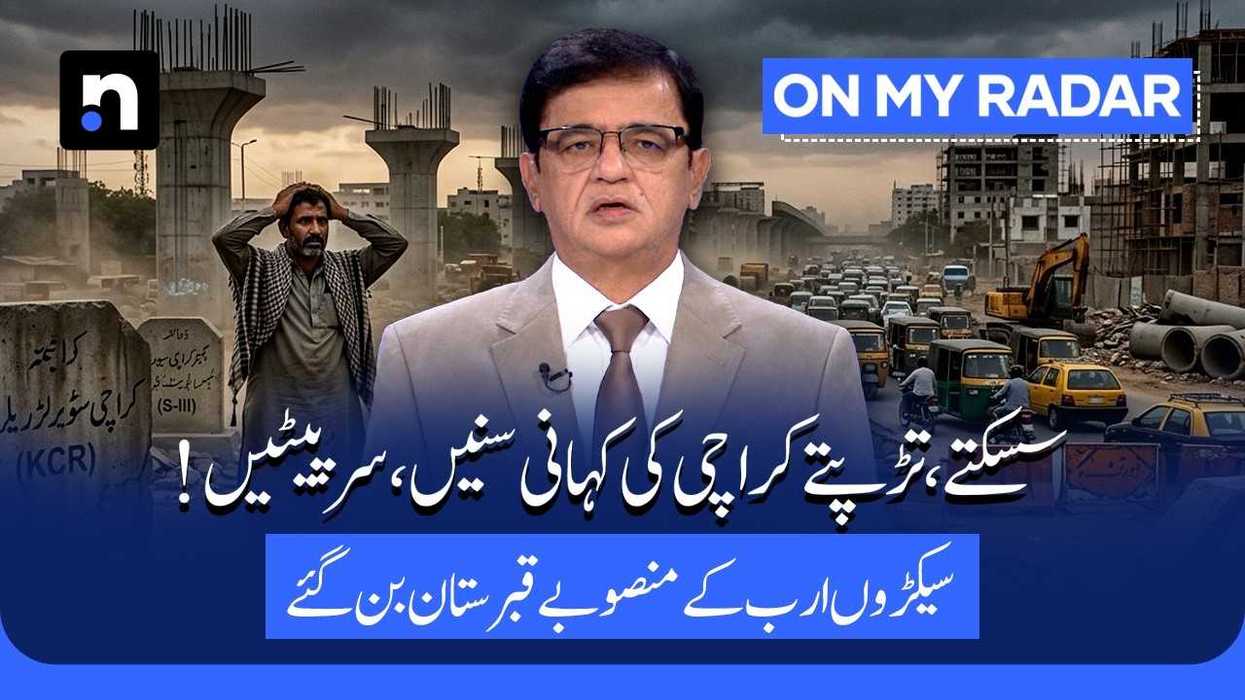
Karachi has become a graveyard of unfinished infrastructure projects despite hundreds of billions of rupees being spent over the past two decades, according to an analysis presented by Kamran Khan, who argued that repeated delays, cost overruns and governance failures have deprived residents of basic services in Pakistan’s largest city.
In the latest episode of his program "On My Radar," Khan described Karachi as a city that contributes about 60% of Pakistan’s tax revenues but continues to suffer from shortages of clean drinking water, inadequate public transportation, poor waste management, deteriorating roads and limited public safety infrastructure.
He said the city was littered with incomplete development schemes that had consumed vast public funds without delivering meaningful benefits to residents.
“If a patient is left on an operating table with an open wound, eventually that patient dies,” Khan said, comparing Karachi’s stalled projects to abandoned operations. “That is the condition of these projects.”
Among the most prominent examples cited was the K-IV water supply project, launched 24 years ago to provide Karachi with 260 million gallons of water per day. Khan said the project had missed dozens of deadlines, while its estimated cost had risen from 25 billion rupees ($89 million) to 250 billion rupees ($890 million), yet it remains incomplete.
He also highlighted the S-3 sewage treatment project, part of the Greater Karachi Sewerage Plan. The project was launched after Pakistan’s Supreme Court took notice of untreated sewage and industrial waste being discharged into the Arabian Sea.
Initially budgeted at 8 billion rupees ($28 million), the project was intended to treat 460 million gallons of wastewater daily. Khan said that nearly two decades later, the scheme remains unfinished and its cost has climbed to 36 billion rupees ($128 million).
Khan said the provincial government had blamed funding shortages from the federal government for the delays, a claim repeatedly made by officials of the ruling Pakistan Peoples Party (PPP).
The revival of the Karachi Circular Railway, another long-promised transport project, was also cited as an example of unmet commitments. Authorities announced plans to restore the railway after Supreme Court intervention and briefly resumed limited train operations in 2020.
PPP Chairman Bilawal Bhutto-Zardari had previously described the railway’s restoration as a personal mission and a vision associated with his late mother, former Prime Minister Benazir Bhutto. In 2022, officials pledged to complete the project by 2025 at a cost of 294 billion rupees ($1.04 billion), but Khan said little progress has since been visible.
The city's Safe City surveillance project has faced similar setbacks. First proposed in 2009, the initiative envisioned the installation of 10,000 security cameras across Karachi.
Despite repeated announcements, Supreme Court directives and multiple planning exercises, Khan said the project failed to advance significantly. In 2024, the Sindh government launched a revised plan worth 35 billion rupees ($124 million) to install 12,000 cameras.
By June 2026, however, only about 1,300 cameras had been installed, covering roughly 8% of the city, according to Khan. He said Karachi ultimately requires around 60,000 cameras to establish a comprehensive surveillance network.
One of the most visible examples of public frustration is the Red Line Bus Rapid Transit project along University Road, one of Karachi’s busiest corridors.
Construction began in 2019 with an estimated cost of 140 billion rupees ($498 million), later rising to 170 billion rupees ($605 million). Originally scheduled for completion in 2024, the project's deadline was pushed to 2026 and is now being discussed for completion in 2028.
Khan said prolonged construction had left commuters facing traffic congestion, damaged roads and dust-filled journeys for years.
As criticism intensified, Sindh Chief Minister Murad Ali Shah publicly apologized to residents and announced that reconstruction of University Road would be handed over to the military-run Frontier Works Organization (FWO).
Meanwhile, the broader Red Line project encountered technical and financial challenges. Khan said the project’s design and construction quality came under scrutiny, while the funding agency, the Asian Development Bank, reportedly classified it as a "project at risk" and eventually declined further funding over construction concerns.
The Sindh government attributed the problems to contractors, while former contractors blamed provincial authorities for mismanagement and poor oversight.
Another BRT initiative, the Yellow Line project, has also faced allegations of corruption. Khan said the $439 million project, launched in 2019 and initially scheduled for completion in 2026, has achieved only about 20% progress.
A new completion target of 2029 is now being discussed. According to Khan, a chief minister’s inspection team found evidence of alleged illegal payments totaling 8.5 billion rupees ($30 million) to contractors.
Khan concluded that Karachi’s growing list of delayed and unfinished projects has become a symbol of governance failures that continue to affect millions of residents, while the future of many of the schemes remains uncertain.



Comments
See what people are discussing