

Middle East war shakes global economy, aviation and energy supply
Kamran Khan says Tehran’s leadership change may shape region’s next phase of crisis

News Desk
The News Desk provides timely and factual coverage of national and international events, with an emphasis on accuracy and clarity.
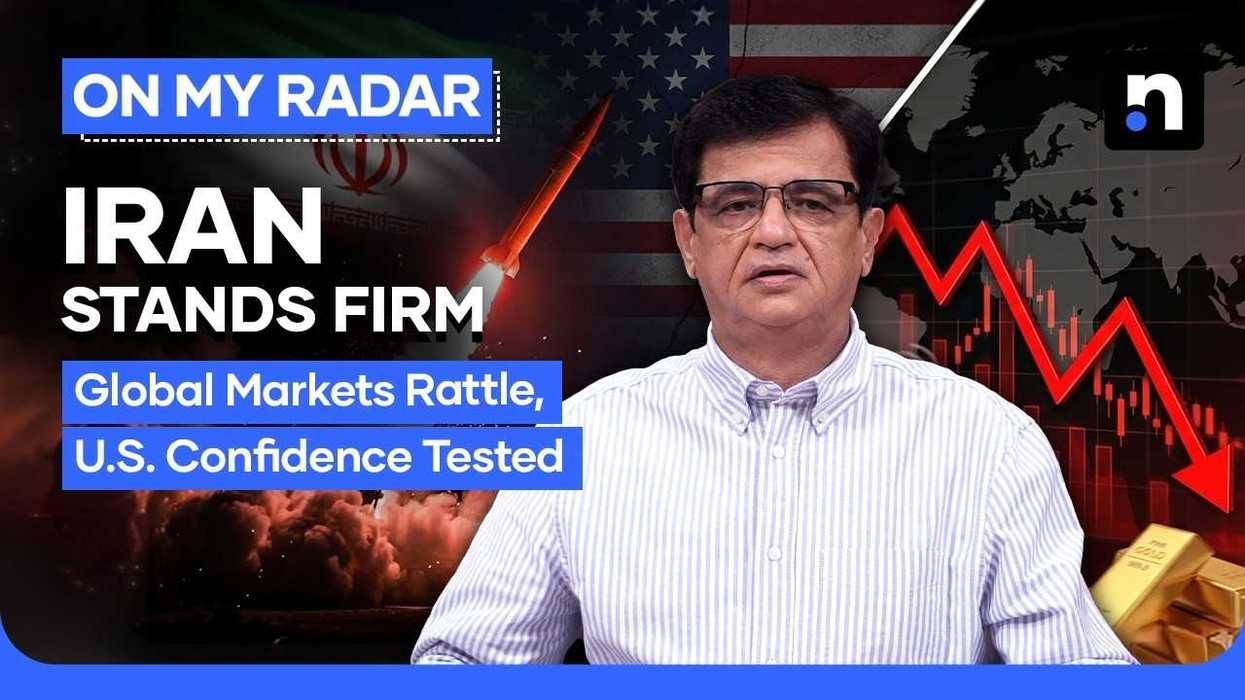
A devastating war involving the United States, Israel, and Iran entered its third day on Monday, sending shock waves through global markets and raising fears of a prolonged regional conflict with worldwide economic consequences.
Speaking on the latest episode of “On My Radar,” Kamran Khan said the scale of Iran’s military and public resistance has surprised analysts who had predicted Tehran would falter within days.
In a later discussion with Lt. Gen. (retd) Khalid Naeem Lodhi, former defense secretary, and Shamshad Ahmed Khan, former foreign secretary, Kamran Khan said the conflict has already moved beyond a regional confrontation and is now reshaping global financial and diplomatic calculations.
Oil prices surged sharply as markets reacted to the intensifying hostilities. At one point, global crude prices rose by as much as 13%, with Brent crude climbing above $82 per barrel. Gold gained 2.6%, reflecting investor flight to safety. European gas prices jumped 25%, while stock markets across the United States, Europe, and Asia came under sustained pressure.
In the Gulf, the economic fallout was immediate. The United Arab Emirates and Kuwait temporarily suspended trading on their stock exchanges amid extraordinary volatility. Pakistan’s stock market recorded what analysts described as its worst crash in history. The benchmark KSE-100 index plunged 9%, forcing a one-hour trading halt. By the end of the session, the market had shed more than 16,000 points, the largest single-day drop on record, exceeding declines seen even during past military standoffs with India.
Global air travel was also severely disrupted. Major airports in Dubai, Abu Dhabi, Qatar, and Kuwait were effectively closed as thousands of flights were canceled or rerouted. The aviation sector faced cascading delays as airspace restrictions expanded across the region.
Energy infrastructure became a direct target. A refinery owned by Saudi Aramco in Saudi Arabia was struck by what officials described as Iranian-launched drones, igniting a large fire in part of the facility. The refinery is considered one of the kingdom’s largest installations, and the disruption raised urgent questions about global oil supply stability.
On the battlefield, tensions escalated further following reports of the death of Iran’s Supreme Leader, Ayatollah Ali Khamenei. Iranian forces reportedly targeted U.S. assets in the Gulf. Explosions were reported in Bahrain, the UAE, Kuwait, and Qatar. Iran claimed it shot down a U.S. F-15 fighter jet in Kuwait, while Kuwaiti authorities confirmed that multiple U.S. aircraft crashed, though crews were reported safe. Tehran also claimed it targeted the U.S. aircraft carrier USS Abraham Lincoln with ballistic missiles.
Iranian retaliatory strikes on Israel reportedly killed nine people. Meanwhile, President Donald Trump said U.S. military operations against Iran could continue for four to five weeks. He also indicated he had “three strong options” regarding Iran’s leadership but suggested sanctions relief could be considered if new Iranian authorities cooperated.
Diplomatic channels appeared uncertain. The Wall Street Journal reported that Ali Larijani, Iran’s senior security official, was attempting to reopen nuclear negotiations with Washington through Omani mediators. However, Larijani publicly denied on social media that any talks with the United States were underway.
Iran now faces a critical internal challenge: selecting a successor to Khamenei. Western media reports suggest Ali Larijani, secretary of Iran’s Supreme National Security Council, is a leading contender. According to The New York Times, Khamenei had entrusted Larijani with ensuring institutional continuity in the event of military escalation or an assassination attempt.
Under Iran’s constitution, an interim council composed of the president, the judiciary chief, and a senior cleric from the Guardian Council oversees affairs after a supreme leader’s death. But amid direct confrontation with Israel and U.S. strikes, the Supreme National Security Council has emerged as the nerve center of decision-making, enhancing Larijani’s influence.
The Economist reported that in recent years, Larijani often represented Khamenei directly in dealings with Russia, China and Arab monarchies, sometimes bypassing President Masoud Pezeshkian. He reportedly traveled to Oman before recent negotiations to outline Tehran’s conditions. Western diplomats have long described Larijani as a pragmatic figure capable of balancing clerical, military, and economic factions, though critics argue he represents continuity rather than reform.
The ultimate decision rests with Iran’s Assembly of Experts, which is tasked with selecting the next supreme leader. Historically, the body has favored consensus candidates capable of bridging internal divides during crises.
For now, the fighting shows no sign of slowing. Across Iran, large crowds have gathered to mourn Khamenei, signaling strong public emotion and defiance. Predictions that Tehran would quickly capitulate appear premature.


Comments
See what people are discussing