

Millions join Khamenei funeral as Tehran hosts massive mourning procession
Kamran Khan says Iran has turned Ayatollah Ali Khamenei's funeral into a political, diplomatic and military message

News Desk
The News Desk provides timely and factual coverage of national and international events, with an emphasis on accuracy and clarity.
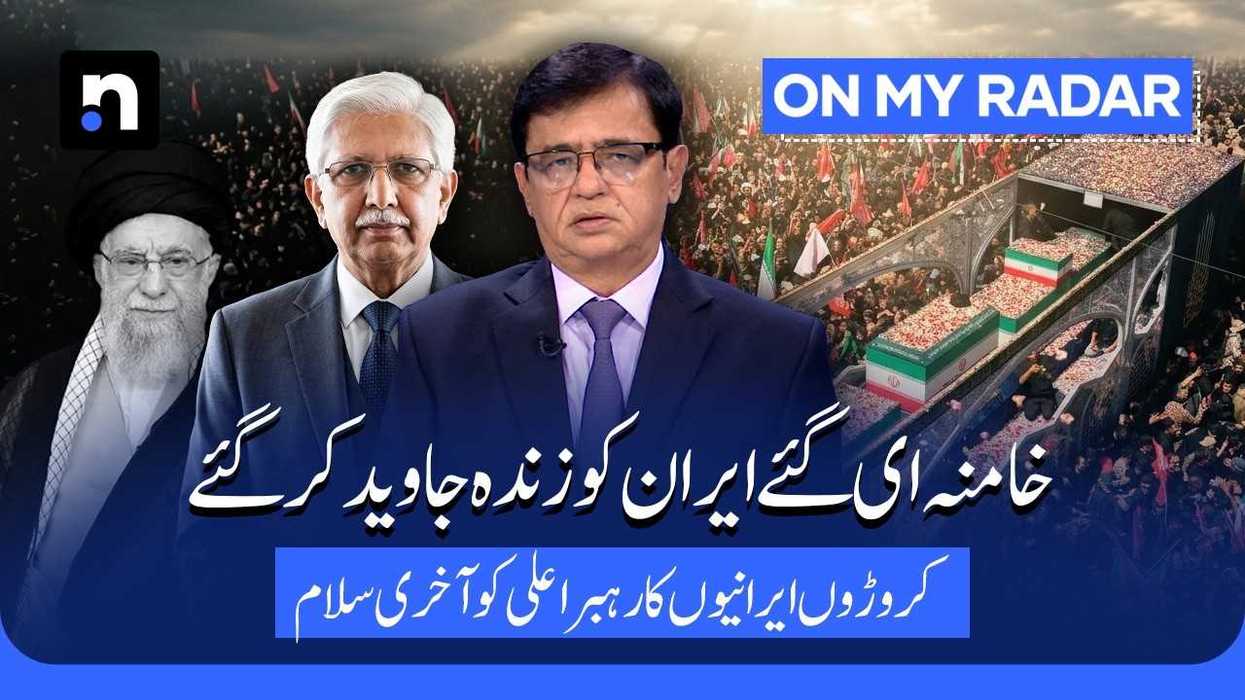
Iran says millions of people have taken to the streets to mourn Supreme Leader Ayatollah Ali Khamenei, with authorities describing the funeral as the largest state funeral in the country's history and estimating that up to 20 million people will participate during the weeklong ceremonies.
Speaking on his program On My Radar, Kamran Khan said the funeral had become more than a mourning event, calling it "a political, diplomatic and military message" aimed at Iran's allies and rivals alike.
The fourth day of funeral ceremonies was underway Monday after the processions began Friday. The official mourning events are scheduled to continue through July 9.
Tehran has drawn millions of mourners from across Iran, while dozens of foreign delegations have also arrived to attend the ceremonies. Streets across the capital are lined with portraits of Khamenei, Iranian flags and red flags that symbolize revenge.
A 12-hour funeral procession began Monday at Imam Khomeini Square after thousands of mourners sang Iran's national anthem together. The procession then moved through Tehran's main roads, which were packed with people dressed in black.
Before the public ceremonies began, Khamenei's coffin was placed Friday inside Imam Khomeini Grand Mosalla, where Iran's leadership and foreign delegations paid their respects. On Saturday, the coffin was transferred into a protective glass enclosure for public viewing, marking the start of a three-day public farewell attended by large crowds from across the country.
During the ceremonies, three of Khamenei's sons were seen praying near their father's coffin. However, Mojtaba Khamenei, widely viewed as the new supreme leader and Khamenei's successor, has not appeared publicly.
According to Iranian sources cited on the program, Mojtaba Khamenei was injured in the Feb. 28 attack, and no new photographs or videos of him have been released since then.
As the funeral procession advanced, crowds at Imam Khomeini Grand Mosalla and surrounding areas chanted "Death to America."
According to the program, mourners delivered two central messages: that Iran's resistance against its enemies would continue and that revenge would be taken for the slain leader.
More than 70 countries sent delegations to Friday's official state memorial before the public funeral. Most representatives came from the Middle East, Asia and countries allied with Iran, while Western participation was minimal.
Kamran Khan said one of the most closely watched aspects of the ceremony was the recitation of different Quranic verses for each visiting foreign delegation. Iranian media described the selections as diplomatic messages rather than purely religious tradition.
For Pakistan's delegation, organizers recited Verse 80 of Surah Al-Isra. For Saudi Arabia's delegation, verses referring to the Battle of Badr were chosen, prompting discussion across Arab media.
The program also highlighted the reappearance of Brig. Gen. Ahmad Vahidi, a senior commander of Iran's Islamic Revolutionary Guard Corps, who returned to public view after several months. Kamran Khan described Vahidi as one of the central figures in Iran's current military and political strategy.
According to the announced schedule, the funeral convoy will travel to Qom on Tuesday. On Wednesday, the bodies of those killed will be taken to Iraq for public funeral ceremonies at the shrines of Imam Ali (AS) in Najaf and Imam Hussein (AS) and Hazrat Abbas in Karbala. Khamenei's body will then return to Mashhad on Thursday, where he will be buried in the courtyard of the Imam Reza (AS) shrine.
The episode also featured analysis from retired Air Vice Marshal Shehzad Chaudhry, a defense and security analyst.


Comments
See what people are discussing