

NATO steps back as US public support for Iran war erodes
Kamran Khan says NATO and key EU states decline support as Trump faces growing domestic pressure

News Desk
The News Desk provides timely and factual coverage of national and international events, with an emphasis on accuracy and clarity.
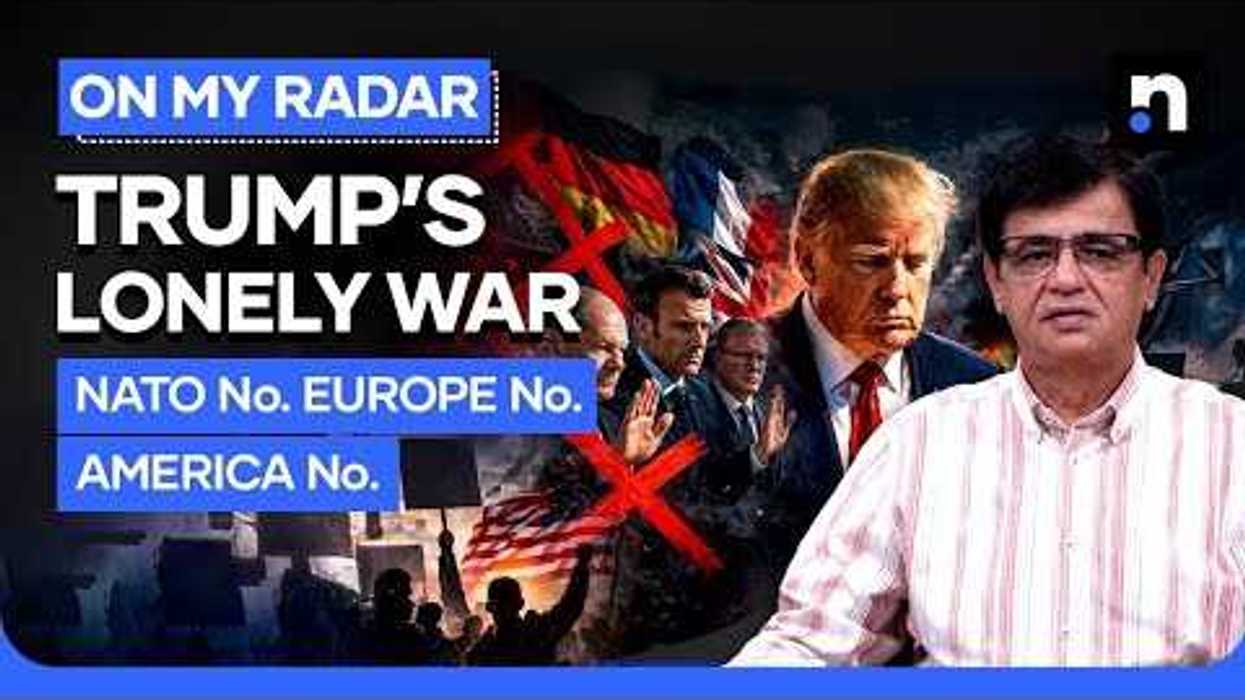
The war between the United States, Israel and Iran has entered its third week, with no clear end in sight, Kamran Khan said on his program “On My Radar.”
Khan said Washington and Tel Aviv appear determined to weaken Iran, but despite sustained strikes, Tehran is neither facing imminent defeat nor is the United States close to securing victory.
He described the conflict as having become a strategic burden for both the U.S. and Israel.
“The war against Iran has become a bone stuck in their throats,” Khan said, pointing to growing political and public pressure on President Donald Trump at home and abroad.
Declining support at home
Khan cited multiple surveys showing declining American support for the war.
According to the Pew Research Center and CNN, divisions within the United States have deepened while Washington’s global standing has weakened.
A PBS survey found that 56% of Americans oppose the war, while a CNN poll put opposition at 59%. A Reuters/Ipsos survey indicated widespread uncertainty among voters, reflecting what Khan described as eroding public confidence.
A separate CNN/SSRS poll found that 60% of Americans have little or no confidence in Trump’s decisions regarding Iran. Fifty-four percent said the strikes could make Iran more dangerous rather than weaken it.
Opposition extends to the potential deployment of ground troops. Nearly 75% of American voters oppose sending ground forces into Iran, while 54% said they would fully oppose the war if U.S. casualties continue to rise.
Thirteen American service members have been killed so far in the conflict, Khan said.
The political fallout intensified after Joe Kent, director of the National Counterterrorism Center, resigned in protest over the war. In his resignation, Kent claimed Iran did not pose an immediate threat to the United States and said the conflict was launched under pressure from Israel and its influential U.S. lobby.
Khan said Kent’s resignation dealt a severe blow to Trump’s narrative on Iran.
Political divisions widen
The war has also exposed sharp political divisions in Washington.
About 86% of Democrats and 61% of independent voters oppose the war, Khan said. Even among Republicans, signs of fatigue are emerging.
Support for Trump’s handling of Iran has declined by 9 percentage points compared with 2020 levels, when 88% backed his approach, according to data cited by Khan.
He said segments aligned with Trump’s “America First” philosophy are increasingly reluctant to support another prolonged Middle East conflict.
Allies step back
Internationally, Khan described NATO’s stance as the most significant diplomatic setback for Washington.
While NATO Secretary-General Mark Rutte initially praised U.S. action, he later clarified that the alliance is not part of the war and has no intention of joining it.
German Chancellor Friedrich Merz said the conflict in the Middle East is not NATO’s responsibility and rejected requests for naval support in the Strait of Hormuz. Germany will not participate in military action aimed at reopening the vital shipping lane, Khan said.
France has also ruled out aggressive military action in the Strait of Hormuz. According to Pew data cited by Khan, only 18% of Germans support U.S. strikes on Iran. In France, 64% believe American intervention has made the world less secure. In Britain, 69% oppose Trump’s operation.
European Union foreign policy chief Kaja Kallas said no country is willing to endanger its people in the Strait of Hormuz without clarity on the war’s objectives, Khan noted.
British Prime Minister Keir Starmer has also signaled that the United Kingdom will not join what he described as a wider war.
Trump reacted angrily to NATO’s refusal, saying in the Oval Office that the alliance was making “a very big mistake.” On social media, he described NATO as a “one way street” and questioned whether it would ever stand up for the United States.
Uncertain endgame
Khan said the United States now finds itself entangled in a major regional war while key allies step aside and public opposition grows at home.
He said Iran, despite suffering heavy damage, continues to resist, reshaping perceptions of power in the region.
The central question, Khan said, is how the 19-day conflict will end. He asked whether continued casualties among leaders and civilians could push Iran toward broader retaliation, or whether mounting domestic and allied pressure might compel Trump to wind down the war.
Global political observers, he added, are watching closely as the balance of power appears poised for potential realignment.




Comments
See what people are discussing