

Over 5,700 missing and USD4.78bn needed one month after deadly Nepal glacial mountain collapse
One month after a massive high-altitude rock and ice collapse on Langtang Lirung mountain triggered catastrophic floods along the Nepal-China border, Nepal is struggling with 1,451 confirmed deaths, thousands missing, severe power deficits, and a USD4.78 billion reconstruction bill

News Desk
The News Desk provides timely and factual coverage of national and international events, with an emphasis on accuracy and clarity.
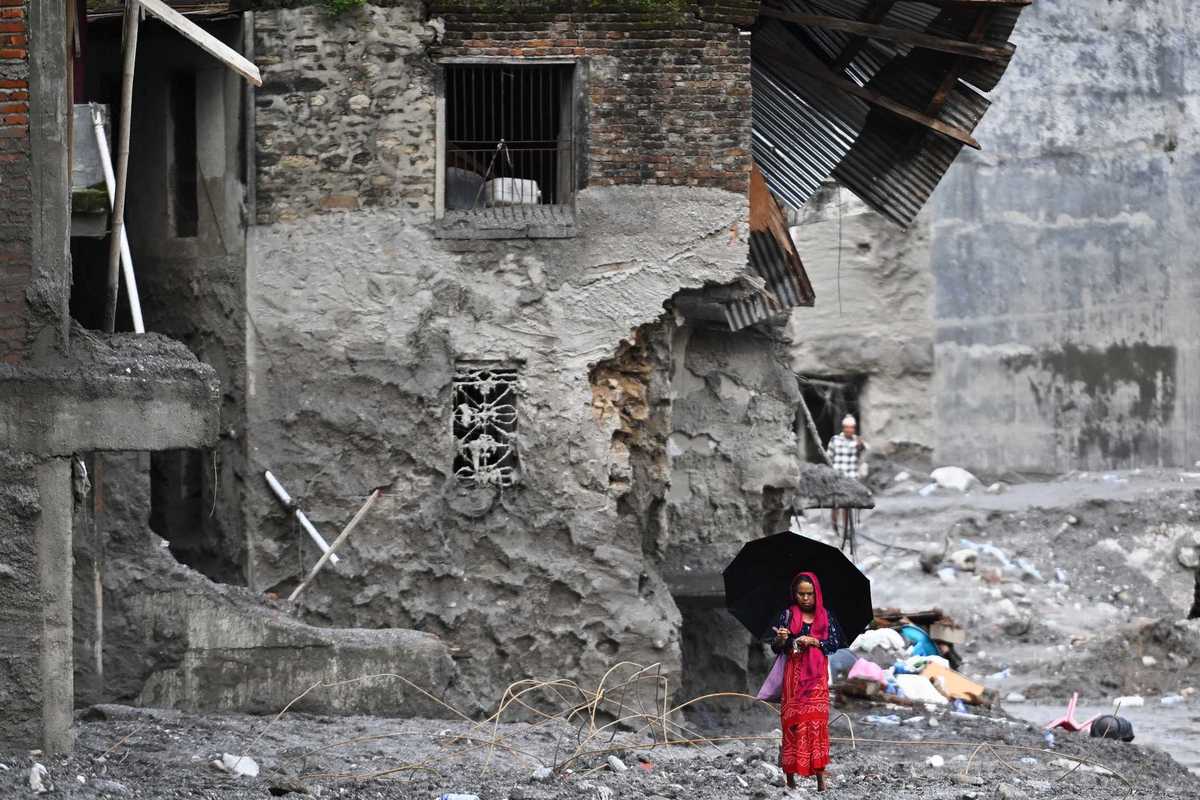
A woman walks among the ruins of flash floods in Nepal's Nuwakot district on September 1, 2026.
AFP
One month after a high-altitude glacial collapse on the China-Nepal border sent a torrent of rock, ice, and mud surging down mountain valleys, Nepal continues to face immense humanitarian and economic challenges.
The August 26 disaster—triggered when a massive section of Langtang Lirung mountain broke away—has left entire settlements erased, essential infrastructure destroyed, and thousands unaccounted for.
How did the Langtang Lirung mountain collapse and flood surge unfold?
On August 26 at 8:37 AM local time, a section of ice and rock over a kilometer wide broke away from the north face of Langtang Lirung at an altitude of approximately 5,200 meters. The mass plunged 800 meters onto a lower glacier, temporarily damming the Lhende River before bursting through and accelerating downhill.
According to geologists from the International Centre for Integrated Mountain Development (ICIMOD) and scientific analysis by the World Weather Attribution (WWA) group, the avalanche debris dropped 1,700 meters over a 20-kilometer distance to reach Rasuwagadhi in just seven minutes. Moving at average speeds exceeding 180 kilometers per hour, the surge acted like a high-speed projectile, obliterating border facilities, bridge crossings, and downstream communities.
What is the human toll, search effort, and economic impact in Nepal?
Disaster management authorities in Kathmandu confirm that 1,451 bodies have been recovered, while more than 5,700 people remain missing across affected river valleys. Missing persons include hundreds of workers swept away from regional hydropower construction sites, as well as foreign tourists and pilgrims. On the Chinese side of the border, state media reported 43 deaths and 519 missing.
Due to overwhelmed morgues and severe decomposition in thick mud deposits, authorities have recorded DNA samples before burying unidentified victims in mass graves. Search and rescue crews deployed via helicopter and cargo drones continue clearing debris, occasionally finding survivors—such as three tunnel workers rescued alive after ten days underground.
According to verified reporting by The Kathmandu Post and Anadolu Agency, Nepal estimates total reconstruction costs at $4.78 billion. The destruction of major facilities along the Trishuli River basin reduced Nepal’s national electricity generation capacity by 10 percent.
How are climate change and UN advocacy driving the recovery response?
Scientists studying the disaster emphasize that long-term climate warming severely weakened high-altitude slopes. Decades of accelerated glacier retreat and permafrost thawing in the Himalayas created the conditions for the massive slope failure.
With over 80,000 people directly affected and thousands remaining in temporary camps, the United Nations launched an urgent $50 million emergency appeal.
Nepal's Prime Minister Balendra Shah, addressing the 81st session of the UN General Assembly in New York, urged the international community to recognize the disaster as a consequence of global climate change and called for dedicated climate compensation and adaptation funding for vulnerable mountain nations.




Comments
See what people are discussing