

Pakistan budget offers tax relief as govt targets 4% economic growth
Kamran Khan says the budget focuses on growth, tax cuts and development spending

News Desk
The News Desk provides timely and factual coverage of national and international events, with an emphasis on accuracy and clarity.
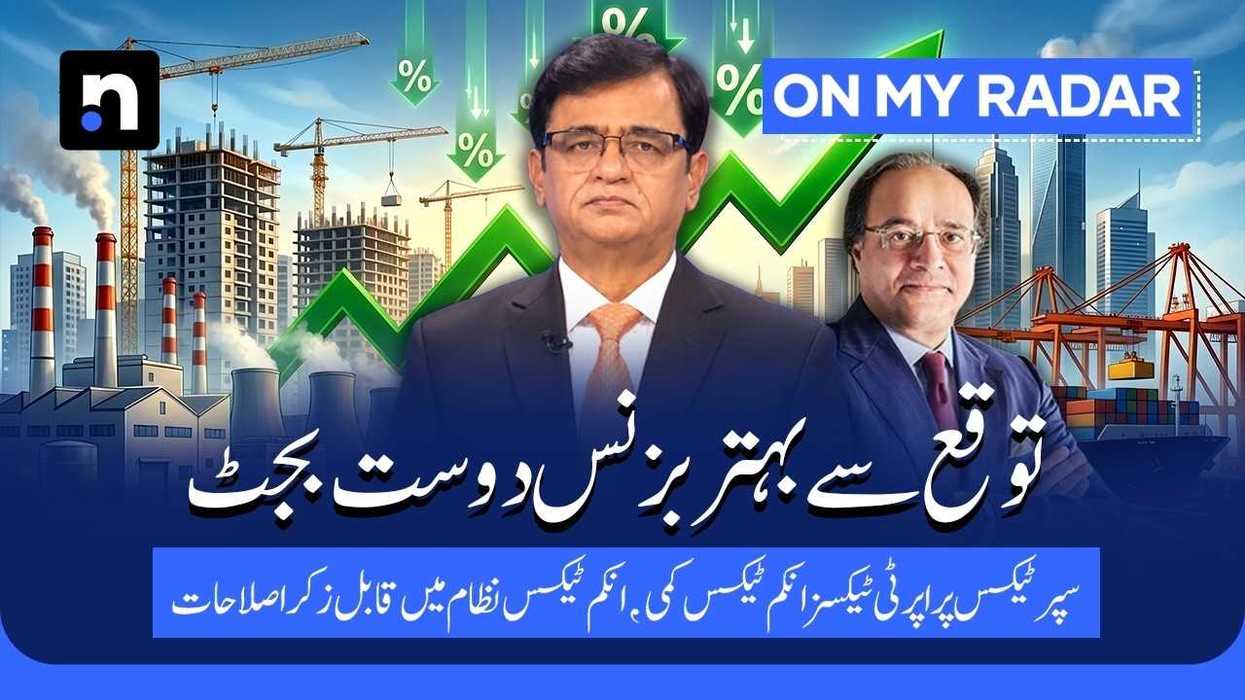
Pakistan's federal budget for the 2026-27 fiscal year aims to boost economic growth while providing tax relief to salaried workers, compliant businesses and the construction sector, according to an analysis presented by Kamran Khan on the latest episode of On My Radar.
Finance Minister Muhammad Aurangzeb unveiled the budget on Friday, marking the fifth consecutive federal budget presented under Prime Minister Shehbaz Sharif's government — a first in Pakistan's political history, Kamran Khan noted.
Calling it a budget that attempts to balance growth with fiscal discipline, Khan said the government had sought to ease the burden on taxpayers while maintaining ambitious revenue and development targets.
The federal budget has been set at 18.771 trillion Pakistani rupees ($66.8 billion). The government is targeting economic growth of 4% in the coming fiscal year after the economy expanded by an estimated 3.7% this year. Inflation has been projected at 8.2%.
The budget deficit is expected to stand at 3.6% of gross domestic product (GDP), while the government aims for a primary surplus equivalent to 2% of GDP.
Debt servicing will remain the single largest federal expense, with 8.054 trillion rupees allocated for repayments. Defense spending has been increased by 16% to 3 trillion rupees, while 8.848 trillion rupees will be transferred to provinces under the National Finance Commission (NFC) award.
The government has set a tax collection target of 15.264 trillion rupees for the Federal Board of Revenue, an 18% increase over the current fiscal year, alongside 5.336 trillion rupees in non-tax revenue. Exports are targeted at $32.9 billion.
Development spending also remains a key priority, with 1 trillion rupees allocated for the federal Public Sector Development Program and 2.218 trillion rupees earmarked for provincial annual development programs. Funding for the Benazir Income Support Program has been increased by more than 17% to 838 billion rupees.
"Overall, the budget focuses on growth, tax collection, development spending and social security, while debt servicing continues to consume the largest share of government resources," Khan said.
A central feature of the budget is tax relief for salaried workers. The government has proposed reducing income tax rates by 3% to 5% for salaried individuals earning between 2.2 million and 7 million rupees annually, while also abolishing the surcharge previously imposed on this category of taxpayers.
The budget also seeks to ease the tax burden on businesses. Super tax on six income slabs for companies earning between 150 million and 500 million rupees annually will be abolished, while the super tax rate for companies earning more than 500 million rupees will be reduced from 10% to 8%.
However, existing super tax rates will remain in place for banks, oil and gas exploration firms, and fertilizer companies.
In a move aimed at supporting exporters, the government has proposed reducing the combined advance and minimum tax on exports from 2% to 1.25% and allocated 88 billion rupees for the expansion of the Export Refinance Scheme.
The construction and real estate sectors, which have long sought tax reforms, are also set to benefit. The government has proposed cutting the withholding tax on property purchases for tax filers from 2.5% to 1.25%, while reducing the tax on property sales from 5.5% to 2.75%.
Additional relief measures include abolishing the capital value tax on overseas assets owned by Pakistanis, reducing withholding tax on international credit and debit card transactions, and scrapping the federal excise duty on business-class international air travel.
Khan also highlighted what he described as a significant breakthrough between the federal and provincial governments, saying Finance Minister Aurangzeb had announced that a consensus had been reached on an important matter related to the NFC framework, though further details were expected.
The episode also featured views from Arif Habib Group Chairman Arif Habib, Sustainable Development Policy Institute Executive Director Abid Qaiyum Suleri, former Commerce Minister Gohar Ejaz and tax expert Asif Haroon.





Comments
See what people are discussing