

Pakistan says 331 killed in Afghanistan as Operation Ghazab‑lil‑Haq continues
Pakistani forces destroy 104 Taliban posts, seize 22 and disable 163 tanks; Afghan Taliban say they are open to talks; US affirms Pakistan’s right to self-defense

News Desk
The News Desk provides timely and factual coverage of national and international events, with an emphasis on accuracy and clarity.
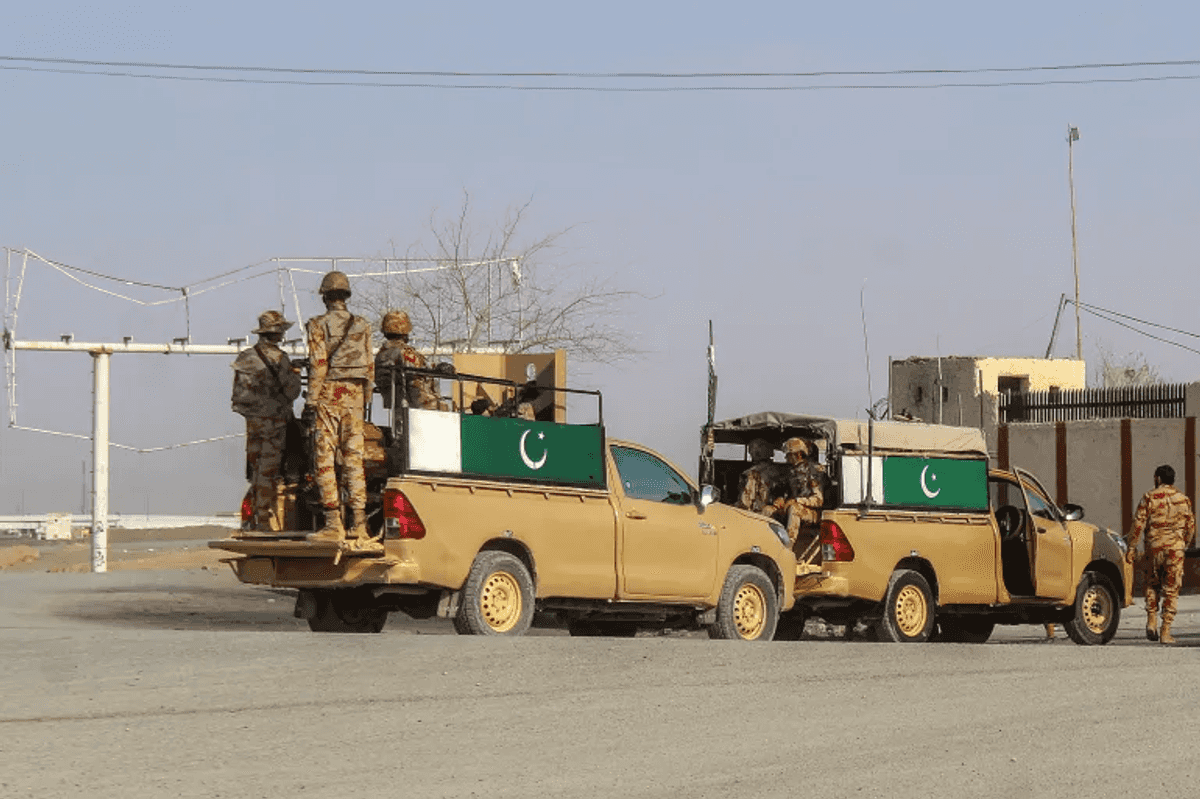
Pakistani soldiers patrol the Chaman border crossing in Balochistan on Feb. 27 after overnight cross-border fighting.
AFP
Pakistan said it had killed nearly 331 Afghan Taliban operatives in a major military operation launched after what it described as unprovoked cross-border attacks from Afghanistan, as regional and global powers urged restraint amid escalating tensions.
A government minister said the Operation Ghazab-lil-Haq, was launched late on Thursday following renewed clashes along the Pakistan-Afghanistan border. Information Minister Attaullah Tarar said Pakistani forces were carrying out what he called a “robust and proportionate” response to aggression from across the frontier.
Pakistan struck the Afghan capital, Kabul, the city of Kandahar where Taliban leaders are based, and other towns, marking the first direct attacks on Afghanistan’s government over allegations it harbors militants plotting against Islamabad.
In a statement posted on social media, Tarar said at least 331 Afghan Taliban and other militants had been killed so far, with more than 500 wounded. He said Pakistani forces destroyed 104 Taliban posts, seized 22 others and disabled 163 tanks and armored personnel carriers. Air strikes were carried out at 29 locations inside Afghanistan.
Operation Ghazb lil Haq
Update 0900 hours 28 Feb
✅*Summary of Afg Taliban losses*
▪️331 Killed,
▪️500 + Injured,
▪️104 Check posts destroyed,
▪️22 Post Captured,
▪️163 Tanks and Armed vehs Destroyed
▪️37 Locs across Afg eff tgt by air
— Attaullah Tarar (@TararAttaullah) February 28, 2026
Pakistani officials said the operation was aimed at armed groups aligned with the Afghan Taliban, whom Islamabad accuses of mounting repeated cross-border attacks.
The fighting continued overnight, with Pakistani ground and air forces pressing operations in multiple sectors. Security sources said the Pakistan Air Force struck brigade and battalion headquarters linked to Afghan Taliban forces in Nangarhar province. Pakistani troops also captured and demolished the New Afghan 8 post, while another position in the Noshki sector was destroyed, the sources said.
Afghan Taliban say open to talks
Afghanistan's Taliban rulers said they were willing to negotiate after Pakistan’s strikes, which they described as an escalation into “open war,” according to a Reuters report.
Zabihullah Mujahid, a Taliban spokesman, said the strikes caused civilian casualties but did not provide figures. “The Islamic Emirate of Afghanistan has always tried to resolve issues through dialogue, and now also we want to resolve this matter through dialogue,” he said.
Mujahid said Pakistani air strikes hit parts of Kabul, Kandahar, and Paktia on Thursday night, and on Paktia, Paktika, Khost, and Laghman on Friday.
The United States said it was closely monitoring the situation. Allison Hooker, the U.S. Under Secretary of State for Political Affairs, said she had spoken with Pakistan’s foreign secretary to offer condolences for lives lost in the fighting and reaffirm Washington’s support for Pakistan’s right to defend itself.
Spoke today with Pakistan Foreign Secretary Baloch to express condolences for lives lost in the recent conflict between Pakistan and the Taliban. We continue to monitor the situation closely and expressed support for Pakistan’s right to defend itself against Taliban attacks.
— Allison M. Hooker (@UnderSecStateP) February 27, 2026
Concern spread across the region as the clashes deepened. China said it was alarmed by the deteriorating security situation, with foreign ministry spokesperson Mao Ning saying Beijing was engaging through diplomatic channels and stood ready to help de-escalate tensions.
Russia called on both sides to halt hostilities immediately and seek a diplomatic solution, saying it would consider mediation if requested. Iran also offered to facilitate dialogue, with Foreign Minister Abbas Araghchi saying Tehran was prepared to support efforts to improve communication between the neighbours.
At the United Nations, Secretary-General Antonio Guterres is closely following developments, his spokesman said, expressing deep concern over the escalation and urging all parties to respect international law and protect civilians.
Clashes timeline
The latest escalation follows a series of tit-for-tat actions over the past year.
Last week, Pakistan carried out air strikes targeting camps of the Tehreek-e-Taliban Pakistan (TTP) and Islamic State Khorasan Province (ISKP) inside Afghanistan after a wave of attacks in Pakistan, including a suicide bombing in the capital, Islamabad. Pakistani security sources said more than 80 militants were killed in those strikes.
Islamabad has long maintained that TTP leaders operate from Afghan territory, an allegation that Kabul has repeatedly denied.
Tensions also surged after a series of explosions in Kabul on October 9 last year. Taliban forces subsequently targeted areas along Pakistan’s border, prompting Islamabad to respond with cross-border shelling. The exchanges caused casualties and infrastructure damage on both sides and led to the suspension of trade after border crossings were closed on October 12.


Comments
See what people are discussing