

Pakistan economy jolted as Iran-Israel war drives oil surge, market crash
Kamran Khan warns Iran-Israel war has rattled Pakistan’s fragile economy, pushing oil costs, inflation and markets into turmoil

News Desk
The News Desk provides timely and factual coverage of national and international events, with an emphasis on accuracy and clarity.
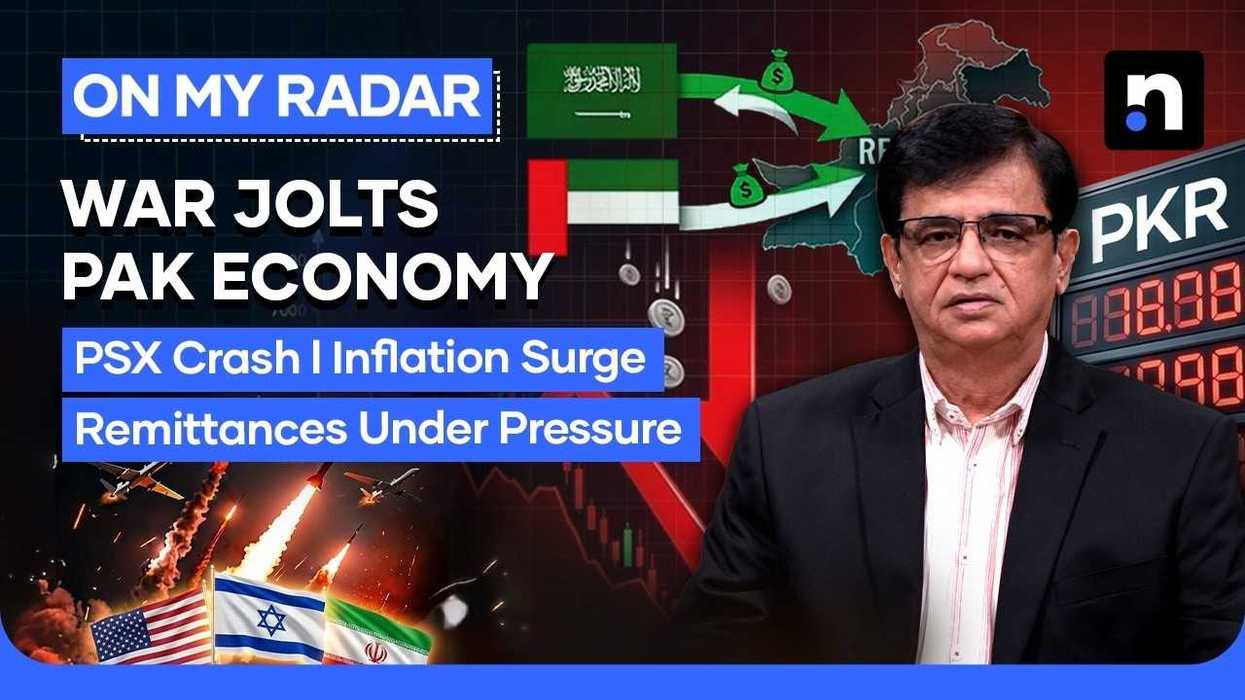
Pakistan’s fragile economic recovery has come under sudden pressure as the expanding war between the United States, Israel and Iran sends shockwaves through global energy markets and financial systems, according to Kamran Khan.
Speaking on his program “On My Radar,” Kamran Khan said the conflict has created a “major economic earthquake” that has shaken Pakistan’s economy at a moment when it was just beginning to emerge from a severe crisis.
Kamran Khan said the situation has become increasingly visible by the tenth day of the conflict, with Pakistan’s financial markets tumbling, the currency facing pressure and inflation risks returning.
The regional war has not only reshaped political dynamics in the Middle East but has also disrupted global oil markets, shipping routes and financial flows, he said.
During the past 10 days, the Pakistan Stock Exchange has experienced its second historic crash, while fuel prices have surged sharply and economic uncertainty has grown.
Despite the turbulence, Pakistan’s central bank decided not to increase interest rates, keeping the policy rate unchanged at 10.5 percent.
Kamran Khan said the most immediate economic threat for Pakistan comes from the surge in global oil prices.
Since the conflict began, Brent crude prices have climbed nearly 60 percent to around $117 per barrel and briefly touched $120, he said.
The increase has been driven largely by the closure of the Strait of Hormuz, one of the world’s most critical oil transit routes.
Nearly 20 percent of global oil supply passes through the strait, making any disruption there a major risk to global energy markets.
According to energy experts cited by Kamran Khan, every $10 increase in oil prices adds roughly $1.5 billion to $2 billion annually to Pakistan’s import bill.
With prices now roughly $25 to $30 higher than before the conflict, Pakistan’s annual oil import bill could increase by $4 billion to $6 billion.
Such a rise would place additional strain on the country’s current account balance and foreign exchange reserves.
The shock comes as Pakistan is already struggling with a large trade deficit.
In February, Pakistan recorded exports of about $2.3 billion while imports stood at roughly $5.3 billion, creating a monthly trade deficit of nearly $3 billion.
If global oil prices remain between $110 and $120 per barrel, Kamran Khan said Pakistan’s monthly import bill could rise by an additional $400 million to $500 million.
That increase would add pressure on the country’s foreign exchange reserves and make it harder to stabilize the Pakistani rupee.
The impact of the global energy shock is also being felt directly by consumers.
Last Friday, the government raised petrol and diesel prices by PKR 55 per liter in a single adjustment.
Following the increase, petrol prices reached roughly PKR 321 per liter, while diesel climbed to about PKR 336 per liter.
Kamran Khan said the sharp fuel increase has already triggered new fears of inflation across the economy.
After suffering one of the worst inflation crises in its history during 2023 and 2024, Pakistan had begun to see some improvement in price stability.
However, if global oil prices remain above $100 per barrel, inflation could rise by two to three percentage points and potentially return to a range of 20 to 25 percent, he said.
Diesel plays a critical role in Pakistan’s logistics system, powering trucks, agricultural machinery and construction equipment.
As diesel prices rise, transportation costs increase and food, manufacturing and distribution prices typically climb within weeks.
Kamran Khan described the effect as an economic “multiplier” that spreads inflation across multiple sectors.
Another major challenge emerging from the conflict is the disruption of liquefied natural gas supplies.
Reports indicate that LNG cargo shipments from Qatar have dropped by nearly 75 percent since the conflict began, placing significant strain on Pakistan’s gas distribution network.
As a result, Sui Southern Gas Company has extended gas outages for domestic consumers during Ramadan.
Gas utilities including Sui Southern Gas Company and Sui Northern Gas Pipelines have also reduced supply to commercial and industrial users.
If volatility in global energy markets continues, Kamran Khan warned Pakistan could face energy shortages in the coming weeks.
Financial markets have also reacted sharply.
The Pakistan Stock Exchange recorded one of the largest single-day crashes in its history, with the benchmark KSE-100 index plunging 16,089 points, a drop of nearly 9.5 percent.
The decline wiped out roughly PKR 1.7 trillion in market capitalization and forced a temporary halt in trading.
The market later recovered some losses but still closed down 11,015 points at 146,480.
Just days earlier, on March 2, the index had also dropped about 9 percent, triggering a trading halt for an hour.
That decline marked the first time in the exchange’s history that the index had fallen by more than 16,000 points in a single day.
Kamran Khan said the repeated market crashes highlight structural vulnerabilities in Pakistan’s economy, particularly its reliance on energy imports and foreign investment flows.
Another concern relates to remittances from Pakistani workers abroad.
More than 60 percent of Pakistan’s remittances come from Gulf economies including Saudi Arabia and the United Arab Emirates.
If regional uncertainty slows construction projects or investment in Gulf states, employment opportunities for Pakistani workers could decline.
Even a five to 10 percent drop in remittances could reduce Pakistan’s annual external income by several billion dollars, Kamran Khan said.
Although Pakistan’s currency has remained relatively stable in recent months due to an International Monetary Fund program and strict financial discipline, the oil shock could change that dynamic.
A higher oil import bill would increase demand for dollars, placing renewed pressure on the rupee.
That scenario could also raise government borrowing costs and complicate economic management.
Energy experts have warned that if the Strait of Hormuz remains closed for an extended period, global oil prices could surge to $150 per barrel.
Kamran Khan said such a development could trigger severe economic consequences for Pakistan.
In simple terms, he said, Pakistan’s economy is closely linked to the Middle East through energy imports, remittances, maritime trade and labor markets.
Because of those connections, any major geopolitical shock in the region has immediate economic repercussions for Pakistan.
Kamran Khan said that if the current conflict remains limited, Pakistan may be able to absorb the pressure.
However, if the war expands or continues for an extended period, he warned the country could face one of the most severe economic crises in its recent history.



Comments
See what people are discussing