

Pakistan stands to gain billions in trade if Iran sanctions ease
Pakistan could save millions on fuel and steel imports if Iran sanctions ease, a Topline Securities report says

Business Desk
The Business Desk tracks economic trends, market movements, and business developments, offering analysis of both local and global financial news.
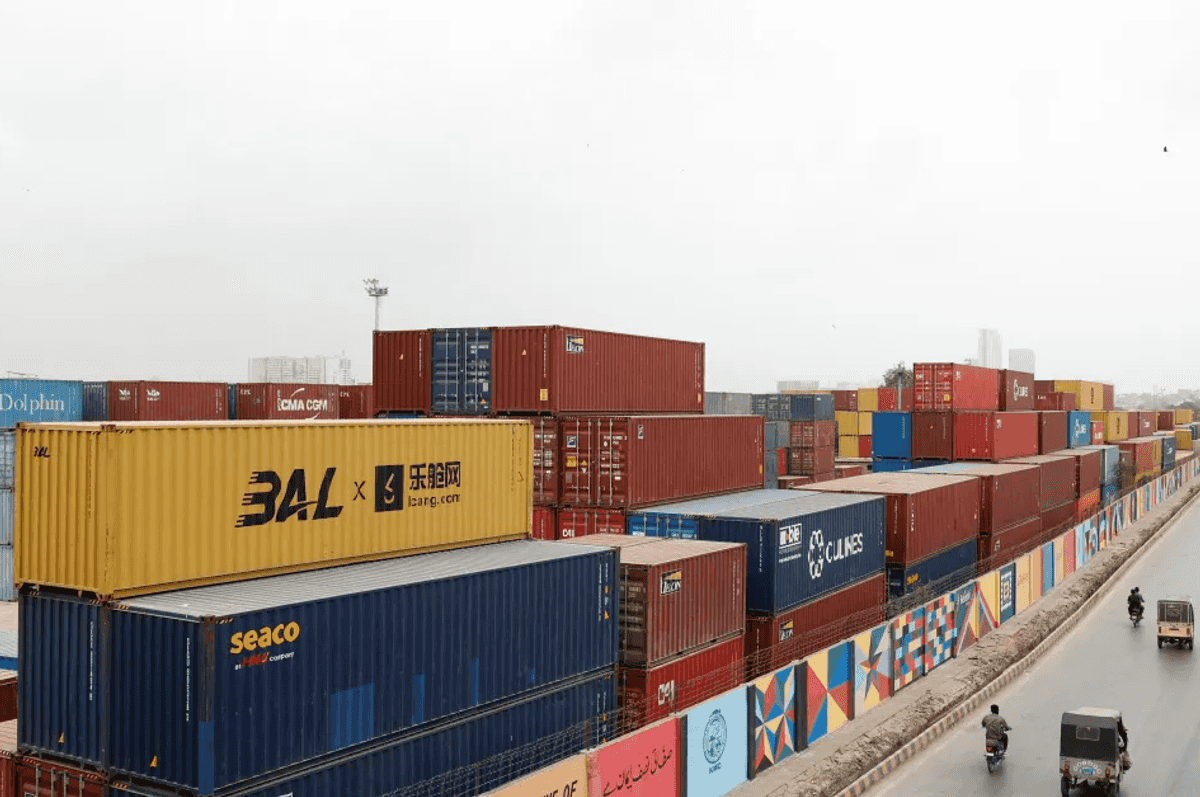
A container yard near Karachi port is seen as vehicles pass by on July 31, 2025.
Reuters/File
Pakistan could save up to $340 million a year on petroleum imports if international sanctions on Iran are lifted, Topline Securities said in a report released Thursday.
The brokerage's strategy note examined how normalized trade with Tehran could cut Pakistan's import bill and open new export markets.
How could Pakistan benefit if Iran sanctions are lifted?
Topline Securities said eased sanctions could revive bilateral trade with Iran, lower Pakistan's fuel and steel import costs, and expand export markets for goods like rice and meat.
The report estimated annual fuel savings alone could reach $340 million. It also said both countries have set a long-term target of raising bilateral trade to $10 billion.
How big was Pakistan-Iran trade before sanctions?
Bilateral trade between Pakistan and Iran peaked at over $1.2 billion in fiscal year 2010, before sanctions on Tehran intensified in 2012.
Pakistan ran a trade deficit with Iran until FY11, with the gap widening to $813 million in FY10, mostly due to fuel imports. As sanctions tightened, Pakistan's trade balance flipped into a $73 million surplus by FY13. Topline said formal trade has remained negligible since then.
What did Pakistan used to export to Iran?
Between FY09 and FY13, Pakistan exported a wide range of agricultural, textile and pharmaceutical goods to Iran. Rice was the largest category, with annual shipments reaching nearly $285 million, followed by oranges at $10 million and mangoes at $3 million. Pakistan also sent dates, apricots, cotton, yarn, pharmaceuticals, surgical instruments and footballs.
Iran mainly supplied Pakistan with fuel and industrial raw materials during that period. Fuel imports alone exceeded $570 million at their peak, alongside coal, hot-rolled coil, iron and steel scrap.
Could trade with Iran reach $10 billion?
Topline said both countries have expressed ambitions to raise bilateral trade to $10 billion through border special economic zones and deeper economic cooperation. If formal channels reopen, Pakistan could expand exports of rice, maize, fruits, vegetables, textiles and pharmaceuticals. The brokerage said lower transportation costs and broader market diversification would support this growth.
How much could Pakistan save on fuel imports?
Pakistan imported nearly $17 billion worth of petroleum products and fuels in 2025. Topline said Iranian crude historically traded at discounts of 13% to 17% compared with supplies from Saudi Arabia and the UAE between FY09 and FY12. Assuming Pakistan sources 10% to 20% of its petroleum needs from Iran at a 10% discount, including freight advantages, annual savings could range between $170 million and $340 million.
The report noted that refineries such as Pakistan Refinery Limited and Bosicor, now Cnergyico, had previously processed Iranian crude.
Would steel imports get cheaper too?
Pakistan imported roughly $4 billion worth of iron and steel products in 2025, along with plastics and aluminum. Historical data showed hot-rolled coil imported from Iran in FY10 was about 16% cheaper than comparable shipments from China and South Africa. Based on Pakistan's estimated $1.3 billion hot-rolled coil import bill in 2025, sourcing 10% to 20% from Iran could save $21 million to $42 million annually if similar discounts hold.
Topline cautioned that recent conflict-related disruptions at major Iranian steel producers could temporarily erode those advantages, as Tehran prioritizes reconstruction and domestic demand.
Is meat trade with Iran growing?
Iran has recently expressed interest in sourcing up to 60% of its meat imports from Pakistan. Pakistan's meat exports to Iran peaked at over $27 million in FY12. Topline said listed exporters such as The Organic Meat Company Limited and Al Shaheer Corporation could benefit if negotiations advance. It added that goods like tiles, tyres, fuel and confectionery, which already enter Pakistan informally, could shift into formal trade.
What is happening with the Iran-Pakistan gas pipeline?
Despite the broader trade opportunities, Topline said the long-delayed Iran-Pakistan gas pipeline is unlikely to move forward quickly even if sanctions ease. The 2,775-kilometer pipeline, often called the Peace Pipeline, has stayed stalled for years despite Iran completing its portion. Pakistan recently told Tehran it intends to pause the project while pursuing an out-of-court settlement, though revival remains possible if sanctions lift.
Why does the pipeline still make weak commercial sense?
Under the original agreement, Pakistan was to import 750 million cubic feet of gas per day, with an option to raise volumes to 1 billion cubic feet daily. Topline estimated the pricing formula, linked to roughly 78% of crude parity, would put gas prices at $9.5 to $10.8 per mmbtu when Brent crude trades between $70 and $80 a barrel. That remains above Pakistan's long-term LNG imports from Qatar, where contracts link to 62% to 77% crude parity, translating into landed costs of about $8.3 to $9.4 per mmbtu.
The brokerage said Pakistan's existing gas surplus, backed by long-term LNG contracts and higher domestic production, reduces the appeal of another long-term supply deal. It also flagged concerns over the pipeline's proposed 25-year term and take-or-pay obligations, which mirror challenges Pakistan already faces under its LNG agreements.
Could the pipeline still be revived later?
Topline said any meaningful revival would need more than sanctions relief. It would also require a major restructuring of volumes and pricing. Pricing closer to the $5 to $6 per mmbtu range currently available to domestic exploration and production firms would significantly improve the project's economics, the report said.
Given Pakistan's LNG commitments with Qatar through 2031, Topline expects serious progress on the pipeline is more likely near the end of that contract cycle than in the near term.
Who would actually build the pipeline?
The report also challenged a common market assumption that Pakistan's gas utilities would directly build the pipeline. Instead, it said the project was previously assigned to Inter State Gas Systems. Transmission networks run by Sui Northern Gas Pipelines Limited and Sui Southern Gas Company Limited would only be expanded or integrated later if required.
Topline said sanctions relief could unlock substantial trade and import savings for Pakistan, but large infrastructure projects like the Iran-Pakistan pipeline will likely stay constrained by commercial realities for years.



Comments
See what people are discussing