

Pakistan leadership holds key meeting on national security, regional tensions ahead of China visit
President, PM discuss key economic, energy and security challenges, emphasizing a coordinated national strategy
Aamir Abbasi
Editor, Islamabad
Aamir; a journalist with 15 years of experience, working in Newspaper, TV and Digital Media. Worked in Field, covered Big Legal Constitutional and Political Events in Pakistan since 2009 with Pakistan’s Top Media Organizations. Graduate of Quaid I Azam University Islamabad.
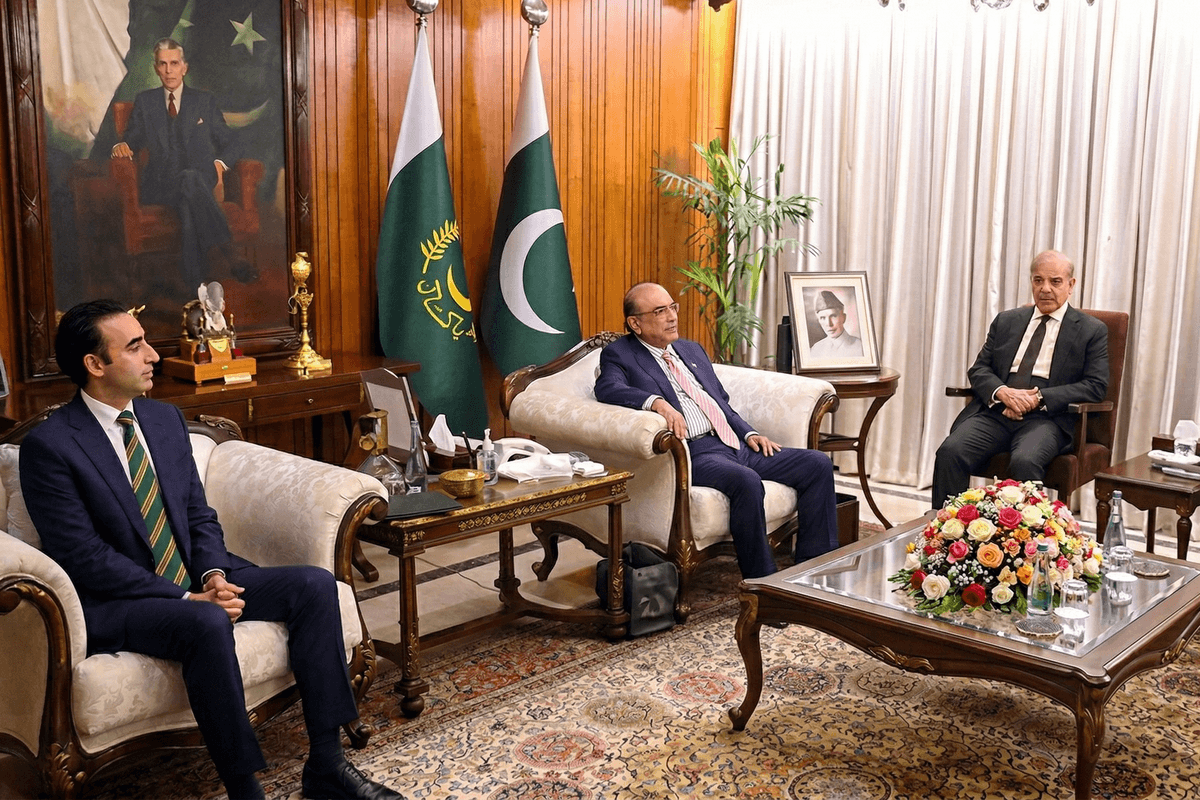
President Asif Ali Zardari met Prime Minister Shehbaz Sharif to review Pakistan’s national security landscape and emerging regional challenges.
Screengrab
President Asif Ali Zardari met Prime Minister Shehbaz Sharif to review Pakistan’s national security landscape and emerging regional challenges, officials said.
Deputy Prime Minister and Foreign Minister Ishaq Dar attended the meeting, along with former Foreign Minister Bilawal Bhutto Zardari, Interior Minister Mohsin Naqvi and National Security Adviser Lt. Gen. Asim Malik.
Participants held what officials described as a detailed exchange on the overall security situation and reviewed evolving regional dynamics and their potential impact on Pakistan.
They also discussed key economic, energy and security challenges, emphasizing a coordinated national strategy and institutional harmony to address current and emerging issues.
Dar to visit China
Earlier in the day, the Foreign Office said Dar will visit China on Tuesday at the invitation of Chinese Foreign Minister Wang Yi.
The visit comes amid evolving regional developments and will include in-depth discussions on bilateral ties and key regional and global issues of mutual interest, the Foreign Office said.
Pakistan and China describe their ties as an “all-weather strategic cooperative partnership,” anchored in political trust and economic cooperation.
The relationship has expanded under the China-Pakistan Economic Corridor, part of China’s Belt and Road Initiative aimed at boosting connectivity, energy security and economic development.
Officials said the upcoming talks will focus on diplomacy, trade and security cooperation. Regional stability, including developments in the Middle East, Afghanistan and broader Asia, is also expected to be discussed.
Dar is proceeding with the trip despite medical advice to rest after sustaining what officials described as a minor shoulder fracture a day earlier.
Regional consultations in Islamabad
A day earlier, Pakistan hosted the foreign ministers of Saudi Arabia, Turkey and Egypt for high-level consultations on the escalating conflict in the Middle East.
The visiting ministers departed Islamabad on Sunday evening after bilateral and quadrilateral discussions focused on strategic coordination and diplomatic efforts to de-escalate hostilities.
Dar said the talks were “detailed and in-depth,” highlighting humanitarian and economic consequences of continued conflict.
He announced that Pakistan has formally offered to host talks between the United States and Iran in Islamabad. Visiting ministers supported the proposal, describing it as a constructive step toward negotiations.
The consultations marked a second round of quadrilateral meetings following an earlier session in Riyadh on March 19. Participants reiterated that diplomacy remains the only viable path to resolve the crisis and agreed to work collectively to reduce escalation risks.
The ministers also agreed to form a committee of senior foreign ministry officials to develop a framework for ongoing cooperation.
Dar said China and the United Nations secretary-general had endorsed Pakistan’s initiative. Several other countries have also expressed confidence in Pakistan’s role as a facilitator, he added.
He reaffirmed Pakistan’s commitment to pursue the initiative and called for continued international backing for a comprehensive and lasting resolution.





Comments
See what people are discussing