

Pakistan loses nearly 1% of GDP a year to climate damage, conference hears
OICCI climate forum urges shift from policy plans to bankable action

Business Desk
The Business Desk tracks economic trends, market movements, and business developments, offering analysis of both local and global financial news.
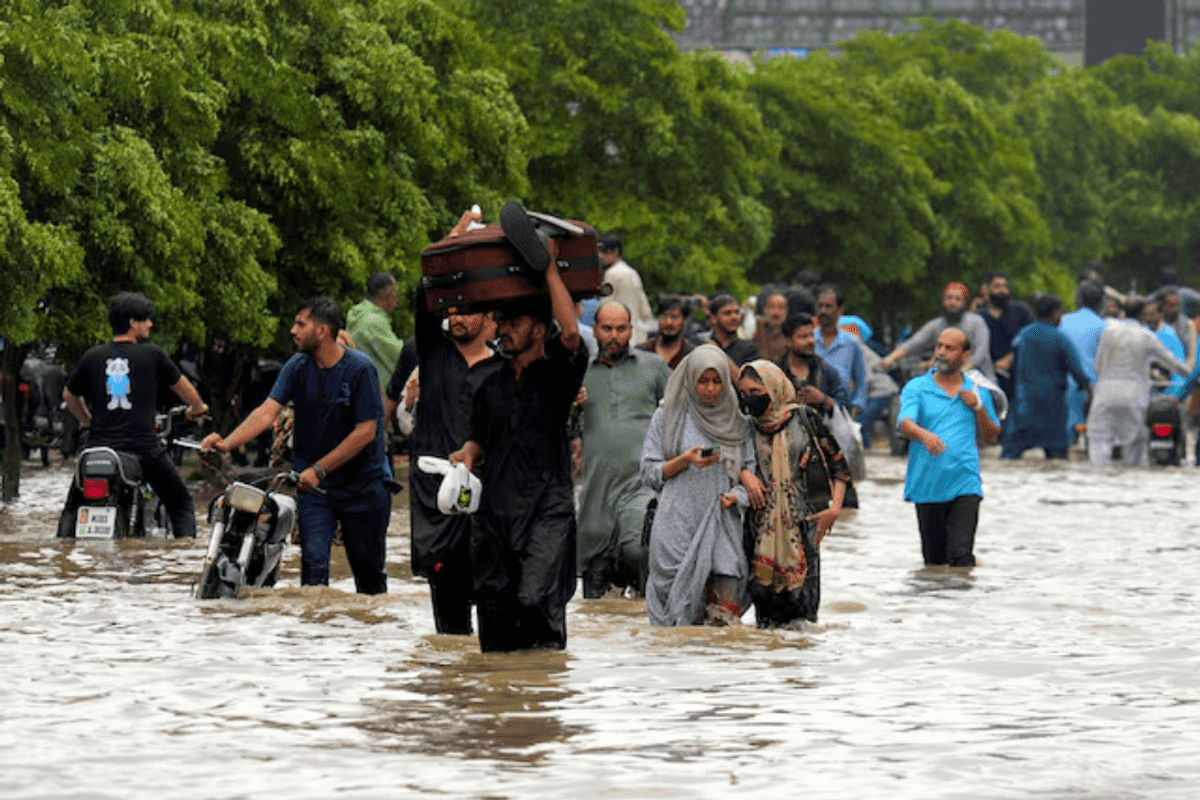
People wade through a flooded road after the monsoon rain in Karachi, Pakistan, August 19, 2025
Reuters
Pakistan is losing close to 1% of its gross domestic product every year to climate-related damage, speakers said Monday at the 4th Pakistan Climate Conference, as policymakers, development partners and business leaders called for faster movement from policy frameworks to investable climate action.
The conference, organized by the Overseas Investors Chamber of Commerce & Industry (OICCI), brought together federal and provincial officials, international institutions, climate experts, journalists and corporate executives to discuss Pakistan’s growing exposure to floods, heatwaves and economic disruption, despite contributing less than 1% to global greenhouse gas emissions.
Climate impacts and investment needs
Federal Minister for Climate Change and Environmental Coordination Dr. Musadik Masood Malik said Pakistan was on the front line of an intensifying climate crisis.
“I commend OICCI for creating a platform where climate resilience is treated not as corporate social responsibility, but as an economic imperative,” Malik said. He cited record heatwaves of up to 53 degrees Celsius, floods that displaced about four million people last year, the melting of more than 13,000 glaciers, and climate-related losses costing nearly 1% of GDP annually.
Referring to Pakistan’s updated climate commitments, Malik said the country’s Nationally Determined Contribution 3.0 targets a 50% reduction in emissions by 2035. He said achieving a just transition would require $565.7 billion in investment, underscoring the need for sustainable, grant-based climate finance rooted in climate justice.
From frameworks to financing
Federal Minister for Finance and Revenue Senator Muhammad Aurangzeb described climate change as an existential threat, saying Pakistan has key frameworks in place, including the National Adaptation Plan, the Climate Prosperity Plan and a Green Taxonomy.
“The focus must now shift to mobilizing available financing and developing investable projects,” Aurangzeb said, adding that the private sector has a critical role to play not only through capital, but also through innovation and technical expertise.
Chongguang Yu, also known as Charles Yu, regional lead for sustainable finance in Asia and the Pacific at the United Nations Development Program, said the main challenge was no longer a lack of capital but fragmented systems.
He called for blended finance, risk-sharing mechanisms and programmatic investment pipelines to unlock scalable private-sector participation.
Public-private momentum
OICCI President Yousaf Hussain said the government has made tangible progress on its climate agenda, pointing to recent initiatives aimed at strengthening sustainable finance.
He cited Pakistan’s emphasis on adaptation finance through public-private partnerships at the World Economic Forum in Davos, the finalization of a $20 billion, 10-year Country Partnership Framework with the World Bank, and preparations to launch Pakistan’s first Green Panda Bond.
“Together, these steps signal a clear and credible national commitment to climate resilience,” Hussain said.
Senior Vice President OICCI Jason Avanceña said the conference was designed to move beyond rhetoric toward practical economic outcomes.
He said discussions focused on modernizing Pakistan’s strained power grid, accelerating renewable energy, unlocking Blue Economy opportunities through coastal resilience and marine sustainability, and using artificial intelligence to improve climate forecasting, reduce disaster losses and strengthen investment planning.
Role of finance and industry
Rehan Shaikh, chief executive officer and head of coverage at Standard Chartered Pakistan, said building resilience, mobilizing sustainable finance and strengthening public-private collaboration are critical to Pakistan’s long-term competitiveness.
He said the bank’s support for platforms such as the OICCI Climate Conference helps move the climate agenda “from intent to action.”
The event was attended by local and international representatives from the United Nations Development Program, Asian Development Bank, International Finance Corporation, World Wide Fund for Nature Pakistan, State Bank of Pakistan, Securities and Exchange Commission of Pakistan, Pakistan Stock Exchange, Punjab Environmental Protection Agency, Sindh Solid Waste Management Board, Sindh Environmental Protection Agency, the Sustainable Development Policy Institute, and corporate participants including Unilever, Nestlé, Standard Chartered Bank and Beko Global.
The conference concluded with the second OICCI Climate Excellence Awards, recognizing organizations advancing renewable energy, circularity, water stewardship and inclusive climate action.
As climate risks intensify, speakers agreed that climate policy can no longer remain peripheral and must become central to Pakistan’s economic planning, investment strategy and national development agenda.



Comments
See what people are discussing