

Pakistan pitches financing, privatization opportunities to global investors in Bangkok
Aurangzeb discusses sukuk, Panda bonds and tokenization as separate IFC and Saudi Fund meetings focus on private-sector growth, infrastructure and investment

Business Desk
The Business Desk tracks economic trends, market movements, and business developments, offering analysis of both local and global financial news.
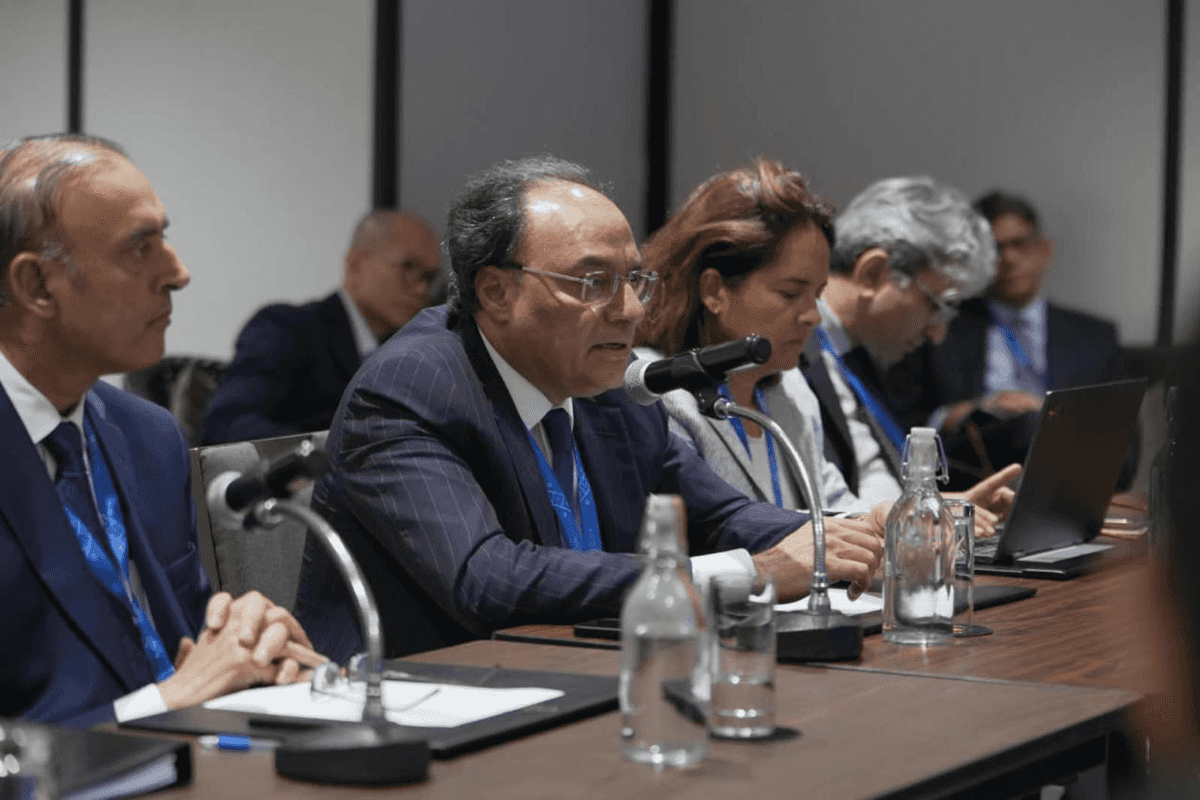
Finance Minister Muhammad Aurangzeb, alongside Secretary Finance, Imdadullah Bosal, and SBP Governor, Jameel Ahmad, participate in a roundtable with institutional investors organized by Jefferies International.
Finance Division
Pakistan’s Finance Minister Muhammad Aurangzeb held talks with institutional investors, the International Finance Corporation and the Saudi Fund for Development on Tuesday, focusing on financing options, privatization, trade and investment as the government seeks to sustain economic stability and promote private-sector-led growth.
The meetings took place on the sidelines of the World Bank Group–International Monetary Fund Annual Meetings 2026 in Bangkok, Thailand, according to statements issued by Pakistan’s Finance Division.
What financing and investment opportunities did Pakistan discuss?
Pakistan’s discussions covered potential financing instruments including sukuk, further Panda bond issuance and tokenization, alongside privatization opportunities and greater business-to-business trade and investment. Separate meetings with the IFC and Saudi Fund for Development focused on private-sector growth, infrastructure, agriculture, housing, mining, refinery upgrades and development cooperation.
At a roundtable organized by Jefferies International, Aurangzeb participated alongside Finance Secretary Imdadullah Bosal and State Bank of Pakistan Governor Jameel Ahmad.
The finance minister highlighted improvements in Pakistan’s fiscal and external balances, stronger foreign exchange reserves, rating upgrades and renewed access to international capital markets.
He emphasized consolidating macroeconomic stability and moving toward sustainable, export-led growth through continued reforms in taxation, energy, state-owned enterprises and public finance.
Discussions with institutional investors covered progress under Pakistan’s IMF program, debt management and potential financing instruments, including sukuk, further Panda bond issuance and tokenization.
Aurangzeb also outlined privatization opportunities and stressed expanding business-to-business trade and investment.
The delegation addressed tax-base broadening, agricultural income tax implementation, digital enforcement and federal-provincial coordination on fiscal targets.
Responding to investor questions, officials also discussed regional geopolitical risks, energy security, LNG obligations and Pakistan’s economic engagement with the United States and Saudi Arabia.
The session concluded with Aurangzeb reaffirming Pakistan’s commitment to maintaining reform momentum and strengthening investor confidence.
IFC talks focus on private-sector growth
In a separate meeting, Aurangzeb met Imad Fakhoury, IFC regional vice president for the Middle East and Central Asia, to discuss strengthening IFC support for private-sector-led growth and jobs and translating macroeconomic stability into sustainable growth.
The meeting reviewed IFC’s expanding portfolio, small-business financing, entrepreneurship, capital markets, and green and digital bonds.
Aurangzeb reaffirmed the government’s commitment to the Reko Diq project and appreciated IFC’s financing leadership.
The discussions also covered mining infrastructure and value addition, affordable housing and developer financing, and agricultural development through improved storage, cold chains and electronic warehouse receipt financing.
Both sides explored greater private-sector participation in livestock development and support for pharmaceutical exports through stronger regulatory standards and investment.
Infrastructure cooperation focused on public-private partnerships in water services, advanced electricity metering and financing mechanisms for provincial projects.
Saudi Fund talks cover trade, investment and refinery upgrades
Aurangzeb also met Sultan Abdulrahman Al-Marshad, chief executive officer of the Saudi Fund for Development, to discuss expanding trade and investment and strengthening private-sector engagement.
The finance minister thanked Saudi Arabia for its longstanding support to Pakistan and highlighted the country’s improving macroeconomic position and renewed access to international capital markets.
The two sides discussed follow-up on the bilateral investment protection agreement and potential opportunities for refinery upgrades.
They also noted satisfactory progress on SFD-supported projects and emphasized the importance of developing a fresh pipeline of projects.
The Saudi Fund for Development reaffirmed its continued support to Pakistan within its mandate.





Comments
See what people are discussing