

Pakistan rejects US intelligence chief’s missile threat assertion
Islamabad says its missile program is defensive and India-focused

Ali Hamza
Correspondent
Ali; a journalist with 3 years of experience, working in Newspaper. Worked in Field, covered Big Legal Constitutional and Political Events in Pakistan since 2022. Graduate of DePaul University, Chicago.
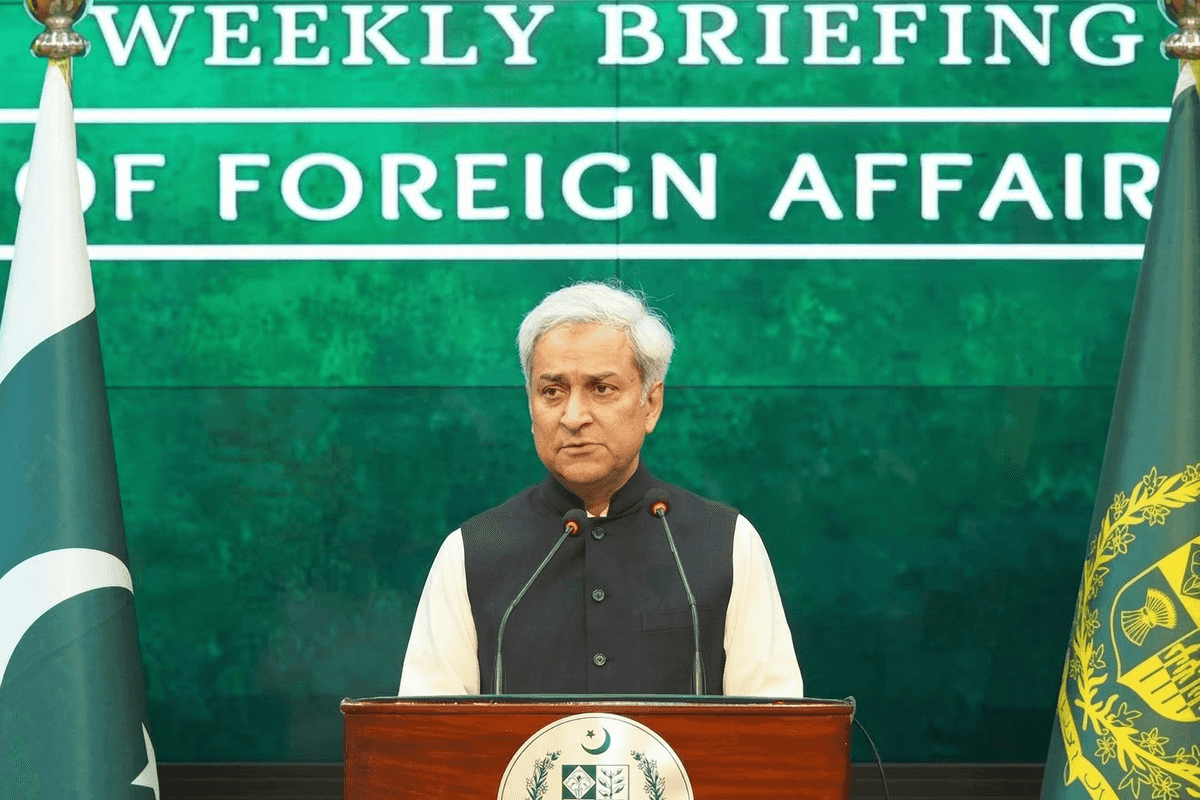
Pakistan rejected on Thursday an assertion by a senior United States intelligence official alleging a potential threat from its missile capabilities, calling its strategic program exclusively defensive.
In a statement, Foreign Ministry Spokesperson Tahir Andrabi said Pakistan categorically rejects the recent claim by a U.S. official regarding a potential missile threat. He said Pakistan’s strategic capabilities are “exclusively defensive in nature,” aimed at safeguarding national sovereignty and maintaining peace and stability in South Asia.
Andrabi said Pakistan’s missile program remains “well below intercontinental range” and is rooted in a doctrine of credible minimum deterrence vis-à-vis India.
In contrast, he said, India’s development of missile capabilities exceeding 12,000 kilometers extends beyond regional security considerations and is a cause of concern for the neighborhood and beyond.
Pakistan remains committed to constructive engagement with the United States based on mutual respect, non-discrimination and factual accuracy, Andrabi said. He urged what he described as a measured approach aligned with South Asia’s strategic imperatives.
US annual threat assessment flags missile risks
The statement follows the 2026 Annual Threat Assessment by the U.S. Intelligence Community, presented under Director of National Intelligence Tulsi Gabbard.
The report identifies Pakistan as a key actor in what it describes as a rapidly evolving global threat landscape, citing its missile development, regional tensions and role in counterterrorism operations.
According to the assessment, U.S. military operations conducted with international partners in 2025, including in Pakistan, Iraq, Somalia and Syria, removed key militant leaders and weakened al-Qaida and the Islamic State group.
However, the report warns that state-based threats are becoming more serious. It names Pakistan among countries developing advanced missile delivery systems capable of carrying nuclear and conventional payloads.
The assessment projects that the number of missiles capable of threatening the U.S. homeland could rise from more than 3,000 today to over 16,000 by 2035.
It also says adversaries are likely to combine sophisticated missiles with cheaper systems, including one-way attack drones, to challenge U.S. defenses.
India-Pakistan tensions remain flashpoint
The report describes India-Pakistan relations as one of the most dangerous flashpoints globally, given both countries’ nuclear capabilities and history of military confrontations.
It notes that past crises have carried risks of escalation and says militant attacks, including a recent incident near Pahalgam in Indian-administered Kashmir, can act as triggers for broader conflict.
The assessment adds that while neither country is currently seeking full-scale war, conditions remain for rapid escalation. It also references recent tensions that required international intervention to de-escalate.
Separately, the report cites escalating tensions between Pakistan and Afghanistan’s Taliban government, including cross-border strikes and retaliatory airstrikes earlier this year.
Sanctions and political reactions
In December 2024, the United States imposed sanctions on Pakistan’s National Development Complex and three commercial entities over their alleged role in advancing long-range ballistic missile capabilities.
At the time, U.S. officials said Pakistan’s trajectory in missile development could eventually enable it to strike targets beyond South Asia, including the United States.
Pakistan rejected those sanctions as “unfortunate and biased,” saying its strategic program is aimed at defending sovereignty and preserving peace and stability in South Asia.
Former senator Mushahid Hussain Syed criticized the latest U.S. assessment in a post on X, calling talk of a “Pakistan missile threat to USA” non-existent and politically motivated.
Former ambassador Maleeha Lodhi said Washington had historically opposed Pakistan’s nuclear and missile development but that such opposition had not halted its programs.
Former caretaker foreign minister Jalil Abbas Jilani said comments by Gabbard during a U.S. Senate hearing were “not grounded in strategic reality,” stating that Pakistan’s nuclear doctrine is India-specific.
@TulsiGabbardDNI assertion at the Senate hearing that the US homeland is within range of Pakistan’s Nuclear/Con missiles is not grounded in strategic reality.Pakistan’s N doctrine is India specific aimed at maintaining credible deterrence in S Asia,not projecting power globally
— Jalil Abbas Jilani (@JalilJilani) March 18, 2026
Rabia Akhtar, dean of the Faculty of Social Sciences at the University of Lahore, said there was no evidence Pakistan was pursuing capabilities to target the United States.
Tulsi Gabbard’s statement reflects a persistent flaw in US threat assessments: substituting worst-case speculation for grounded analysis. Pakistan’s deterrence posture is India-centric. Folding it into a US homeland threat narrative is misleading.
For those interested in the… https://t.co/Sf1j2FFh3p
— Rabia Akhtar (@Rabs_AA) March 18, 2026
She said Pakistan’s longest-range systems are calibrated to counter India’s capabilities and not designed to project power globally.
The U.S. assessment says Pakistan’s growing missile capabilities could extend its strategic reach beyond the region in the future, increasing its prominence in U.S. threat perceptions.





Comments
See what people are discussing