

Pakistan terrorism is blowback of Afghan war of 1980s, defense minister tells parliament
Khawaja Asif says denial, sectarianism and political division are weakening the state amid renewed militant attacks

Ali Hamza
Correspondent
Ali; a journalist with 3 years of experience, working in Newspaper. Worked in Field, covered Big Legal Constitutional and Political Events in Pakistan since 2022. Graduate of DePaul University, Chicago.
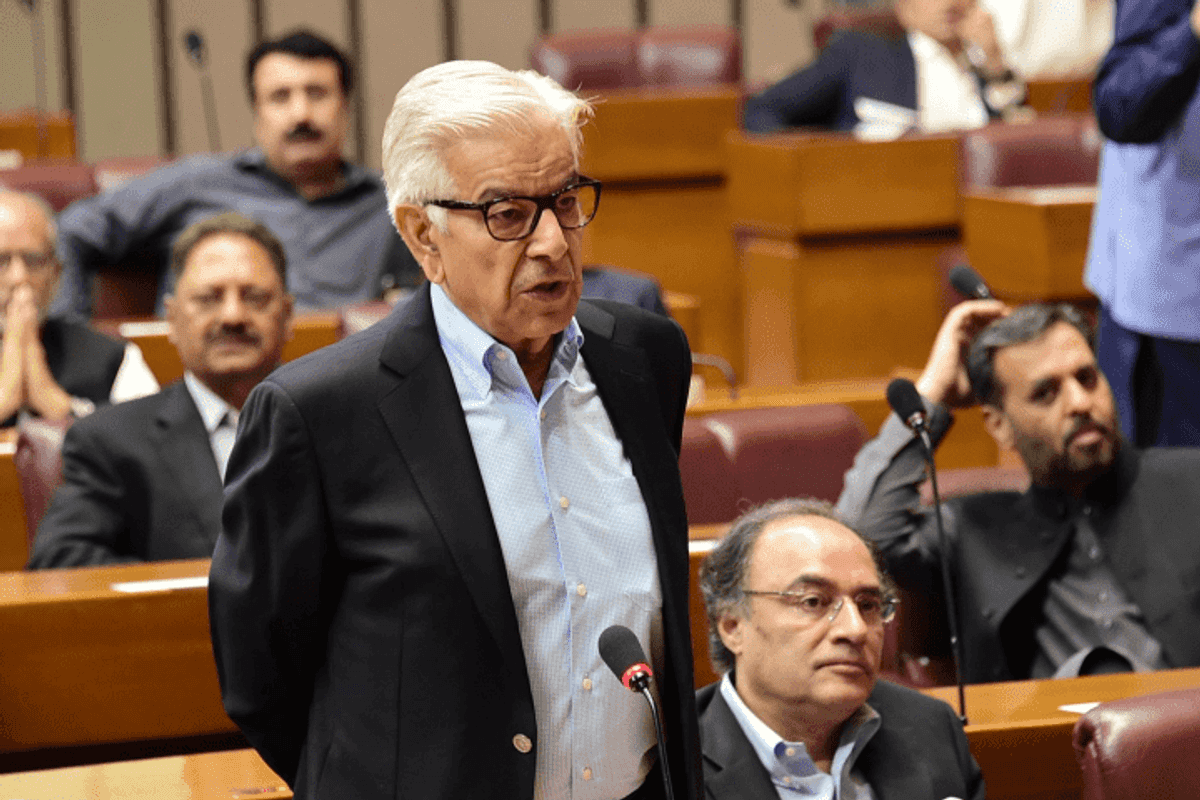
Pakistan’s Defense Minister Khawaja Asif said on Monday that the country’s persistent militant violence is the result of decisions taken during the Afghan war of the 1980s, urging political unity and an honest reckoning with history to confront what he described as the consequences of decades of conflict.
Speaking in the National Assembly after a suicide bombing at an Imambargah in Islamabad killed at least 31 people, Asif said Pakistan was facing “blowback” from its participation in foreign-led wars and warned that denial, sectarianism and political division were weakening the state amid renewed militant attacks.
“We have to accept our mistakes from the past. We are denying our own history,” Asif told lawmakers. “Terrorism in Pakistan is the blowback of our participation in the Afghan war.”
‘Blowback from past wars’
The Afghan war he referred to began in 1979, when the Soviet Union deployed troops to Afghanistan at the request of the Kabul government, triggering a decade-long conflict in which the United States and other allies backed Afghan resistance fighters, with Pakistan serving as a key frontline state and logistical base.
Asif said Pakistan’s relationship with Afghanistan had been complex since independence, noting that the two countries shared largely open borders until the 1980s and that Kabul had launched armed actions against Pakistan twice in the early years.
Despite this history, he said, Islamabad aligned itself with Washington in two separate Afghan conflicts - first during the Soviet invasion and later after the Sept. 11, 2001 attacks on the United States.
“The Soviet Union went to Afghanistan on the invitation of Kabul. It was not attacked,” Asif said. “But dictators in Pakistan needed legitimacy, and that is why we went to war. It was not jihad. It was a made-in-US jihad.”
He said Pakistan fundamentally reshaped its education system, political thinking and religious discourse during that period, arguing that history was distorted to serve geopolitical objectives. Asif cited historian K.K. Aziz’s book The Murder of History as an example.
“Superpowers abandoned us, but we did not learn anything,” he said.
Referring to Pakistan’s founder Muhammad Ali Jinnah, Asif said even the country’s core national principles had been altered over time. “Quaid-e-Azam said ‘Unity, Faith, Discipline’,” he said. “We changed it to ‘Faith, Unity, Discipline’, and that change reflects what went wrong with our national priorities.”
Asif said Pakistan again entered a prolonged conflict after the 2001 U.S.-led invasion of Afghanistan, despite the fact that none of the Sept. 11 attackers came from the region.
“We fought that war for more than two decades because another military ruler needed political crutches,” he said, referring to former president Pervez Musharraf.
He added that he had publicly apologized in parliament for his father’s role in the government of military ruler General Zia-ul-Haq, saying acknowledgement of past mistakes was essential.
“We will have to make confessions if we want to absolve ourselves from our past,” he said.
Condemning sectarian violence, Asif said it was deliberately injected into Pakistan and did not reflect the country’s social fabric.
“Islam is a religion of peace,” he said. “These so-called religious outfits are not religious. We have turned religion into franchises. It was not like this 40 years ago.”
Calls for unity as attacks rise
He said rising militant attacks over the past three years had failed to unite Pakistan’s political leadership.
“For our petty political goals, we don’t even attend the funerals of our martyrs who are giving their lives for this country,” he said, adding that he had received threats after naming the sect targeted in the Islamabad attack.
On regional security, Asif accused India of waging a proxy campaign against Pakistan using Afghan territory.
“India cannot fight us directly now, that’s why it is attacking us via Afghanistan,” he said, adding that Pakistan was now facing the consequences of past alliances rather than direct confrontation.
Asif said Pakistan had held several rounds of talks with Afghan authorities in Jeddah, Riyadh, Istanbul and Doha, as well as direct discussions with Taliban defense minister Mullah Yaqub.
“They accepted our position 100%, but they never gave guarantees,” he said.
Calling for unity, Asif urged lawmakers to restore parliament as the center of national decision-making.
“Let’s make this house functional,” he said. “When political narratives override national narratives, that is where difficulties begin.”
“These 31 martyrs are ours,” Asif added. “The only thing immortal is Pakistan, and we must unite in these times.”


Comments
See what people are discussing