

Pakistan urges world to press Afghan regime on counterterrorism commitments
PM Shehbaz Sharif says the scourge of terrorism is raising its head yet again from Afghanistan

News Desk
The News Desk provides timely and factual coverage of national and international events, with an emphasis on accuracy and clarity.
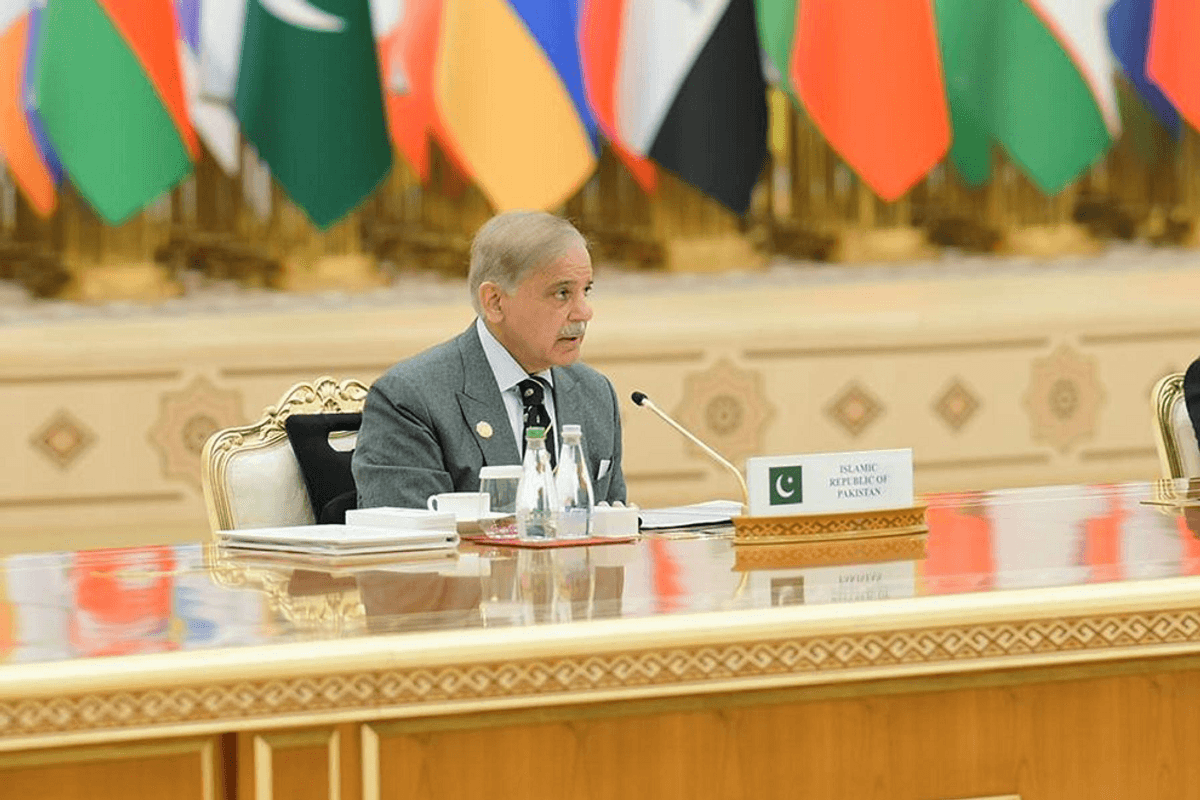
Prime Minister Shehbaz Sharif addresses an international forum in Ashgabat on Dec 12.
PID
Prime Minister Shehbaz Sharif reaffirmed on Friday Pakistan’s commitment to the peaceful settlement of global disputes and urged the international community to press Afghanistan’s Taliban authorities to honor their international obligations and curb terrorist groups operating from Afghan soil, according to the state-run APP news agency.
“Peaceful resolution of disputes is a cornerstone of Pakistan’s foreign diplomacy,” Sharif said in his address to an international forum marking the International Year of Peace and Trust 2025, the International Day of Neutrality, and Turkmenistan’s anniversary of permanent neutrality.
He said Pakistan supported the Gaza Peace Plan and welcomed its endorsement by the U.N. Security Council.
Sharif noted that Pakistan began the year by taking its seat as a non-permanent member of the U.N. Security Council, where the country aimed to uphold global peace and security.
He warned that terrorism was resurging in the region, saying “the scourge of terrorism is, however, raising its head yet again, and this time, unfortunately, Afghan soil.” He called on the international community to press the Taliban authorities in Kabul to fulfill their commitments and rein in militant groups operating from Afghanistan.
Sharif thanked Qatar, Turkey, Saudi Arabia, the United Arab Emirates and Iran for what he described as their sincere efforts to achieve a permanent ceasefire in Gaza. He said the situation remained fragile.
He said the unanimous adoption of U.N. Security Council Resolution 2788 earlier this year was a strong endorsement of Pakistan’s vision for the peaceful settlement of disputes.
Sharif expressed hope that the ongoing diplomatic push by the group of eight Arab Islamic countries would help protect Palestinian lives, ensure a lasting ceasefire, allow humanitarian aid to flow into Gaza and support reconstruction.
He reaffirmed Pakistan’s support for the right to self-determination of the Palestinian people and the “brave and resilient” Kashmiri people.
Sharif said the pursuit of peace was tied to sustainable development. The 2030 Agenda for Sustainable Development, he said, offered a universal blueprint for a more peaceful and equitable world. He said his government’s top priority was socioeconomic development and public welfare.
He said Pakistan had made gains in financial inclusion and brought women and marginalized groups into the economic mainstream. He added that Pakistan had shown strong commitment to “cleaner and greener solutions” in response to global warming, setting what he called a global example in ecosystem restoration.
But he cautioned that developing countries faced severe challenges posed by climate-induced disasters and inequities in international economic systems.
Sharif noted Pakistan suffered devastating floods in 2023 that caused significant loss of life and economic damage. He said the country again faced catastrophic conditions this year due to climate-related disasters.
He said climate change, poverty and inequality were interconnected threats that required international solutions rooted in shared responsibility and unity of purpose.
Sharif said access to advanced, especially digital, technologies must be equitable and free from discrimination.
He urged global leaders to treat the forum as a call for urgent collective action and a new paradigm of international relations, one that moves beyond zero-sum thinking.
“Let us invest in connectivity, not just as conduits for transportation of goods, but as bridges for people, ideas and prosperity,” he said.
Earlier, Sharif congratulated Turkmenistan’s leadership on the 30th anniversary of its permanent neutrality and on the success of its initiative to have the United Nations designate 2025 as the International Year of Peace and Trust.



Comments
See what people are discussing