

Pakistani delegation led by army chief arrives in Tehran for mediation talks
Delegation arrives in Iranian capital as part of ongoing mediation efforts, says Pakistan military media wing

News Desk
The News Desk provides timely and factual coverage of national and international events, with an emphasis on accuracy and clarity.
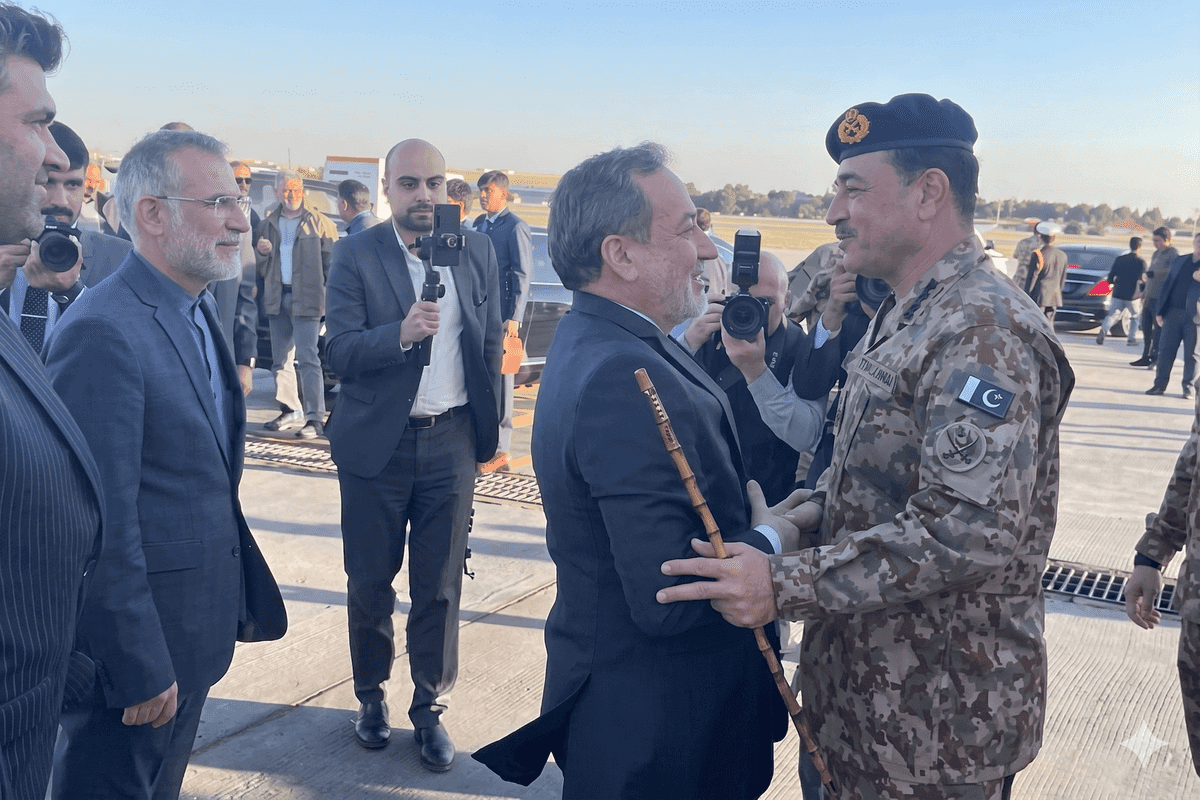
Iranian Foreign Minister Abbas Araghchi receives Chief of Army Staff Field Marshal Asim Munir in Tehran on April 15, 2026.
ISPR
A high-level Pakistani delegation led by Field Marshal Asim Munir, Pakistan’s army chief and chief of defense forces, arrived in Tehran on Wednesday as part of ongoing mediation efforts aimed at ending the conflict between the United States and Iran, according to Pakistan’s military media wing.
Interior Minister Mohsin Naqvi is also part of the delegation, the Inter-Services Public Relations (ISPR) said in a short press release. It said the group arrived in the Iranian capital “as part of the ongoing mediation efforts.”
Iranian state television earlier reported that Tehran would receive the delegation led by Munir and that Foreign Minister Abbas Araghchi would welcome the team. The visit comes after a weekend round of talks in Islamabad ended without a breakthrough.
📸 Arrival of Pakistan’s Army Chief, General Asim Munir, in Tehran, welcomed by Foreign Minister @araghchi. pic.twitter.com/HWwvhAV0Nx
— Government of the Islamic Republic of Iran (@Iran_GOV) April 15, 2026
Iranian Foreign Ministry spokesman Esmaeil Baqaei said at a weekly briefing that communication with the United States has continued through Pakistan since Iranian negotiators returned from Islamabad.
“Since Sunday, when the Iranian delegation returned to Tehran, several messages have been exchanged through Pakistan,” Baqaei said. He added that Tehran expected further engagement and suggested a Pakistani delegation could arrive to continue discussions.
Iranian state media said the visit is expected to carry what it described as a new message from Washington following the Islamabad talks.
Senior Pakistani sources said Islamabad is working to facilitate a second round of discussions as regional diplomatic activity continues.
The developments come as indirect contacts between Washington and Tehran continue alongside heightened regional tensions involving Iran, the United States and Israel.
U.S. President Donald Trump suggested that negotiations with Iran could resume within days. In comments to the New York Post, he said a new round of talks could take place in Pakistan “over the next two days” after earlier discussions ended without agreement.
In a separate interview scheduled to air on Fox Business, Trump said the situation was “very close to being over.”
Washington has maintained pressure on Tehran, including maritime restrictions. The U.S. Central Command said its blockade had been “fully implemented” and claimed it had halted economic trade into and out of Iran by sea. However, maritime tracking data cited in reports indicated that some vessels departing Iranian ports continued to pass through the Strait of Hormuz.
The nuclear program remains central to stalled negotiations. U.S. officials have reportedly proposed a 20-year suspension of Iran’s uranium enrichment program, while Iran countered with a five-year suspension proposal. The U.S. rejected the offer, according to those reports.
U.S. Vice President JD Vance said Iran was being offered what he called a “grand bargain.” Trump has said any deal must permanently prevent Iran from obtaining nuclear weapons. Those claims have not been confirmed by the International Atomic Energy Agency, the U.N. nuclear watchdog.
Iran maintains its nuclear program is peaceful and for civilian purposes.
Iranian President Masoud Pezeshkian said the country does not seek war or instability and favors dialogue, while rejecting what he described as attempts to force submission. He also referred to an “unprovoked war” by the United States and Israel and said Iran’s response led to a ceasefire after 40 days.


Comments
See what people are discussing