

Pakistan’s diplomacy pulls world back from brink as Trump halts Iran strike
Islamabad brokers two-week truce after threats of devastating attacks shake markets and raise fears of wider war

Ali Hamza
Correspondent
Ali; a journalist with 3 years of experience, working in Newspaper. Worked in Field, covered Big Legal Constitutional and Political Events in Pakistan since 2022. Graduate of DePaul University, Chicago.
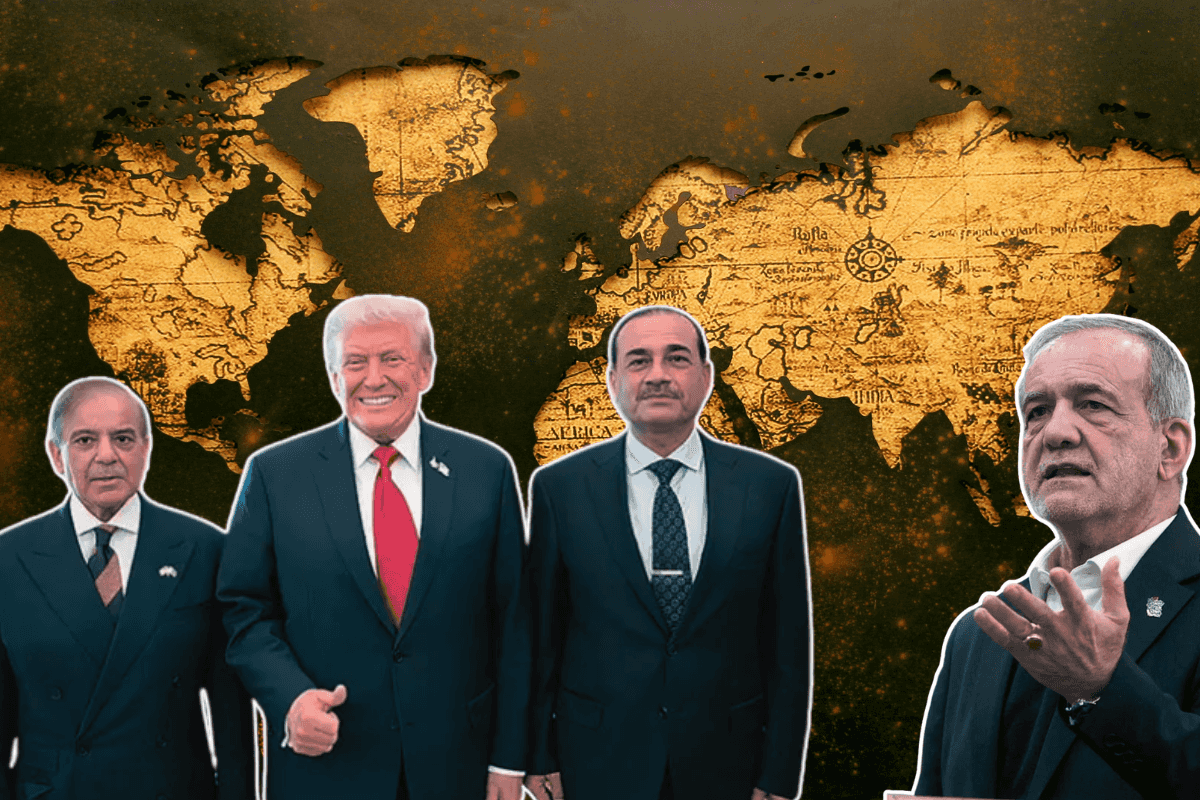
Peace talks between the United States and Iran are scheduled to begin in Islamabad on Friday, April 10.
Nukta illustration
Pakistan brokers two-week ceasefire between US and Iran
Trump halts strike hours after warning of civilization’s destruction
Strait of Hormuz reopening eases global energy crisis fears
Oil prices post biggest drop since 1991 Gulf War on truce news
In the final hours before what many feared could become one of the most destructive military escalations in modern history, Pakistan launched a quiet diplomatic effort that helped halt a looming U.S. strike on Iran – an intervention that reshaped global politics, rattled energy markets and positioned Islamabad at the center of an international crisis.
In a frantic 24 hours of shuttle diplomacy, Prime Minister Shehbaz Sharif and Army Chief Field Marshal Asim Munir persuaded Washington and Tehran to accept a two-week ceasefire, hours after U.S. President Donald Trump warned that “a whole civilization will die tonight.”
The agreement – now known as the “Islamabad Accords” – took effect at midnight GMT Tuesday after Trump agreed to suspend planned strikes and Iran committed to reopening the Strait of Hormuz under coordinated arrangements. Peace talks between the United States and Iran are scheduled to begin in Islamabad on Friday, April 10.
The breakthrough marked the most significant de-escalation since the United States and Israel launched joint strikes on Iran on February 28 that killed Supreme Leader Ali Khamenei and triggered a 39-day conflict that shook global energy supplies.
Markets reacted instantly. Oil prices recorded their largest single-day drop since the 1991 Gulf War, reversing weeks of war-driven gains that had pushed fuel costs sharply higher worldwide. Stock markets surged across Asia, Europe and the United States.
For Pakistan – long viewed primarily through the lens of regional security challenges – the moment represented an unexpected diplomatic ascent.
Trump’s threats and rising fears
The hours leading to the ceasefire were among the most alarming of the war.
On April 6, Trump posted an expletive-filled message on Truth Social threatening Iran’s civilian infrastructure.
“Tuesday will be Power Plant Day, and Bridge Day, all wrapped up in one, in Iran. There will be nothing like it!!! Open the F*** Strait, you crazy b**, or you'll be living in Hell, JUST WATCH! Praise be to Allah.”
By the following morning, his rhetoric intensified further.
“A whole civilization will die tonight never to be brought back again. I don't want that to happen, but it probably will,” Trump wrote on April 7.
Speaking by phone to Fox News hours before the deadline, Trump confirmed preparations for strikes were continuing. “If we get to that point, there is going to be an attack like they have not seen,” he said.
At the same time, Israeli jets struck eight bridges and three airports across Iran and hit the country’s largest petrochemical complex. Iranian missile barrages triggered alarms across southern Israel and struck more than ten locations in Haifa.
Energy markets surged in panic. West Texas Intermediate crude climbed to an intraday high of $117 per barrel – more than 74% above its pre-war level of $66.96 – as traders priced in potential destruction of Iranian energy infrastructure. Prediction markets placed the odds of oil reaching $120 at 87%.
The world appeared on the verge of a broader regional war with global economic consequences.
Pakistan’s quiet diplomatic offensive
Behind the scenes, Islamabad was moving rapidly.
Iran’s ambassador to Pakistan, Reza Amiri Moghadam, provided an early signal that negotiations were still possible. In a carefully worded post on X, he wrote:
“Pakistan positive and productive endeavors in Good Will and Good Office to stop the war is approaching a critical, sensitive stage… Stay Tuned for more.”
In another message, he hinted that Tehran was seeking a shift in tone from Washington.
“At the next stage, rhetoric and excessive categoricality will replace respect and politeness. Follow the news…”
Diplomats and analysts later interpreted the posts as coded indications that talks were active despite escalating threats.
Prime Minister Sharif then made a public appeal hours before Trump’s deadline, addressing both Washington and Tehran simultaneously.
“Diplomatic efforts for peaceful settlement of the ongoing war in the Middle East are progressing steadily, strongly and powerfully with the potential to lead to substantive results in the near future,” Sharif wrote on X.
“To allow diplomacy to run its course, I earnestly request President Trump to extend the deadline for two weeks. Pakistan, in all sincerity, requests the Iranian brothers to open the Strait of Hormuz for a corresponding period of two weeks as a goodwill gesture. We also urge all warring parties to observe a ceasefire everywhere for two weeks to allow diplomacy to achieve a conclusive termination of war.”
According to a source close to the talks, Sharif and Munir maintained direct telephone contact with Trump during the final hours. Pakistan’s military communication channel with Washington – operating alongside diplomatic outreach – proved decisive.
The ceasefire announcement
At 6:18 p.m. ET, less than two hours before the deadline, Trump announced the agreement on Truth Social.
“Based on conversations with Prime Minister Shehbaz Sharif and Field Marshal Asim Munir, of Pakistan, and wherein they requested that I hold off the destructive force being sent tonight to Iran… I agree to suspend the bombing and attack of Iran for a period of two weeks,” Trump wrote.
“This will be a double sided CEASEFIRE!”
He added that military objectives had already been achieved and said discussions toward “Longterm PEACE with Iran” were advancing.
Within an hour, Iranian Foreign Minister Seyed Abbas Araghchi confirmed Tehran’s acceptance and opened his statement by thanking Pakistan.
“On behalf of the Islamic Republic of Iran, I express gratitude and appreciation for my dear brothers HE Prime Minister of Pakistan Sharif and HE Field Marshal Munir for their tireless efforts to end the war in the region,” he said.
“If attacks against Iran are halted, our Powerful Armed Forces will cease their defensive operations. For a period of two weeks, safe passage through the Strait of Hormuz will be possible via coordination with Iran's Armed Forces and with due consideration of technical limitations.”
Iran’s Supreme National Security Council endorsed the ceasefire but warned: “Our hands remain upon the trigger, and should the slightest error be committed by the enemy, it shall be met with full force.”
Sharif quickly invited both sides to Islamabad for negotiations.
“I warmly welcome the sagacious gesture and extend deepest gratitude to the leadership of both the countries and invite their delegations to Islamabad on Friday, 10th April 2026,” he wrote.
“Both parties have displayed remarkable wisdom and understanding… We earnestly hope that the ‘Islamabad Talks’ succeed in achieving sustainable peace.”
Trump later described the outcome as “a big day for World Peace!” and told AFP the United States had won “a total and complete victory. 100 percent. No question about it.”
Ambassador Moghadam posted a brief final message: “At the moment, this is a step forward from a critically important and delicate stage.”
Markets react with historic swings
The ceasefire’s most immediate impact was felt in financial markets.
West Texas Intermediate crude plunged 16.5% to $94.47 per barrel, while Brent crude fell between 13% and 15% to roughly $92-95 – the largest single-session drop since the first Gulf War.
The reversal followed weeks of escalating disruption.
Before the war began, WTI traded at $66.96 per barrel. By early March, prices surged past $80 after Iran closed the Strait of Hormuz, stranding roughly 200 tankers and triggering what the International Energy Agency described as the largest supply disruption since the 1970s energy crisis.
Gulf producers shut in between 7.5 and 9.1 million barrels per day of output. Brent crude briefly exceeded $120 per barrel, prompting the IEA to release 400 million barrels from emergency reserves.
In the United States, gasoline prices rose from below $3 per gallon before the war to $4.14 by April 7.
Then the ceasefire changed expectations overnight.
Japan’s Nikkei 225 climbed 4.8%, South Korea’s Kospi rose 5.6%, and U.S. S&P 500 futures advanced 2.3%. Dow futures jumped 725 points, while Nasdaq 100 futures gained 1.8%.
Analysts cautioned that the relief remained fragile. Goldman Sachs said a full unwinding of the “war premium” would require sustained reopening of the Strait of Hormuz. The U.S. Energy Information Administration warned Gulf oil production might not return to pre-war levels until late 2026.
“This is a reprieve, not a resolution,” one analyst said.
Global reaction and diplomatic recognition
Within hours, world leaders issued statements praising Pakistan’s mediation.
British Prime Minister Keir Starmer said he welcomed the ceasefire, calling it “a moment of relief to the region and the world.”
German Chancellor Friedrich Merz thanked Pakistan for its mediation efforts, saying negotiations must now aim for a permanent end to the war.
China said it supported Pakistan’s “active mediation effort,” while Malaysia’s Prime Minister Anwar Ibrahim praised Islamabad’s willingness to engage all sides “without fear or favour.”
European Union foreign policy chief Kaja Kallas said she thanked Pakistan’s foreign minister for securing the initial deal, adding that “the door to mediation must remain open.”
U.N. Secretary-General António Guterres also expressed appreciation for countries that facilitated the truce and urged all parties to respect its terms.
A Bloomberg analysis described Pakistan’s role as marking “a central position in global politics,” highlighting an unexpected diplomatic resurgence for a country that has spent years grappling with economic and political instability.
A fragile pause
Despite the breakthrough, the ceasefire remains uncertain.
Iran insists the war has not ended, while Israeli Prime Minister Benjamin Netanyahu said the truce applies only to Iran and not to ongoing operations in Lebanon. Missile exchanges continued in parts of the region even after the ceasefire took effect.
Oil prices remain far above pre-war levels, reflecting lingering anxiety about whether diplomacy will hold.
All attention now turns to Islamabad, where U.S. Vice President JD Vance is expected to lead the American delegation in talks with Iranian officials.
The negotiations will unfold in the same capital whose last-minute diplomacy prevented – at least temporarily – a catastrophe that Trump himself had described as the possible death of a civilization.
“Both parties have displayed remarkable wisdom and understanding,” Sharif wrote in a final post on April 8. “We earnestly hope that the Islamabad Talks succeed in achieving sustainable peace and wish to share more good news in coming days."


Comments
See what people are discussing