

Pakistan’s prime minister arrives in Saudi Arabia amid Mideast tensions
Aamir Abbasi
Editor, Islamabad
Aamir; a journalist with 15 years of experience, working in Newspaper, TV and Digital Media. Worked in Field, covered Big Legal Constitutional and Political Events in Pakistan since 2009 with Pakistan’s Top Media Organizations. Graduate of Quaid I Azam University Islamabad.
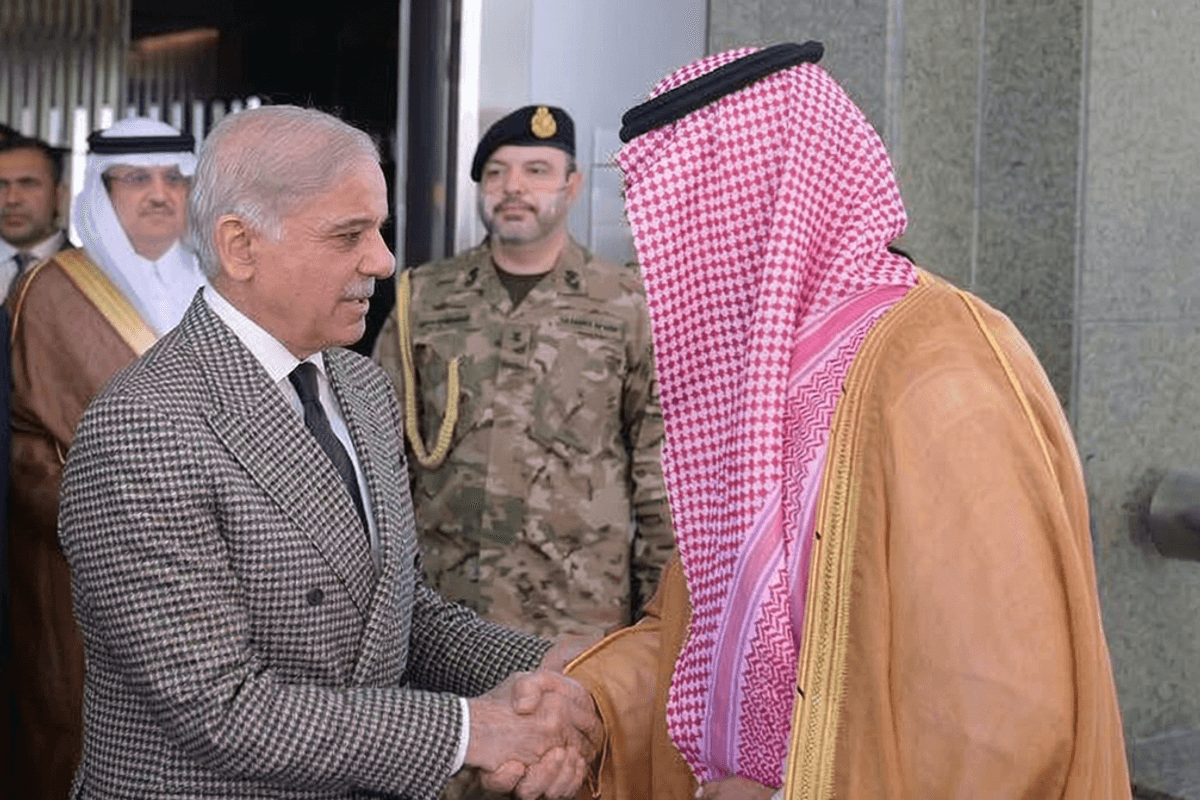
Prime Minister Shehbaz Sharif arrives in Saudi Arabia’s Red Sea city of Jeddah on March 12, 2026 for a brief official visit.
Screengrab
Prime Minister Shehbaz Sharif arrived in Saudi Arabia’s Red Sea city of Jeddah on Thursday for a brief official visit and a high-level meeting with Crown Prince Mohammed bin Salman, according to Pakistan’s Prime Minister’s Office.
The visit comes at the invitation of the crown prince, who also serves as Saudi Arabia’s prime minister, the statement said.
Sharif is scheduled to remain in the kingdom for a few hours and return to Pakistan after holding talks with the Saudi leader, it added.
Upon arrival at the Royal Terminal of King Abdulaziz International Airport, Sharif was received by Prince Saud bin Mishaal bin Abdulaziz, deputy governor of the Mecca Region, Pakistan’s Ambassador to Riyadh Ahmed Farooq, Consul General in Jeddah Syed Mustafa Rabbani and other diplomatic officials, the Prime Minister’s Office said.
During the meeting, Sharif and the crown prince are expected to hold detailed discussions on the evolving regional situation, regional security and bilateral relations, according to the statement.
The Prime Minister’s Office said the visit reflects Pakistan’s “positive and constructive diplomatic role,” adding that the country will continue to promote stability and dialogue in the region.
The trip follows a March 7 visit to Saudi Arabia by Pakistan’s Chief of Army Staff, Field Marshal Asim Munir. During that visit, Munir met Saudi Defense Minister Prince Khalid bin Salman.
Those discussions focused on Iranian missile and drone attacks targeting Saudi Arabia and measures to address escalating regional threats, according to the information provided.
The broader regional tensions began on Feb. 28, when the United States and Israel launched coordinated strikes on multiple targets in Iran. The strikes triggered Iranian missile and drone reprisals across the Gulf and drew in allied states.
Meanwhile, Pakistan’s Foreign Office said Islamabad is seeking to help de-escalate tensions in the Middle East.
Foreign Office spokesperson Tahir Andrabi said at his weekly briefing in Islamabad that Pakistan is playing the role of a “bridge builder” to ease current tensions in the region, according to state-owned Radio Pakistan.
Andrabi said Pakistan’s principled position on sovereignty, international law, the U.N. Charter, dialogue and diplomacy is respected in regional capitals, enabling it to maintain communication channels between relevant countries.
He said Pakistan has consistently urged parties involved in the conflict to adhere to three principles: respect for sovereignty and territorial integrity, refraining from the use of force within each other’s territories, and upholding international law and the principles of the U.N. Charter. He also called for the resumption of dialogue to achieve a peaceful negotiated resolution.
Addressing the situation along the Pakistan-Afghanistan border, Andrabi said Pakistan conducted targeted operations with due diligence to ensure that no civilians were harmed.
“We have nothing against Afghan citizens,” he said, adding that Pakistan considers them “our brothers and sisters” and seeks no harm to them.
He said Pakistan has asked the Afghan side to provide verifiable assurances that its territory would not be used for attacks against Pakistan. Since such assurances have not been received, he said, Islamabad will continue its existing policy toward Afghanistan.
The spokesperson also expressed concern over a long-term uranium supply agreement between Canada and India.
He said the arrangement represents another country-specific exception in nuclear cooperation and emphasized that civilian nuclear cooperation should follow a non-discriminatory, criteria-based approach applied equally to states that are not parties to the nuclear nonproliferation treaties.
Selective exceptions, he said, undermine the credibility of the global nonproliferation framework and risk destabilizing regional and global peace and security.
Pakistan and Saudi Arabia maintain close defense and security ties, including military cooperation and economic support.
In September last year, Sharif and Crown Prince Mohammed bin Salman signed a strategic mutual defense agreement under which an attack on either country would be treated as aggression against both.



Comments
See what people are discussing