

Pakistan’s petrol pumps: The government’s biggest tax collection point?
Kamran Khan questions whether the national treasury should rely on the helplessness of low-income commuters

News Desk
The News Desk provides timely and factual coverage of national and international events, with an emphasis on accuracy and clarity.
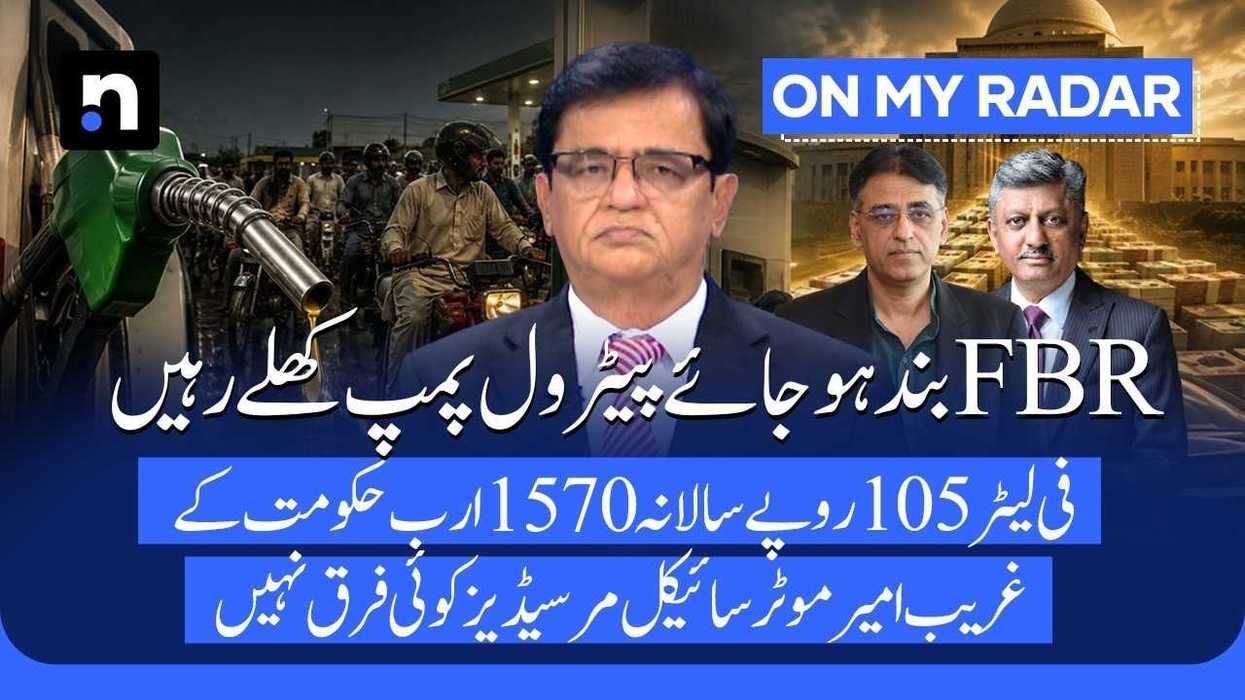
For millions of Pakistanis, filling up a motorcycle is not just a daily expense. It is also one of the government’s most reliable ways of collecting revenue.
In the latest episode of On My Radar, Kamran Khan pointed out that petrol pumps may effectively be Pakistan’s biggest tax-collection points, with motorists paying a substantial amount to the government every time they refuel.
Consider a labourer, clerk or delivery rider starting his motorcycle every morning. He is not simply buying petrol; he is also contributing to government revenue. At the current price of Rs346 per litre, around Rs124 comprises the petroleum levy, climate levy, customs duty, OMC and dealer margins, and other fixed charges. Of this, around Rs105 goes directly to the government.
One of the government’s biggest revenue tools is the Petroleum Development Levy, or PDL. Five years ago, it stood at just Rs10 per litre. Today, it is around Rs80. Over the same period, PDL revenue has risen from Rs128 billion to Rs1.567 trillion, now accounting for roughly 8% of federal revenue.
The burden becomes more striking when viewed against Pakistan’s income levels. Per capita income is around $1,900, compared with roughly $2,600 to $2,800 in India and Bangladesh.
Yet fuel remains expensive in Pakistan. Diesel costs around Rs372 per litre, compared with roughly Rs280 in India and the equivalent of about Rs260 in Bangladesh when converted into Pakistani rupees.
In other words, Pakistanis earn less but can end up paying more for fuel.
For an ordinary motorcycle rider, the monthly petrol bill can reach Rs7,000 to Rs10,000, consuming around 12% to 20% of their income.
And the impact does not stop at the petrol pump. More expensive diesel raises the cost of transport, food, construction and a wide range of other goods and services.
For many households, the pressure is felt twice: first when they fill their tank, and then again when they go to the market.
That raises a difficult question: in a country where many low-income workers depend on motorcycles simply to get to work, how much of the national revenue burden should be placed on fuel they cannot do without?
If petrol pumps have become one of the government’s most dependable tax-collection points, it is ordinary Pakistanis who are paying into that system every time they fill their tanks.



Comments
See what people are discussing