

PIMS fire exposes deeper crisis in Pakistan’s public hospitals
Kamran Khan said the tragedy raises fresh questions over PIMS' preparedness and long-standing safety lapses

News Desk
The News Desk provides timely and factual coverage of national and international events, with an emphasis on accuracy and clarity.
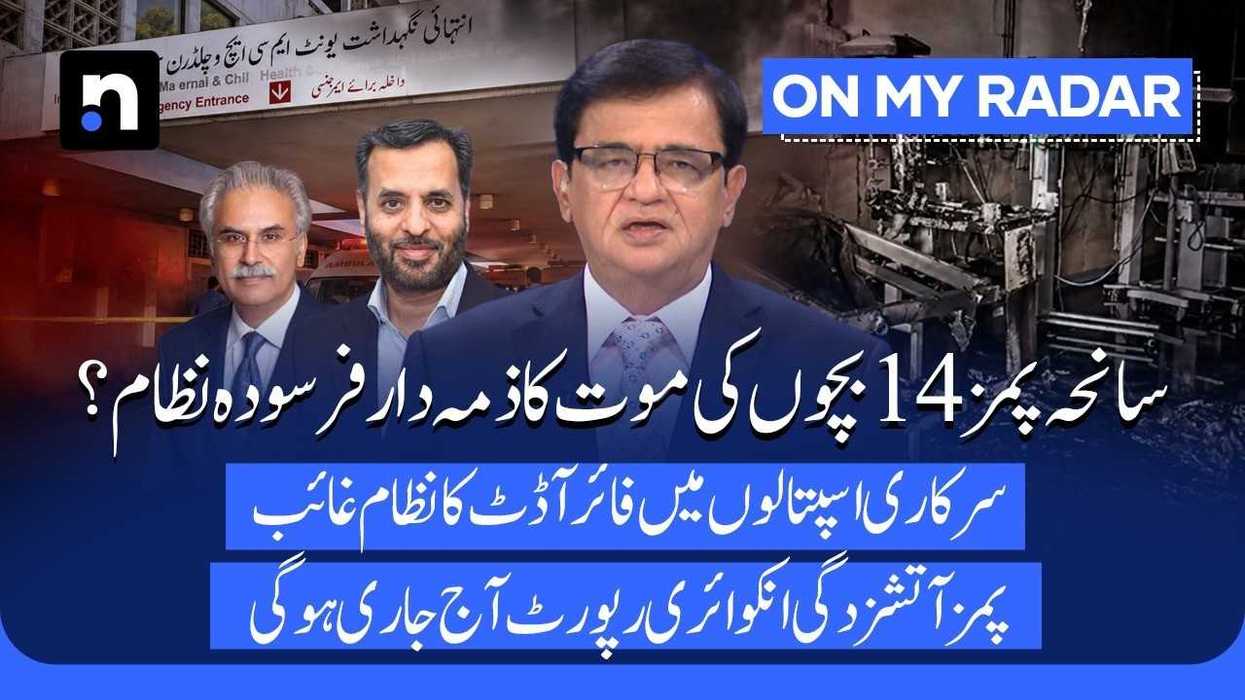
The deaths of 14 newborn babies in a fire at Islamabad’s largest public hospital have exposed a far deeper crisis than the circumstances surrounding the blaze itself: years of warnings about inadequate fire-safety measures, gaps in emergency preparedness and an apparently neglected hospital system.
The babies were laid to rest on Thursday, just a day after the fire tore through the nursery of the Pakistan Institute of Medical Sciences (PIMS). Families who had been celebrating the arrival of their children only days earlier were left mourning a loss that will stay with them for the rest of their lives.
Kamran Khan, speaking in the latest episode of On My Radar, said the tragedy should not be viewed simply as a fire incident but as a failure of the system at PIMS, where serious safety shortcomings had allegedly been identified years before the blaze.
A complete investigation into the incident is still awaited, but preliminary findings have already raised serious questions about what happened inside the Mother and Child Health Ward and whether the tragedy could have been prevented.
According to preliminary findings, a spark was seen near an air conditioner in the nursery at 6:38 a.m. on Wednesday. About a minute later, an explosion was heard and part of the ceiling collapsed. Initial accounts suggested that a short circuit or malfunction in the air conditioner had triggered the fire, which was then intensified by the high concentration of oxygen in the nursery.
However, Mahesh Kumar Malani, chairman of the National Assembly’s Standing Committee on Health, has questioned that explanation. Malani said the old air conditioner had reportedly been out of service for some time and that CCTV footage did not establish that the fire had started there.
But the cause of the fire may ultimately prove less important than another question: why was a critical hospital facility so poorly prepared to deal with one?
A fire audit conducted by the Capital Development Authority found serious deficiencies in PIMS’ fire-safety arrangements. Several fire extinguishers were expired, while the number available was considered insufficient. The hospital also lacked an automatic sprinkler system that could help contain a fire by releasing water.
Emergency lighting and fire doors were incomplete, while trained fire-safety personnel were not available around the clock. The audit also found that PIMS did not have an underground firefighting water tank or pump.
More troubling is the fact that these shortcomings were apparently not new.
Fire and disaster management officials of the Metropolitan Corporation Islamabad had been issuing notices to PIMS since 2018, warning that its fire-prevention, fire-protection and life-safety systems were incomplete. Yet the deficiencies remained unresolved.
One report also said PIMS did not have the required fire-safety NOC when the fire broke out.
The rescue operation raised further concerns. Emergency routes were reportedly blocked or obstructed, forcing rescue workers to break windows to enter the affected area. At a hospital where newborns should have been among the most protected patients, rescuers allegedly struggled simply to gain access to them.
There are also conflicting accounts of the emergency response. PIMS management says two doctors and four nurses were on duty when the fire broke out, while eyewitnesses alleged that staff were not present.
The government moved quickly after the tragedy. Prime Minister Shehbaz Sharif removed the federal health secretary, while Health Minister Mustafa Kamal came under intense pressure. Kamal submitted his resignation to the prime minister three hours after the incident, but Shehbaz declined to accept it.
Shehbaz later formed a five-member investigation committee headed by former federal interior secretary Shahid Khan. The committee has submitted its report to the prime minister, although questions over accountability and the hospital’s longstanding safety failures remain.
The PIMS fire claimed the lives of 14 newborns, but its implications extend far beyond one hospital.
If Islamabad’s largest public hospital had such serious gaps in fire prevention and emergency preparedness despite years of warnings, the obvious question is what lies behind the doors of other major public hospitals across Pakistan.
What is the situation at Karachi’s Jinnah Hospital, Lahore’s Mayo Hospital, Peshawar’s Lady Reading Hospital and Quetta’s Civil Hospital?
Do they have functioning fire alarms and sprinkler systems? Are emergency exits accessible? Are trained fire-safety teams available around the clock? And when was the last time these hospitals conducted a proper fire or mock evacuation drill?
The tragedy at PIMS should not become another incident that fades from public attention once the headlines disappear. The real test is whether the warnings that preceded it will finally be taken seriously — before another hospital becomes the scene of another preventable tragedy.



Comments
See what people are discussing