

Saudi-Turkey-Pakistan defence pact creates new security alliance in Middle East
Saudi-Turkey-Pakistan defence pact establishes a mutual defence agreement to address Iranian threats and shifting reliance on the United States

News Desk
The News Desk provides timely and factual coverage of national and international events, with an emphasis on accuracy and clarity.
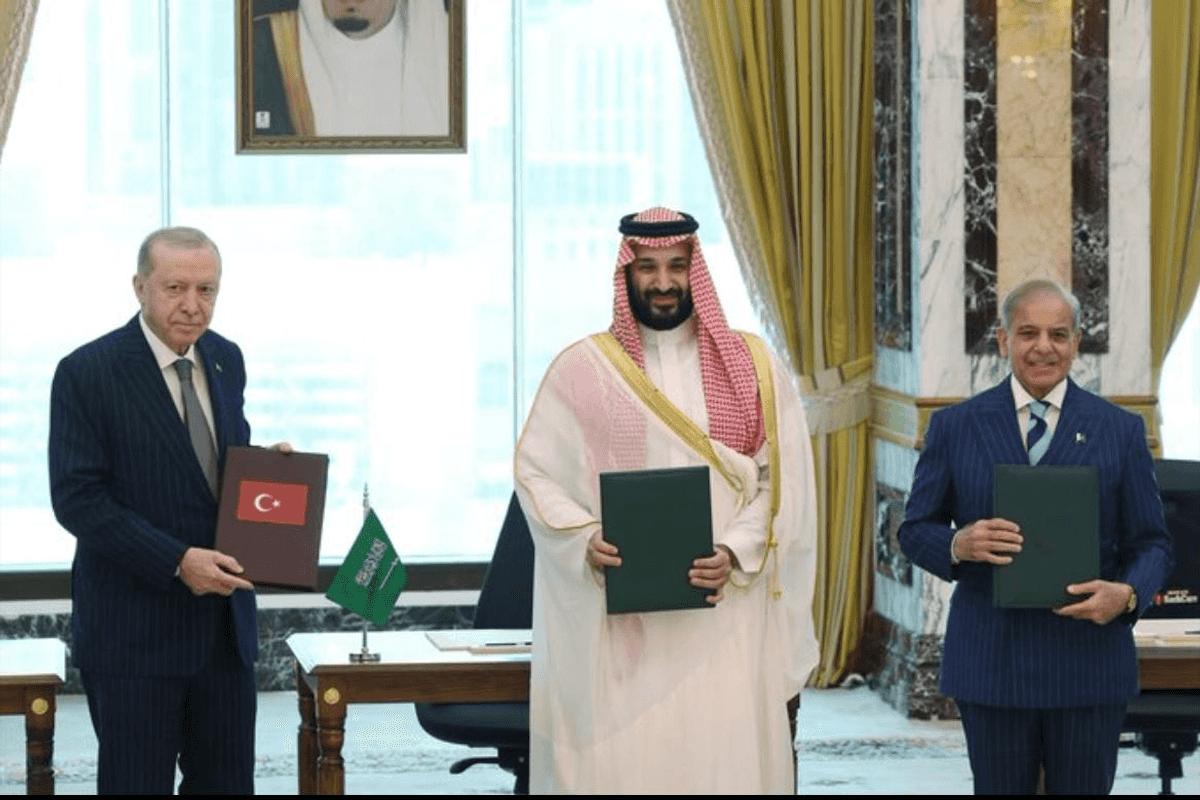
Saudi Arabia, Turkey, and Pakistan signed a historic Saudi-Turkey-Pakistan defence pact in Mecca, establishing a major security alliance across the Middle East. The three strategic nations formed a NATO-style agreement to deter Iranian aggression, counterbalance declining reliance on the United States, and send a clear political signal to Israel amid ongoing regional conflict.
What is the Saudi-Turkey-Pakistan defence pact?
The agreement binds three powerful Sunni nations under a mutual defence clause where an attack on one member is considered an attack on all. Saudi Arabia provides financial capital, Turkey contributes advanced military technology, and Pakistan offers nuclear deterrence and manpower. The pact creates an alternative regional security framework to manage local threats independently.
Six months into the regional conflict, American forces have struggled to intercept every drone and ballistic missile launched by Iran and its regional proxies. Tehran continues to restrict maritime traffic around the Strait of Hormuz while Houthi forces disrupt crucial shipping routes across the Red Sea. These persistent disruptions forced Gulf leaders to rethink traditional security assumptions built on guaranteed United States military dominance.
Political analyst Ali Shihabi observed that deteriorating American deterrence compels regional powers to manage security threats directly. Consequently, Saudi officials cultivated stronger diplomatic ties with Ankara, Cairo, and Islamabad to build alternative regional security arrangements. Although Riyadh and Islamabad maintained previous bilateral military ties, this broader partnership significantly expands collective strategic cooperation among the signatory countries.
Will Turkey and Pakistan military forces attack Iran?
Security experts consider military retaliation against Tehran unlikely if Iranian forces launch additional strikes against Saudi infrastructure. Pakistan refrained from launching military strikes against its Iranian neighbor despite maintaining a similar defense treaty with Riyadh last year. Brookings Institution fellow Asli Aydintasbas noted that Ankara and Islamabad view their military roles as regional stabilizers aimed at creating political momentum for diplomatic resolutions.
Royal United Services Institute analyst H.A. Hellyer emphasized that the tripartite treaty functions as a potent symbolic signal toward both Tehran and Tel Aviv. The complementary alliance merges oil wealth, technological manufacturing, and nuclear capabilities into a unified strategic bloc. While the trio cannot replace Washington entirely, they effectively bridge critical security gaps caused by American reluctance to restrain Israeli actions or insulate Gulf energy assets.
How does the Saudi-Turkey-Pakistan defence pact affect Middle East politics?
The emerging partnership consolidates key American allies into an independent security architecture that actively rejects Israeli regional dominance. Washington previously sought to integrate Israel into regional defense plans through expanded normalization agreements under the Abraham Accords framework. However, Riyadh continues to insist on a clear pathway toward Palestinian statehood before considering formal diplomatic normalization with Tel Aviv.
This new coalition also impacts internal dynamics within the Gulf Cooperation Council, where strategic divisions previously emerged between regional partners. While Saudi Arabia and the United Arab Emirates recently repaired public rifts, Emirati officials remain cautious regarding this new defense structure. The agreement demonstrates a clear determination among member states to interrupt both Iranian expansionism and Israeli military supremacy across the Middle East.



Comments
See what people are discussing