

Syria and France collaborate to develop Damascus transit hub for global trade
Syria and France are partnering to establish a Damascus transit hub for global trade, offering secure alternatives to the volatile Strait of Hormuz

News Desk
The News Desk provides timely and factual coverage of national and international events, with an emphasis on accuracy and clarity.
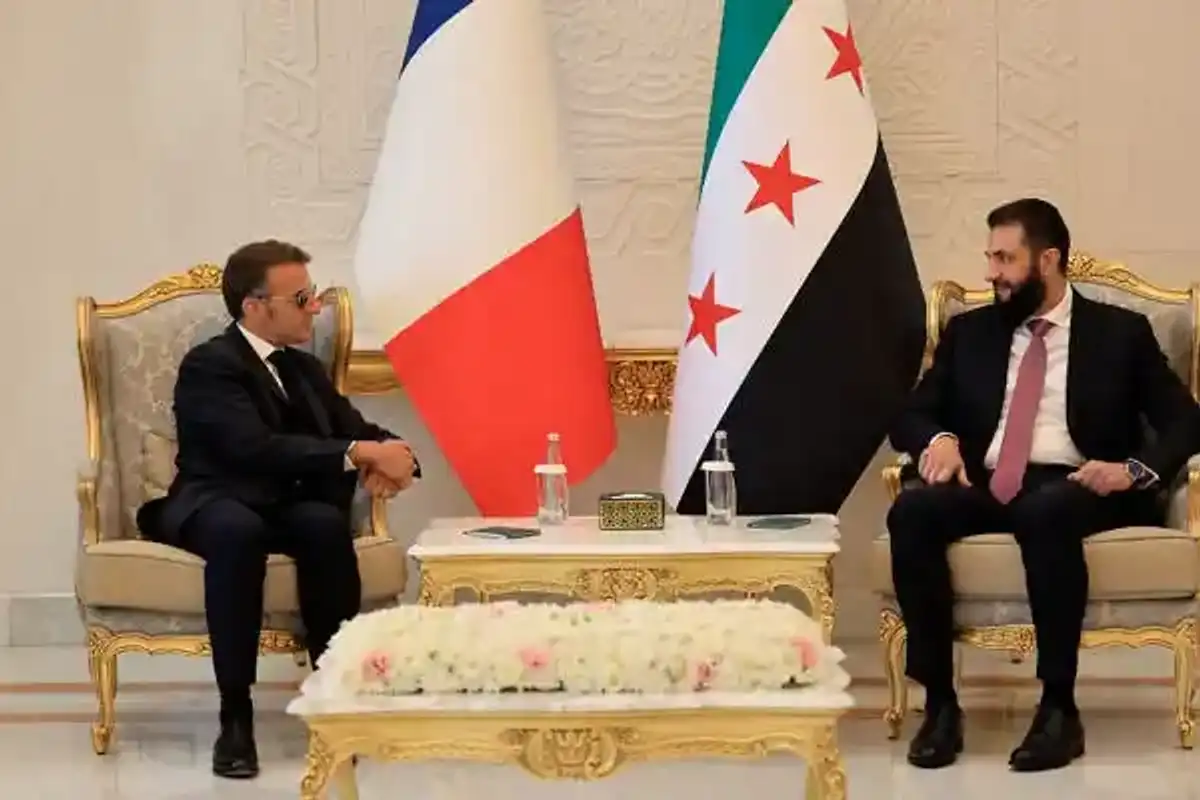
France's President Emmanuel Macron (L) and Syria's President Ahmed al-Sharaa attend a meeting at the People's Palace in Damascus on July 7, 2026.
AFP
Syrian President Ahmed al-Sharaa and his French counterpart Emmanuel Macron announced plans on Tuesday to establish a Damascus transit hub for global trade.
Meeting in the Syrian capital, the leaders outlined strategies to position the country as a vital economic link following recent regional maritime disruptions.
Why do Syria and France want to build a Damascus transit hub?
The two nations aim to construct secure overland corridors to safeguard international logistics chains from volatility in the Strait of Hormuz. This strategic partnership will allow global shipping companies to bypass risky maritime routes while accelerating Syria's post-war infrastructure reconstruction efforts.
President Sharaa highlighted the critical value of stable trade corridors during a major post-war economic reconstruction forum held in the capital.
He asserted that the unique geography of the nation has officially regained its vital role as an indispensable link in global logistics. The Syrian administration explicitly requested that France serve as its primary corporate partner to spearhead this multi-billion-dollar infrastructure modernization initiative.
The current state framework establishing economic ties with Paris represents the foundational model that Damascus intends to replicate across Europe.
President Macron arrived for the second day of his official state visit, accompanied by several senior executives from prominent French companies. The French leader expressed strong interest in transforming the country into a long-term regional centerpiece for multinational corporate strategies.
Specialized Western enterprises intend to construct next-generation energy pipelines and secure digital data routes directly across the recovered sovereign territory. Macron emphasized that this terrestrial alternative would successfully minimize the commercial risks inherent to maritime operations in the Persian Gulf. He noted that local geopolitical challenges remain substantial but maintained that French commercial interests align perfectly with the broader regional stabilization effort.
What business agreements have Syria and France signed?
Both governments signed a series of bilateral trade agreements during the forum, though European investors continue to approach the market cautiously. The commercial momentum builds upon a previous 30-year contract signed last May with the prominent French shipping and logistics giant CMA CGM. That initial maritime infrastructure deal is valued at approximately 230 million euros and targets major port management modernizations along the coast.
The nation additionally completed a joint memorandum of understanding to advance offshore oil and gas exploration across its territorial waters.
This expansive energy consortium involves major corporate participation from international powerhouses including TotalEnergies, QatarEnergy, and the American firm ConocoPhillips. President Sharaa urged the visiting delegation to transition immediately from preliminary expressions of intent to binding contracts with explicit execution timetables.
The administration aims to foster organic, long-term partnerships directly between European corporate entities and the expanding Syrian domestic private sector. Local authorities believe that executing these concrete transport projects will quickly revitalize the urban economy and create sustainable employment opportunities.
International shipping experts will monitor the progress of these land-based networks as global trade continues to seek protection from naval chokepoints.




Comments
See what people are discussing