

Trump hints Iran war nearing end as oil plunges and markets rebound
Uncertainty lingers despite Trump’s claim Iran’s military capacity is destroyed

News Desk
The News Desk provides timely and factual coverage of national and international events, with an emphasis on accuracy and clarity.
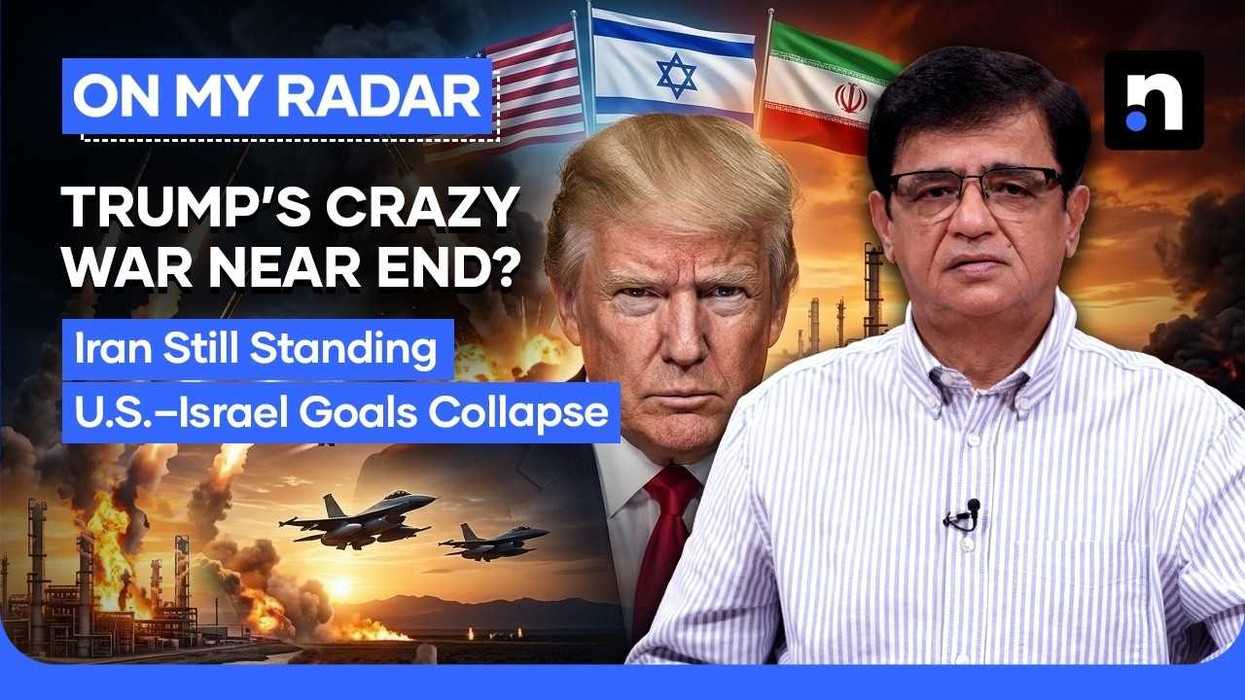
The world has spent 11 days watching a war that until recently appeared prolonged and dangerously unpredictable, Kamran Khan said on his program “On My Radar.”
The sudden conflict involving the United States, Israel and Iran pushed global politics, diplomacy and financial markets into turmoil, he said. But in the past 24 hours, he noted, events took an unexpected turn after remarks by U.S. President Donald Trump signaled a possible shift.
According to Kamran Khan, Trump indicated in multiple statements that the joint U.S.-Israeli military campaign against Iran may be entering its final phase.
In one interview, Trump described the war as “almost complete,” claiming Iran’s naval, air force and communications capabilities had been destroyed. In separate remarks in Florida to Republican lawmakers, he referred to the conflict as a “short-term excursion,” Kamran Khan said.
Global financial markets interpreted the statements as a signal that Washington may be preparing to wind down the conflict.
Oil, which had surged to $119 per barrel during the height of tensions, fell 23% to $92 within a day. The sharp reversal followed days of volatility driven by fears over supply disruptions in the Middle East.
In Pakistan, the Pakistan Stock Exchange staged a historic rebound. After recording its largest single-day crash earlier, the KSE-100 index closed up 9,697 points at 156,177. During the 11-day conflict, the market twice suffered declines of 16,000 points, underscoring the scale of investor anxiety.
Despite the relief rally, uncertainty persists, Kamran Khan said, pointing to Trump’s shifting objectives since the conflict began.
At the outset, the stated goal was to dismantle Iran’s nuclear capability. That focus later shifted to weakening Iranian military infrastructure. Subsequent rhetoric expanded to undermining the Iranian government itself. At one stage, Trump suggested Washington should decide who Iran’s next supreme leader would be.
Critics, Kamran Khan said, have described the evolving aims as evidence of an unclear political endgame despite decisive military action.
The most immediate fallout has been in global energy markets. The temporary closure of the Strait of Hormuz — a critical artery for global oil shipments — sent shockwaves through the world economy.
Oil prices rose 60% in a week before retreating on Trump’s latest remarks.
According to the Financial Times, Europe was among the hardest hit by the energy shock. European governments began mobilizing quickly. France’s finance minister announced the release of strategic oil reserves to stabilize markets.
French President Emmanuel Macron also announced preparations for a defensive escort mission in the Middle East to help secure container ships and oil tankers transiting the Strait of Hormuz.
Macron said the objective was to ensure the safe reopening of the key trade route once the most intense phase of the conflict subsides.
Iran, however, has warned that full security in the strait cannot be guaranteed while hostilities continue.
Senior Iranian officials have signaled that continued military pressure would have consequences for global energy flows. Security chief Ali Larijani warned that as long as fighting persists, stability in the waterway remains uncertain.
A spokesperson for a wing of the Islamic Revolutionary Guard Corps, Ebrahim Zolfighari, said U.S. strikes on Iran’s energy infrastructure had opened a new chapter in the conflict. He warned that if global markets could withstand oil at $200 per barrel, “then continue this game.”
Major powers are increasingly engaged.
China, the world’s largest crude importer, views the conflict as a threat to global energy stability, Kamran Khan said. Chinese leadership has conveyed that prolonged instability in the Gulf is unacceptable for the global economy.
Russia has also called for urgent dialogue. President Vladimir Putin has signaled Moscow’s readiness to mediate, framing the conflict as one with implications beyond the Middle East and into the broader Eurasian security balance.
Domestic U.S. politics are another factor, Kamran Khan said.
American history shows that rising fuel prices can trigger political crises for presidents. As gasoline costs increase, inflationary pressure spreads and public dissatisfaction grows. With elections approaching, sustained high energy prices could pose a political challenge for Trump.
Inside Iran, expectations that sustained airstrikes would fracture the state have not materialized, Kamran Khan said.
Despite heavy losses, Iran’s governing structure remains intact. Public demonstrations in several cities have expressed support for the leadership.
Following the elevation of Mojtaba Khamenei, son of the late Supreme Leader Ali Khamenei, large gatherings were reported in Tehran’s Enghelab Square, where thousands pledged loyalty.
Kamal Kharazi, foreign policy adviser to the late supreme leader, said in an interview that there was currently no room for diplomacy. Iran, he said, was prepared for a prolonged war, and only economic pressure could ultimately end the conflict.
Kamran Khan said the war now appears to be approaching a decisive juncture.
Whether it ends through quiet diplomacy, a unilateral declaration of “mission accomplished” from Washington, or mounting economic pressure forcing compromise remains unclear.
What is evident, he said, is that the final decision may be shaped less on the battlefield and more by global energy markets and political calculations far beyond the front lines.



Comments
See what people are discussing