

Trump pushes Abraham Accords as US-Iran peace framework nears completion
Kamran Khan says Washington wants regional states, including Pakistan, to join proposed normalization push

News Desk
The News Desk provides timely and factual coverage of national and international events, with an emphasis on accuracy and clarity.
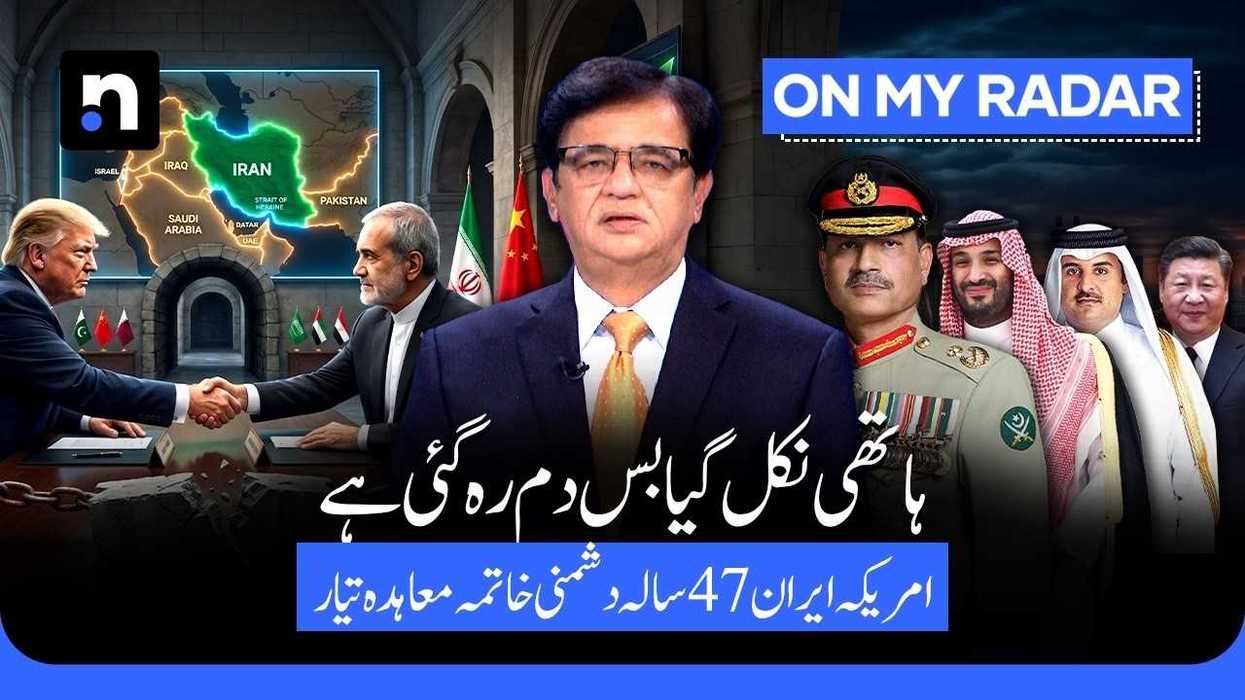
A potential peace agreement between the United States and Iran appears to be taking shape after weeks of conflict, missile strikes and global economic uncertainty, with President Donald Trump saying a deal has been “largely negotiated” and Iranian officials confirming progress in talks.
In the latest episode of “On My Radar,” Kamran Khan said the most significant development came after Trump declared participation in the Abraham Accords “mandatory” not only for Iran but also for countries involved in the negotiations.
According to Trump, he held discussions on Saturday with the leadership of Saudi Arabia, United Arab Emirates, Qatar, Pakistan, Turkey, Egypt, Jordan and Bahrain, telling them that after Washington’s efforts to resolve the crisis, all these countries should simultaneously join the Abraham Accords.
Trump said the process should begin immediately with Saudi Arabia and Qatar signing the accord. He also said it would be an honor to include Iran in what he described as an “extraordinary global alliance.”
Iran’s Foreign Ministry also confirmed progress in peace negotiations, saying the framework of an agreement was nearly complete.
According to front-page reports by The Washington Post and The New York Times cited in the program, Washington and Tehran are finalizing a memorandum of understanding that could extend the current ceasefire for another 60 days while broader political negotiations continue.
Diplomatic sources said the initial draft of the MOU is awaiting approval from Iran’s top leadership and Supreme Leader, making Tehran’s final decision critical to the process.
Iranian media reported that Parliament Speaker Mohammad Bagher Ghalibaf and Foreign Minister Abbas Araghchi arrived in Doha for talks with Qatar’s emir and senior officials.
According to Reuters and AFP, discussions are focused on the Strait of Hormuz, enriched uranium and economic sanctions.
The developments followed a day of intense diplomacy by Pakistan Army Chief Field Marshal Asim Munir in Tehran on Saturday. He held three meetings with Araghchi, talks with Iranian President Masoud Pezeshkian and separate discussions with Ghalibaf.
Chinese President Xi Jinping also praised Pakistan’s role in the Iran crisis and thanked Islamabad for peace efforts, specifically mentioning Munir’s role in the negotiations, according to the program.
Trump had earlier written on social media that a peace agreement with Iran had been “largely negotiated,” but later cautioned that Washington would not rush the process. In another message apparently directed at his domestic political opponents, Trump said the agreement was not yet finalized and that nobody had seen all its details.
Iranian Foreign Ministry spokesperson Esmaeil Baghaei said on Monday that talks with the United States mediated by Pakistan had made some progress, but warned that this did not mean a signing was imminent.
“Several points have already been decided,” Baghaei said during a news conference in Tehran.
He had earlier said on Sunday that some issues still required further discussions through mediators and that the next three to four days would be “extremely important.”
Meanwhile, Pezeshkian said Tehran did not seek nuclear weapons and was prepared to assure the world that Iran was not pursuing a nuclear weapons program.
Prime Minister Shehbaz Sharif said Islamabad would continue its peace efforts “with full seriousness” and expressed hope that the next round of negotiations could soon take place in Pakistan.
News of a possible U.S.-Iran agreement boosted global financial markets, with international stock indexes approaching record highs and Asian shares rising about 1.4%.
Oil prices fell sharply on expectations of reduced tensions. Brent crude dropped more than 5% to $97.70 per barrel, its lowest level in more than two weeks, while U.S. WTI crude also fell over 5% to trade at $91.37 per barrel.
Pakistan’s stock market also rallied strongly, with the KSE-100 index gaining more than 3,600 points within minutes of the opening bell.
The program concluded by asking whether Washington and Tehran were truly on the verge of a historic reconciliation, as the world waits for a formal announcement that could mark the beginning of a new phase of stability in the Middle East.



Comments
See what people are discussing