

Trump shifts Iran conflict to economic blockade
Kamran Khan says Trump ended open war but is using a naval blockade to force Iran into a deal

News Desk
The News Desk provides timely and factual coverage of national and international events, with an emphasis on accuracy and clarity.
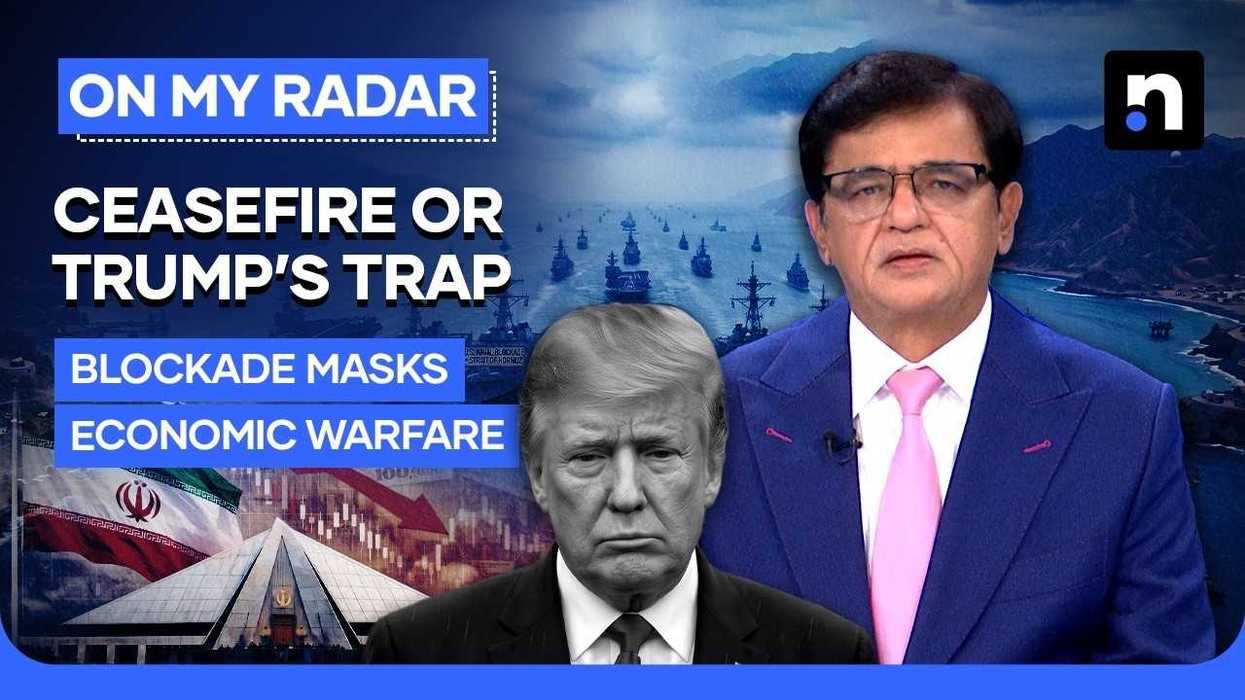
Kamran Khan says the United States has effectively ended direct military conflict with Iran but replaced it with an economic strategy centered on blocking Tehran’s oil exports and maritime trade.
Speaking on his program “On My Radar,” Khan said the ceasefire between Washington and Tehran now appears open-ended after comments from the White House press secretary, who said the truce was not limited to three or five days but would continue indefinitely.
He said that while fighting may have paused, U.S. pressure on Iran remains active through what he described as a naval blockade.
Khan said President Donald Trump is attempting to preserve America’s remaining global standing by using economic leverage instead of a prolonged battlefield campaign.
He said Trump posted on Truth Social that the United States had full control over the Strait of Hormuz and that no vessel could pass without U.S. Navy permission. Khan said Trump declared the route would remain shut until Iran agreed to a deal.
The Strait of Hormuz is one of the world’s most important energy shipping lanes, carrying a large share of global oil exports.
Khan said Iran is publicly resisting U.S. demands but is increasingly trapped by economic pressure.
He cited a social media statement from Iranian President Masoud Pezeshkian, who said Iran has always welcomed negotiations and agreements, but distrust, siege tactics and threats remain major barriers to talks.
Khan said Iranian Parliament Speaker Mohammad Bagher Ghalibaf also warned that any ceasefire would be meaningless if it was violated through continued naval pressure.
He said the Trump administration may have shifted tactics partly because the conflict had become costly for Washington.
According to Khan, citing CNN, the United States spent $60 billion during 55 days of war, averaging about $1.2 billion per day.
He also said Trump had suffered politically, claiming the president’s popularity had sharply declined and some allies were distancing themselves.
Khan said tensions were also visible inside the U.S. government, particularly at the Pentagon.
He said Defense Secretary Pete Hegseth had dismissed Navy Secretary John Phelan and had already removed nearly two dozen senior military officers, including former Army Chief of Staff Gen. Randy George.
Despite internal strain, Khan said one factor still favors Trump: growing economic pressure on Iran.
He cited The Washington Post as saying Trump does not urgently need a deal on Iran’s terms, while Tehran may now need an agreement more quickly than Washington.
Khan said repeated military strikes had already weakened Iran, while the blockade was now inflicting severe damage on the country’s economy.
He said U.S. Central Command believes Iran’s maritime trade has been severely disrupted.
Khan added that about 95% of Iran’s trade moves through the Strait of Hormuz. If oil exports cannot continue, Iran would need to store unsold crude, but existing storage capacity may last only two weeks.
Once storage fills up, he said, Iran could be forced to halt oil extraction, risking long-term damage to production infrastructure and state revenues.
Khan said that could eventually affect Tehran’s ability to pay its military forces, including the Revolutionary Guard.
He said the key question now is how long the U.S. blockade can continue and whether it can push Iran back to the negotiating table.




Comments
See what people are discussing