


News Desk
The News Desk provides timely and factual coverage of national and international events, with an emphasis on accuracy and clarity.
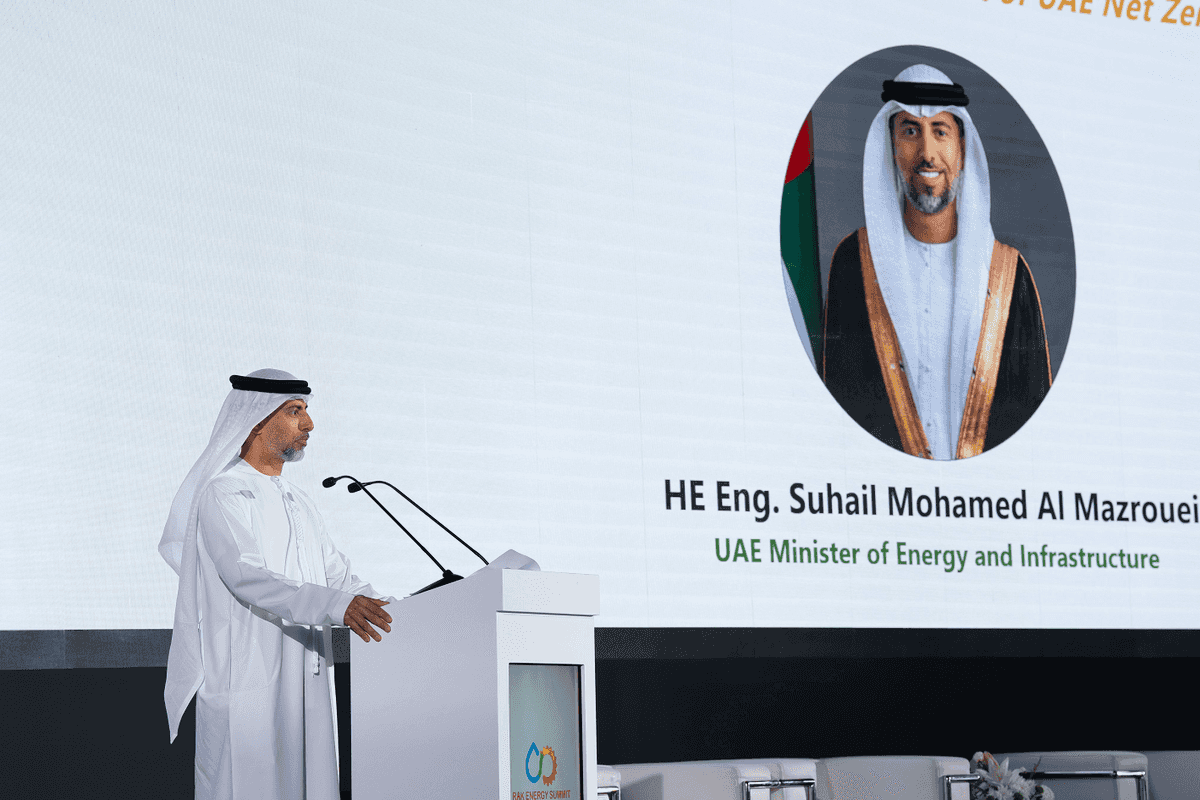
UAE minister said advances in renewable energy and battery technology have made the higher target achievable.
WAM
The UAE has raised its clean energy target from 30% to 35% of its electricity mix by 2031, Energy and Infrastructure Minister Suhail bin Mohammed Al Mazrouei said on Wednesday.
He spoke at the opening of the third RAK Energy Summit at RAK Expo Centre in Ras Al Khaimah, linking the move to energy diversification and water supply security, according to WAM.
Why did the UAE raise its clean energy target?
Al Mazrouei said renewable energy has become more competitive and battery technology has improved, which made the higher target possible.
He also said disruptions to energy supplies in parts of the world show why countries need strategies suited to their own circumstances. Such strategies should be revisited as those circumstances change, he added.
Where does the UAE get its electricity from?
The UAE adopted a policy of diversifying its energy supply early, Al Mazrouei said. Its electricity system relies on solar, natural gas and nuclear power, and he said gas helps keep supplies reliable as renewable use expands.
Installed renewable capacity reached about 8.2 gigawatts (GW) in 2025, according to the minister. The UAE aims to raise solar capacity to around 23 GW by 2031, and to have 5.6 GW of nuclear capacity.
How is the UAE planning to boost its water supply?
The minister said the UAE is considering new desalination plants along the eastern coast, using advanced technologies and linked to water transmission networks.
The aim is to raise production capacity and diversify where water is produced. The UAE is also looking at expanding storage in underground reservoirs.
How will the UAE cut energy and water use in buildings?
Al Mazrouei said a retrofit project for federal government buildings aims to cut energy and water use in the targeted buildings by up to 27%. He pointed to opportunities to extend AI-powered building management systems to other sectors and to explore incentives for adopting more efficient solutions.
The Ministry of Energy and Infrastructure is working with federal and local bodies to share expertise and draw on results from efficiency measures already in place, he said. He also said road, logistics and energy projects are expected to expand over the next five years.



Comments
See what people are discussing