

US-Iran deal prospects grow as Pakistan, Qatar, Oman step up diplomacy
Kamran Khan says CDF Asim Munir’s Iran visit removes key hurdles to renewed US-Iran talks and builds diplomatic momentum.

News Desk
The News Desk provides timely and factual coverage of national and international events, with an emphasis on accuracy and clarity.
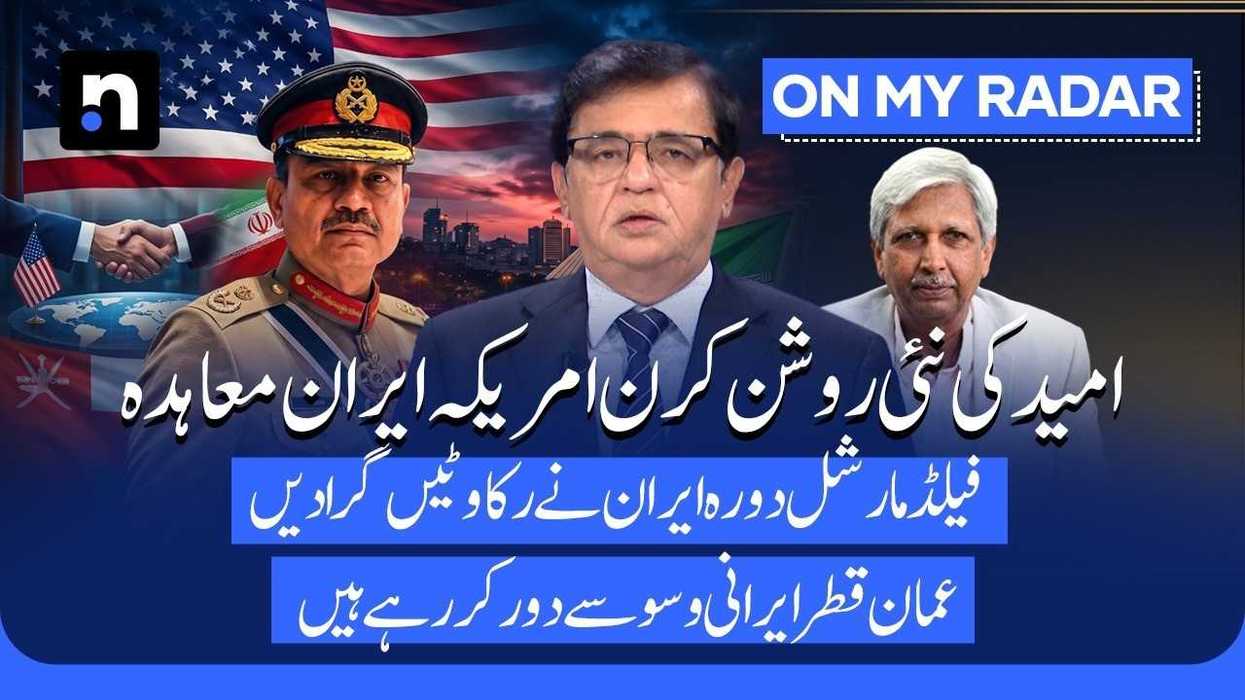
Diplomatic efforts to revive an agreement between the United States and Iran appear to be gathering momentum, with Pakistan, Qatar and Oman stepping up engagement with Tehran as Washington shifts towards economic pressure and the conflict enters its sixth month.
In the latest episode of On My Radar, Kamran Khan said Field Marshal Asim Munir's recent visit to Iran had played a significant role in removing key obstacles to renewed US-Iran negotiations. He said Munir's high-level meetings with Iran's leadership had resulted in important progress and helped create fresh diplomatic momentum.
The visit received an unusually positive response from Tehran. Interior Minister Mohsin Naqvi, who accompanied Munir, described it as an "extremely important development" towards peace, while Iranian President Masoud Pezeshkian's office called the visit "highly productive" and an "important diplomatic success".
According to Al Arabiya, Munir held a key meeting with Mohsen Rezaei, secretary of Iran's Supreme National Security Council and representative of Supreme Leader Ayatollah Ali Khamenei. During the meeting, Munir urged Tehran to take steps to reopen the Strait of Hormuz and halt attacks by Iran-linked proxy groups. In return, Washington has offered to lift economic sanctions on Iran and end its naval blockade, according to the report.
Munir also pressed Iran to resume implementation of the memorandum of understanding reached between Islamabad and Washington in June, Khan said.
The diplomatic activity continued immediately after Munir's visit, with Oman's foreign minister travelling to Tehran. Iranian and Omani officials subsequently announced a framework for a temporary shipping corridor through the Strait of Hormuz, although details of the arrangement remain unresolved.
The development helped ease pressure in global oil markets, with crude prices falling for a fourth consecutive day. Brent crude slipped to about $87 a barrel, while West Texas Intermediate fell to around $82.
Qatar has also entered the diplomatic effort. Prime Minister and Foreign Minister Sheikh Mohammed bin Abdulrahman bin Jassim Al Thani arrived in Tehran and held talks with Iranian Foreign Minister Abbas Araghchi and other senior officials.
Qatar's foreign ministry said the discussions focused on regional developments, efforts to reduce tensions and creating conditions for renewed negotiations between Washington and Tehran. The two sides also stressed the need for de-escalation and dialogue to strengthen regional security and stability.
Iranian President Masoud Pezeshkian, meanwhile, called for greater unity among Muslim countries while addressing the Islamic Unity Conference in Tehran. He said that despite political differences, no Muslim country should allow its territory to be used against another Muslim state.
The diplomatic push comes as the conflict approaches its sixth month. With U.S. military operations in the region largely halted and the U.S. Central Command reporting no new attacks on Iran for nearly a month, Washington appears to be relying increasingly on economic pressure rather than further military action.
For President Donald Trump, the prolonged conflict has increasingly become a difficult and politically costly stalemate, while the absence of a diplomatic breakthrough continues to keep the region on edge.



Comments
See what people are discussing