

How the US-Saudi nuclear deal could reshape the Middle East
Kamran Khan says the deal extends far beyond civilian energy and reshapes Middle East geopolitics

News Desk
The News Desk provides timely and factual coverage of national and international events, with an emphasis on accuracy and clarity.
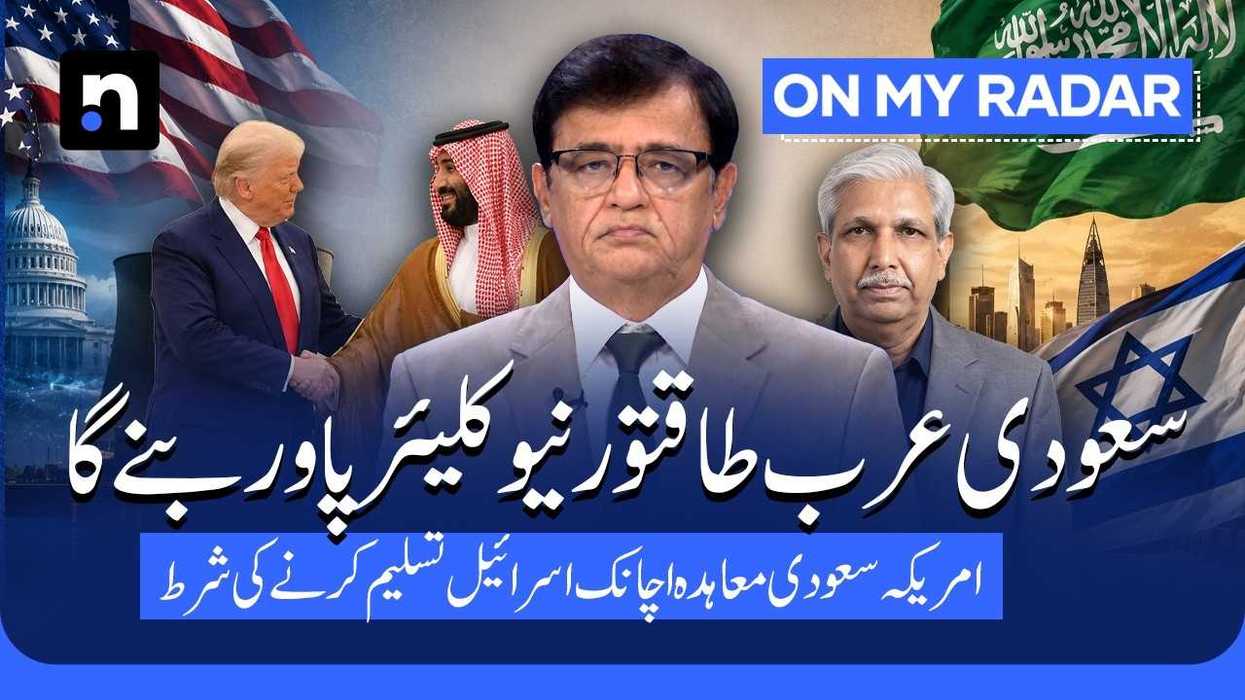
A landmark civil nuclear agreement between the United States and Saudi Arabia has the potential to reshape the strategic landscape of the Middle East, with implications extending well beyond energy cooperation.
The 30-year accord could alter the regional balance of power, influence the nuclear calculations of Iran and Israel, redefine Washington's partnerships in the Gulf, and create new opportunities for countries such as Pakistan.
Kamran Khan said in the latest episode of On My Radar that the agreement should not be viewed simply as a civilian energy project. He argued that it represents one of the most consequential geopolitical developments in the Middle East in recent years, with the potential to redraw strategic alignments involving the United States, Saudi Arabia, Iran, Israel, China and Russia.
Under the agreement, U.S. companies will build nuclear power plants in Saudi Arabia, provide advanced technology and cooperate with the kingdom on the development of its civilian nuclear sector over the next three decades. However, less than 24 hours after the deal was announced, President Donald Trump introduced a new political dimension by linking congressional approval to Saudi Arabia's willingness to join the Abraham Accords.
In a statement on social media, Trump said the agreement would proceed only if Saudi Arabia agreed to normalize relations with Israel by joining the Abraham Accords. The UAE, Bahrain, Sudan and Morocco joined the U.S.-brokered normalization framework after its launch in 2020. Saudi Arabia has yet to respond publicly to Trump's remarks.
While the agreement is officially centered on civilian nuclear energy, analysts say its strategic significance lies in Saudi Arabia's reported ability to pursue uranium enrichment. According to reports, the proposed framework would permit the kingdom to enrich uranium and reprocess spent nuclear fuel—provisions that go beyond the commitments made by the United Arab Emirates under its 2009 nuclear cooperation agreement with Washington, in which Abu Dhabi renounced both uranium enrichment and plutonium reprocessing.
The U.S. administration says the agreement complies with the non-proliferation requirements of the U.S. Atomic Energy Act, one of the world's most stringent legal frameworks governing civilian nuclear cooperation. However, the reported framework does not include the Additional Protocol that would authorize the International Atomic Energy Agency (IAEA) to conduct short-notice inspections, a point that has drawn scrutiny from lawmakers and nuclear non-proliferation experts.
The agreement is expected to be submitted to the U.S. Congress, where opponents would need a two-thirds majority within 90 days to block it. Given the current political balance in Congress, many analysts believe such a threshold would be difficult to achieve.
Beyond nuclear cooperation, the agreement also serves a broader geopolitical objective by reinforcing U.S. influence in the Gulf and reducing the likelihood that Saudi Arabia would seek nuclear partnerships with China or Russia. Riyadh has consistently said its civilian nuclear ambitions are aimed at reducing dependence on oil, meeting rising electricity demand and supporting its Vision 2030 economic transformation agenda. Crown Prince Mohammed bin Salman has previously stated that if Iran were ever to acquire a nuclear weapon, Saudi Arabia would pursue the same capability for its own security.
Experts believe Iran will be among the countries most affected by the agreement. Tehran has long defended uranium enrichment as a sovereign right under international law. If Saudi Arabia is granted comparable capabilities under a U.S.-backed framework, Iran may find it more difficult to argue that Washington applies different standards to its regional partners.
Pakistan also occupies an important place in the evolving regional equation. Islamabad and Riyadh signed a wide-ranging defense cooperation agreement in September last year, building on decades of military collaboration, intelligence sharing and joint exercises. Thousands of Pakistani military personnel have served in Saudi Arabia over the years, reinforcing one of the region's closest defense partnerships.
Although Western media and several think tanks have speculated that the Pakistan-Saudi defense relationship could eventually extend to nuclear cooperation, neither government has ever confirmed such claims. Nevertheless, Saudi Arabia's expanding civilian nuclear program could open new avenues for collaboration with Pakistan in nuclear engineering, safety, regulation, nuclear medicine and technical training.
Taken together, the U.S.-Saudi nuclear agreement is increasingly being viewed as more than an energy partnership. Many analysts believe it could redefine the Middle East's strategic architecture while strengthening the alignment between Washington and Riyadh. Some also see the potential emergence of a broader strategic framework involving the United States, Saudi Arabia and Pakistan, although the nature and scope of any such alignment remain the subject of debate.




Comments
See what people are discussing